


January 29, 2026
.png)
Modular Team

Today we’re releasing Modular 26.1, a major step toward making high-performance AI computing easier to build, debug, and deploy across heterogeneous hardware. This release is focused squarely on developer velocity and programmability—helping advanced AI teams reduce time to market for their most important innovations.
Modular 26.1 centers on a new MAX Python API that simplifies building and deploying high-performance GenAI models across heterogeneous hardware. This release also improves the strength and ergonomics of our APIs within Mojo and includes new DevEx improvements to error reporting, language features to catch more bugs at compile time, and expanded Apple silicon GPU support.
model.compile() for productionWe generally describe MAX as an AI modeling and serving framework that delivers state-of-the-art performance and cost efficiency for production inference. But one of MAX’s most distinctive strengths is its programmability and extensibility, and Modular 26.1 brings that into sharper focus.
The MAX Python API makes it easy to port custom GenAI models — often trained in PyTorch — into a high-performance format that runs across diverse hardware. With 26.1, the eager execution APIs graduate out of experimental, offering a PyTorch-like modeling interface backed by more robust documentation and a growing developer community.
The result is that MAX is no longer just a faster way to serve models — it’s a platform for building and serving GenAI models end to end, without sacrificing performance, portability, or control.
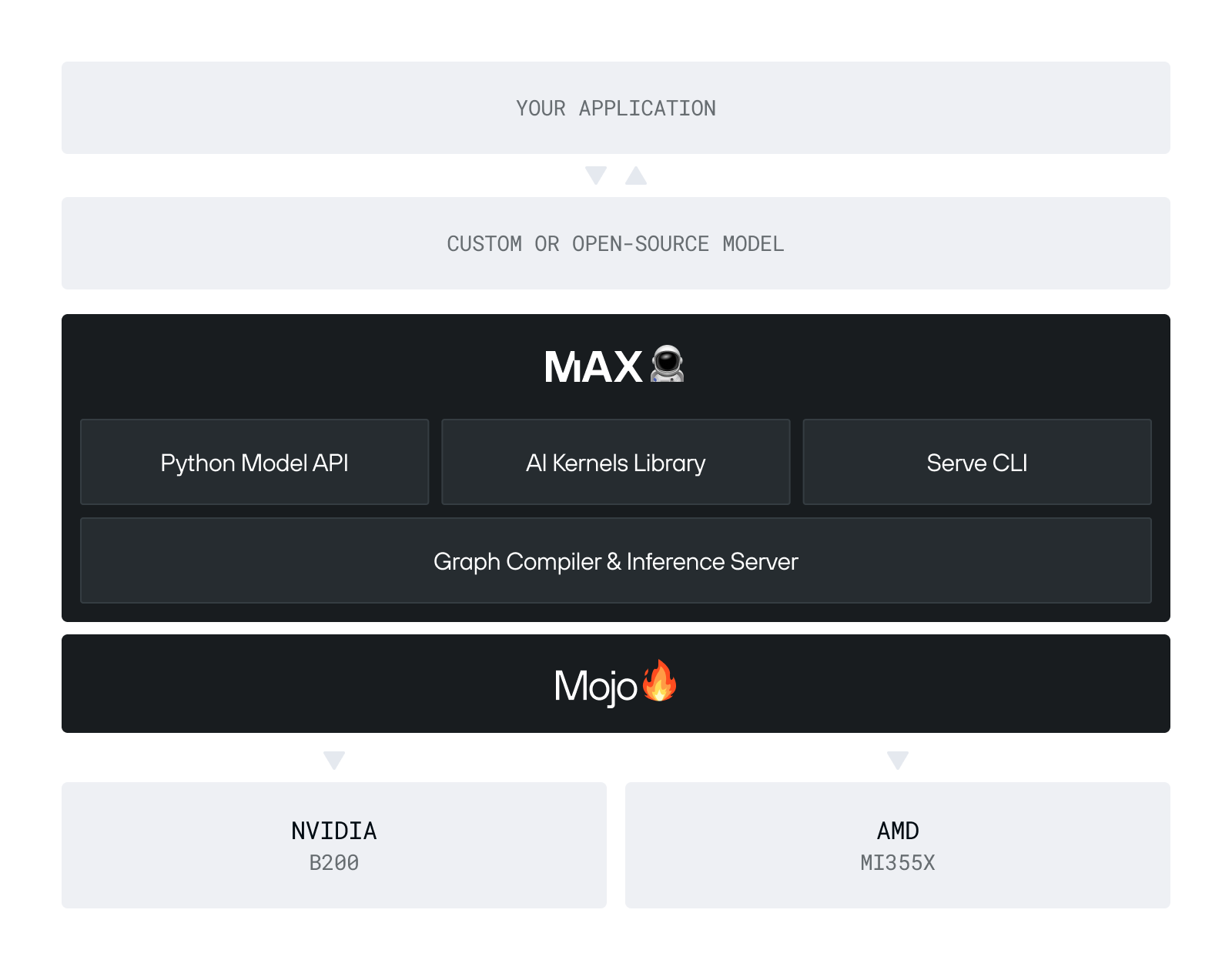
In 26.1, MAX takes a major step toward feeling intuitive to users coming from PyTorch:
model.compile(). You’ll get all the benefits of ahead-of-time graph compilation with the full speed and memory efficiency benefits you can expect from the MAX graph compiler and its high-performance GPU kernels. Together, these improvements bring MAX much closer to the “just works” experience users expect, while preserving the ability to scale seamlessly into fully compiled, production-grade execution when performance and efficiency matter most.

Our comprehensive guide to building an LLM from scratch (the MAX LLM book) is now stable and maintained alongside API changes in the nightly builds. If you saw the experimental version, take another look—we completely updated the sequence so the code you write in each step builds upon the last one, until you've built a fully executable OpenAI LLM in MAX.
The MAX LLM Book walks through every component of a transformer—from tokenization and embeddings to attention and decoding—while teaching you how to express these ideas using the MAX Python APIs. It’s designed for two audiences:
Each chapter includes executable code and detailed explanations, making it both a learning resource and a practical reference. Start building now.
Building on our initial Apple silicon GPU support in 25.7, we've significantly expanded coverage in 26.1. Simple MAX graphs can compile and run on Apple silicon GPUs, and all the Mojo GPU puzzles now run on Apple GPUs (excluding NVIDIA-specific puzzles). Future updates will expand our support all the way to LLM inference on Apple Silicon GPUs. Please join our community if you'd like to help build into this support.
The latest features are landing regularly in our nightly releases, so keep up with those to get the best support. You can also help by contributing new Apple silicon GPU support to many of our existing open source Mojo kernels.
The past few months have marked a turning point in MAX’s evolution — from an internal framework to a community-grown modeling platform. Contributors from across the ecosystem are extending MAX with new model architectures, performance improvements, and infrastructure enhancements that benefit everyone. Here are a few highlights:
We’ve already open-sourced the MAX Python API, our entire GPU kernel library (for NVIDIA, AMD, and Apple silicon), all our model architectures, serving pipelines, and more. If you're interested in contributing model architectures, performance optimizations, or expanding MAX's capabilities, check out our contribution guidelines and join the conversation in our MAX forum.
Mojo 26.1 delivers a set of foundational language features that move the language meaningfully closer to Mojo 1.0. Our objective with 1.0 is to provide a language that’s capable of high-performance computing for diverse hardware but is still a joy to use.
This release drives us toward that by incorporating research directions in language design for compile-time safety, improving the experience when you encounter errors, and enhancing the overall ergonomics of Mojo code. Specifically, this release adds:
As always, there are far more interesting and useful additions to Mojo and its tooling than those listed above, so check out the full Mojo changelog.
Get everything you need to build LLMs with MAX and write high-performance GPU kernels with Mojo by installing the modular package with pip, uv, pixi, or conda. For more details, see our quickstart guide.
shell
uv pip install modularOnce you’re set up, you can explore everything in Modular Platform 26.1:
For a complete breakdown, see the MAX and Mojo 26.1 changelogs.
Modular 26.1 is another step toward making high-performance AI development accessible to everyone. Your questions, feedback, and contributions directly shape the platform — join the discussion on our forum and report any issues or feature requests.
We can’t wait to see what you build!
Discover what Modular can do for you
Request a demo

Sign up today
Signup to our Cloud Platform today to get started easily.
Sign Up

Browse open models
Browse our model catalog, or deploy your own custom model
Browse models
Get all our latest news, announcements and updates delivered directly to your inbox. Unsubscribe at anytime.
Thanks for signing up to our newsletter! 🚀
Thank you,
Modular Sales Team
Oops! Something went wrong while submitting the form.
此内容由惯性聚合(RSS阅读器)自动聚合整理,仅供阅读参考。 原文来自 — 版权归原作者所有。