
惯性聚合 高效追踪和阅读你感兴趣的博客、新闻、科技资讯
阅读原文 在惯性聚合中打开

推荐订阅源

Project Zero
Project Zero
B
Blog RSS Feed
爱范儿
爱范儿
freeCodeCamp Programming Tutorials: Python, JavaScript, Git & More
阮一峰的网络日志
阮一峰的网络日志
美团技术团队
Cyber Security Advisories - MS-ISAC
K
KPMG report finds enterprise disconnect between AI and its ROI | CIO
D
Docker
B
Blog
大猫的无限游戏
大猫的无限游戏
V
Vulnerabilities – Threatpost
OSCHINA 社区最新新闻
OSCHINA 社区最新新闻
S
Schneier on Security
Spread Privacy
Spread Privacy
NISL@THU
NISL@THU
博客园 - 【当耐特】
IT之家
IT之家
云风的 BLOG
云风的 BLOG
L
Lohrmann on Cybersecurity
V
V2EX
Latest news
Latest news
S
Secure Thoughts
C
Check Point Blog
N
Netflix TechBlog - Medium
N
News | PayPal Newsroom
C
Cybersecurity and Infrastructure Security Agency CISA
The Register - Security
The Cloudflare Blog
博客园_首页
博客园 - 三生石上(FineUI控件)
L
LINUX DO - 最新话题
W
WeLiveSecurity
G
GRAHAM CLULEY
量子位
T
The Exploit Database - CXSecurity.com
Security Latest
Security Latest
C
Cisco Blogs
Security Archives - TechRepublic
GbyAI
GbyAI
A
Arctic Wolf
Attack and Defense Labs
博客园 - 叶小钗
SecWiki News
SecWiki News
Vercel News
Vercel News
Engineering at Meta
Engineering at Meta
S
Security @ Cisco Blogs
小众软件
小众软件
N
News and Events Feed by Topic
WordPress大学
WordPress大学

Modular Blog

Qualcomm to Acquire Modular Modular 26.4: SOTA MoE Serving, Model Bringup via Agent Skills, Mojo 1.0 Beta 2 and More ModCon 2026: Modular’s Developer Conference Day Zero: MiniMax M3 Open Weights on Modular Cloud Modverse #55: Mojo 1.0 Beta, Community Mojo Libraries, and Real-Time Patient Conversations Powered by MAX What about OpenCL and CUDA C++ alternatives? (Democratizing AI Compute, Part 5) Why LLM Inference Needs a New Kind of Router - Part 3 Three trends from MLSys 2026 Why LLM Inference Needs a New Kind of Router - Part 2 How I built a pure Mojo app (and 10 libraries) with AI agents Hippocratic AI partners with Modular to power flexible, high-quality inference for real-time patient conversations Translating to Mojo via AI Agents Inkwell: Why Your Inference Platform Matters As Much As Your Model Why LLM Inference Needs a New Kind of Router - Part 1 Modular 26.3: Mojo 1.0 Beta, MAX Video Gen, and more Modverse #54: AMD AI DevDay, New Modular Offices, and a Community That Keeps Shipping How Frontier Coding Agents Built a Video Diffusion Pipeline on MAX TileTensor Part 1 - Safer, More Efficient GPU Kernels Modular Opens Edinburgh & San Francisco Offices Structured Mojo Kernels Part 4 - Portability and the Road Ahead Day Zero Launch: Fastest Performance for Gemma 4 on NVIDIA and AMD Modverse #54: From GTC to Edinburgh, a Community Building Momentum Software Pipelining for GPU Kernels: Part 1 - The Pipeline Problem Structured Mojo Kernels Part 3 - Composition in Practice Modular 26.2: State-of-the-Art Image Generation and Upgraded AI Coding with Mojo Modular at NVIDIA GTC 2026: MAX on Blackwell, Mojo Kernel Porting, and DeepSeek V3 on B200 Structured Mojo Kernels Part 2 - The Three Pillars Modverse #53: Community Builds, Research Milestones, and a Growing Ecosystem Structured Mojo Kernels Part 1 - Peak Performance, Half the Code The Claude C Compiler: What It Reveals About the Future of Software BentoML Joins Modular The Five Eras of KVCache Modular 26.1: A Big Step Towards More Programmable and Portable AI Infrastructure How to Beat Unsloth's CUDA Kernel Using Mojo—With Zero GPU Experience 🔥 Modular 2025 Year in Review The path to Mojo 1.0 Modverse #52: Advancing AI Together — Community Projects & Platform Milestones Modular 25.7: Faster Inference, Safer GPU Programming, and a More Unified Developer Experience "TTS 1 Max" (powered by Modular Platform) Ranked #1 Speech Model on Artificial Analysis PyTorch and LLVM in 2025 — Keeping up With AI Innovation Achieving State-of-the-Art Performance on AMD MI355 — in Just 14 Days Modular Raises $250M to scale AI's Unified Compute Layer Modular 25.6: Unifying the latest GPUs from NVIDIA, AMD, and Apple Matrix Multiplication on Blackwell: Part 4 - Breaking SOTA Modverse #51: Modular x Inworld x Oracle, Modular Meetup Recap and Community Projects Matrix Multiplication on Blackwell: Part 3 - The Optimizations Behind 85% of SOTA Performance Matrix Multiplication on Blackwell: Part 2 - Using Hardware Features to Optimize Matmul Matrix Multiplication on Blackwell: Part 1 - Introduction Modverse #50: Modular Platform 25.5, Community Meetups, and Mojo's Debut in the Stack Overflow Developer Survey Modular Platform 25.5: Introducing Large Scale Batch Inference SF Compute and Modular Partner to Revolutionize AI Inference Economics AI Agents for AWS Marketplace Modverse #49: Modular Platform 25.4, Modular 🤝 AMD, and Modular Hack Weekend Inside Modular Hack Weekend: Top Projects and Community Highlights How is Modular Democratizing AI Compute? (Democratizing AI Compute, Part 11) Modular 25.4: One Container, AMD and NVIDIA GPUs, No Lock-In Introducing Mammoth: Enterprise-Scale GenAI Deployments Made Simple Modular + AMD: Unleashing AI performance on AMD GPUs Modverse #48: Modular Platform 25.3, MAX AI Kernels, and the Modular GPU Kernel Hackathon Exploring Metaprogramming in Mojo Modular GPU Kernel Hackathon Highlights: Innovation, Community, & Mojo🔥 Modular’s bet to break out of the Matrix (Democratizing AI Compute, Part 10) Modular Platform 25.3: 450K+ Lines of Open Source Code and pip Packaging A New, Simpler License for MAX and Mojo Why do HW companies struggle to build AI software? (Democratizing AI Compute, Part 9) Modverse #47: MAX 25.2 and an evening of GPU programming at Modular HQ What about the MLIR compiler infrastructure? (Democratizing AI Compute, Part 8) What about Triton and Python eDSLs? (Democratizing AI Compute, Part 7) MAX 25.2: Unleash the power of your H200's–without CUDA! What about TVM, XLA, and AI compilers? (Democratizing AI Compute, Part 6) Modverse #46: MAX 25.1, MAX Builds, and Democratizing AI Compute CUDA is the incumbent, but is it any good? (Democratizing AI Compute, Part 4) MAX 25.1 - Introducing MAX Builds How did CUDA succeed? (Democratizing AI Compute, Part 3) Paged Attention & Prefix Caching Now Available in MAX Serve What exactly is “CUDA”? (Democratizing AI Compute, Part 2) Modular DeepSeek's Impact on AI (Democratizing AI Compute, Part 1) Modular Hands-on with Mojo 24.6 Evaluating Llama Guard with MAX 24.6 and Hugging Face Modular Introducing MAX 24.6: A GPU Native Generative AI Platform MAX GPU: State of the Art Throughput on a New GenAI platform Understanding SIMD: Infinite Complexity of Trivial Problems Community Spotlight: Writing Mojo with Cursor Hands-on with Mojo 24.5 MAX 24.5 - With SOTA CPU Performance for Llama 3.1 Debugging in Mojo🔥 Write hardware-agnostic custom ops for PyTorch | Modular Take control of your AI Develop locally, deploy globally A brief guide to the Mojo n-body example What's new in MAX 24.4? MAX on macOS, fast local Llama3, native quantization and GGUF support What’s new in Mojo 24.4? Improved collections, new traits, os module features and core language enhancements MAX 24.4 - Introducing quantization APIs and MAX on macOS Deep dive into ownership in Mojo What ownership is really about: a mental model approach Fast⚡k-means clustering in Mojo🔥: a guide to porting Python to Mojo🔥 for accelerated k-means clustering
Announcing stack-pr: an open source tool for managing stacked PRs on GitHub
No items found. · 2024-07-23 · via Modular Blog

We are pleased to announce the release of a new tool aimed at simplifying the management of stacked pull requests (PRs) on GitHub - stack-pr. This tool is still in its early development days, but we are excited to share it with the community and welcome your contributions.

What are stacked PRs?

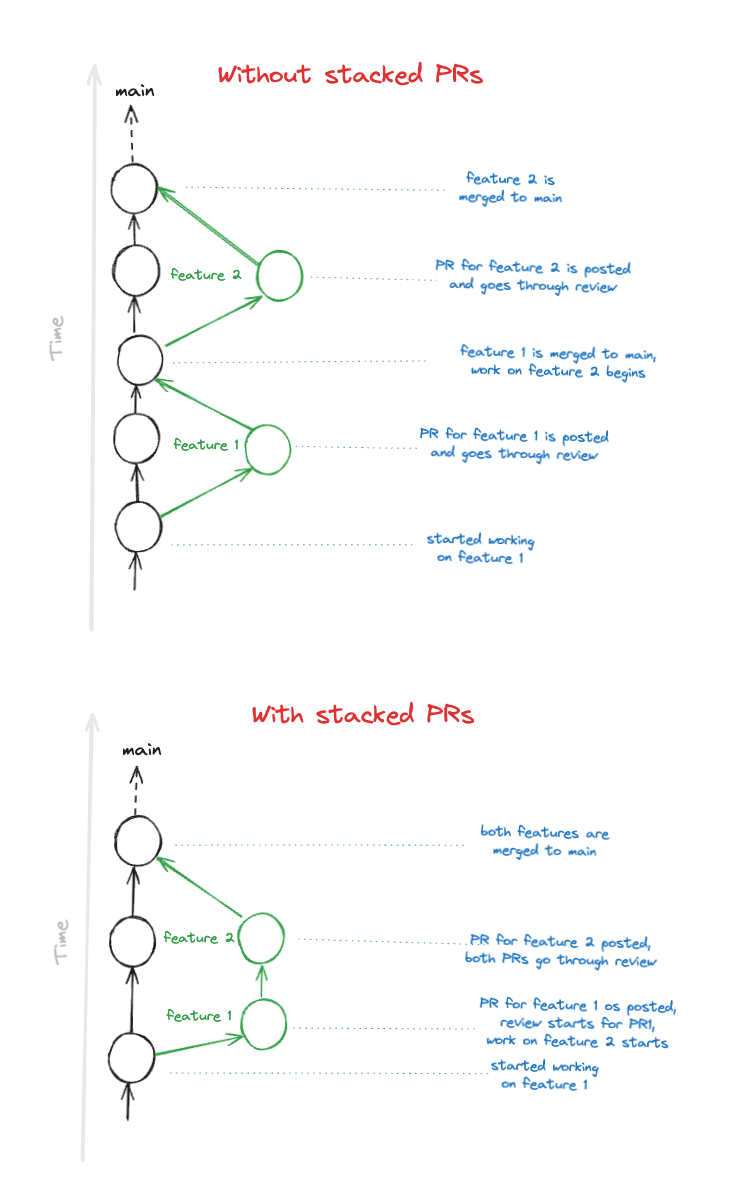
Stacked PRs are a way to structure pull requests in a way when one PR depends on another in a sequence. Instead of submitting one large PR, you can break your changes into smaller, more manageable PRs that build on each other. As each PR in the stack is reviewed and merged, the remaining PRs are automatically updated, ensuring a smooth integration process.

What are the benefits of using stacked PRs?

Stacked PRs offer a structured way to manage multiple interdependent changes in a codebase. By breaking down large changes into smaller, more focused PRs, developers can benefit from:

  • Better code reviews: Each PR can be reviewed independently, making it easier to identify issues and understand changes.
  • Parallel work: You can proceed with work on a next change before another required change is fully reviewed and merged.
  • Cleaner history: The commit history remains more organized, reflecting the logical progression of changes.

In the diagram below, the first graph demonstrates a typical workflows without stacked PRs. In the second graph, you can see the updated and simplified workflow with stacked PRs:
__wf_reserved_inherit

What is stack-pr and how to use it?

stack-pr is a CLI tool for managing stacked PRs from the comfort of your terminal. With a simple interface it allows you to create, update and merge stacked PRs.

stack-pr offers a simple mental model for managing stacks of PR - each commit in your local git branch becomes a separate PR dependent on the PR from the previous commit. When you want to update the stack - e.g. either include some changes to existing PRs, reorder them, drop some of them, or add new PRs - you simply make the corresponding changes in your local git branch (usually you’ll be using git rebase -i for this) and then run a single command stack-pr export to update the PRs on GitHub correspondingly. When you are ready to merge your PRs, you can use the stack-pr land command, which would land the bottommost PR and rebase the rest of the stack.

You can find a more detailed manual on how to use the tool in README.md.

Acknowledging similar tools

stack-pr is not the first tool in the space, and we’d like to acknowledge other existing tools - specifically ghstack which heavily inspired stack-pr. ghstack is also a great tool for working with PR stacks, however it has some limitations which we worked around in stack-pr. For example, ghstack requires you to allow force pushes to your repo, and also it generates 3x more branches when constructing a stack compared to our tool. Nevertheless, we highly recommend giving it a shot too!

Why are we open-sourcing stack-pr?

Our company believes in giving back to the community. By open-sourcing this tool, we hope to contribute to the ecosystem and encourage collaboration and improvement. We invite developers, teams, and open-source enthusiasts to try out our tool, provide feedback, and contribute to its development. stack-pr is in its early days and there are many things that can be improved, and while you can use it as-is right now, we also welcome contributions to the tool to make it better for everyone!

Thank you for your support, and we look forward to seeing how this tool evolves with your contributions! You can get stack-pr on GitHub, and be sure to check out the rest of the Modular community, which includes an active Discord where you can share feedback and connect with other devs.