


惯性聚合 高效追踪和阅读你感兴趣的博客、新闻、科技资讯
阅读原文 在惯性聚合中打开

推荐订阅源

H
Help Net Security
The GitHub Blog
The GitHub Blog
F
Fortinet All Blogs
cs.CV updates on arXiv.org
Simon Willison's Weblog
D
Darknet – Hacking Tools, Hacker News & Cyber Security
Cisco Talos Blog
Cisco Talos Blog
P
Privacy & Cybersecurity Law Blog
I
Intezer
Y
Y Combinator Blog
Threat Intelligence Blog | Flashpoint
CTFtime.org: upcoming CTF events
N
Netflix TechBlog - Medium
The Hacker News
The Hacker News
AWS News Blog
AWS News Blog
aimingoo的专栏
aimingoo的专栏
A
About on SuperTechFans
Exploit-DB.com RSS Feed
Stack Overflow Blog
Stack Overflow Blog
Hacker News: Ask HN
Hacker News: Ask HN
酷 壳 – CoolShell
酷 壳 – CoolShell
量子位
K
KPMG report finds enterprise disconnect between AI and its ROI | CIO
B
Blog
T
Tor Project blog
C
Cybersecurity and Infrastructure Security Agency CISA
云风的 BLOG
云风的 BLOG
博客园_首页
V2EX - 技术
V2EX - 技术
T
Threat Research - Cisco Blogs
腾讯CDC
宝玉的分享
宝玉的分享
博客园 - 叶小钗
罗磊的独立博客
S
Securelist
The Last Watchdog
The Last Watchdog
Google Online Security Blog
Scott Helme
Scott Helme
博客园 - 司徒正美
W
WeLiveSecurity
有赞技术团队
有赞技术团队
OSCHINA 社区最新新闻
OSCHINA 社区最新新闻
S
Secure Thoughts
NISL@THU
NISL@THU
N
News and Events Feed by Topic
Cyber Security Advisories - MS-ISAC
雷峰网
雷峰网
大猫的无限游戏
大猫的无限游戏
K
Kaspersky official blog
IT之家
IT之家

Blog of Simple Analytics

The EU wants to kill cookie banners Google is tracking you (even when you use DuckDuckGo) German court rules Meta’s tracking tech violates GDPR Closing the data gap - Simple Analytics x Usercentrics The EU-US data deal may be dead in the water You are missing 20% of your website data with GA4 How a reverse trial will push Simple Analytics to the next level Google will start tracking all your devices (WTF?) Big Tech Fails EU’s Digital Services Act: Only Wikipedia Passes the Test Meta fined $102 million by the Irish Data Protection Commission Europeans spend 575 Million hours per year clicking cookie banners The most interesting GDPR fines GDPR and fines: all there is to know Google loses key antitrust case Web Analytics for Crypto Companies Web analytics for publishers Google pulls Uno Reverse card: Rolls back decision to kill third-party cookies Privacy Monthly July 2024 Privacy Perspectives June 2024 Privacy Monthly June APRA fumbles targeted advertising Privacy Monthly May Meta loses key privacy battle Google delays cookie phase-out once again Privacy Monthly April 2024 Web Analytics and Consent Cookies 101 Privacy Monthly March 2024 German authority cracks down on cookie banners Google Tag Manager vs Google Analytics Google search alternative Data retention in Google Analytics Guide to Google Analytics and Cookie consent What are Google Analytics' identifiers? How to export data from Google Analytics Privacy Monthly February 2024 The Criteo case: a big deal for Big Tech Privacy Monthy January 2024 What the Digital Markets Act means for privacy Legal troubles for Adobe Analytics Web analytics for nonprofits HIPAA and mental health Why Meta subscriptions are under attack, and why it matters for privacy Privacy Monthly: December Simple Analytics AI Host analytics on Cloudflare Zaraz Add Google Analytics to Convertkit Google Analytics Pricing - Paid vs Free Road to 1 Million ARR - October update CCPA and Data Protection: all there is to know Analytics without a cookie banner Enterprise Analytics Privacy Monthly: November 2023 Delete Act: all you need to know Mobile App Tracking Under Fire The road to 1 Million ARR - September Update Privacy Monthly: October 2023 HIPAA violations First challenge to the EU-US data transfer framework Direct Marketing under GDPR Road to 1 million ARR - August Update CCPA vs CPRA: what is new? Privacy Monthly: September 2023 A/B Testing with Simple Analytics Dobbs v. Jackson ruling is a privacy mess Privacy Monthly: August 2023 What are your rights under the CCPA? When does the CCPA apply? How does the HIPAA compare to the CCPA and GDPR? Why Meta is in a world of trouble CJEU: cookie-based analytics collects sensitive data Road to 1 million ARR - July update All about the new Data Transfer Framework Road to 1 Million ARR - June update What is PHI under HIPAA? Sweden declares Google Analytics illegal Searching for GA4 Alternatives? Top 10 Reliable Options for Google Analyticss Ultimate HIPAA Compliance Checklist: Essential Steps for Healthcare Providers Privacy Monthly: June 2023 More troubles for Google Analytics The path to 1M ARR - May Update Data Processing Agreements Minimal Product Analytics Facebook data transfers declared illegal Is Google Analytics CCPA-compliant? Help us with your input Cookie banners: How to stay GDPR compliant? GDPR Compliance Checklist Privacy Monthly: May 2023 Simple Analytics: Privacy-first website analytics Improve your e-commerce performance with analytics European Facebook blackout is closer than we think Know your website’s Carbon Emissions - and how to reduce it The path to 1M ARR - April 2023 How to add video tracking using Google Tag Manager? How to track form submissions using Google Tag Manager? Why is my Simple Analytics data different from Google Analytics? Debug Simple Analytics script How to Import Google Analytics Data to Simple Analytics
Google Settles in $5B Incognito Mode Lawsuit
Iron Brands · 2024-01-07 · via Blog of Simple Analytics

In 2020, a class action was filed against Google for $5 billion, claiming that Google Chrome was collecting data from its users without consent during incognito browsing. On December 28, Google settled the lawsuit for an undisclosed amount.

While not much is known about the proceedings, available documents suggest that the California court found that Google presented Chrome’s incognito mode in a confusing and potentially deceptive way. These documents are interesting and worth glancing through!

  1. Exploiting ambiguity
  2. Placebo buttons
  3. Update
  4. Final Thoughts

Exploiting ambiguity

The most comprehensive source of information on the case is the District Court of Northern California’s decision to deny Google’s motion for a summary judgment. There’s a lot of legalese about harm and breach of contract, but the really interesting part is the Court’s assessment of the claim that Google did not supply clear enough information on how Incognito Mode works.

It is worth highlighting that the Court did not ultimately adjudicate the claims; it only ruled that they did not appear without merit. Still, the reasoning is worth analyzing.

Google claimed that the disclosures of personal data were clear from the Incognito mode splash screen:
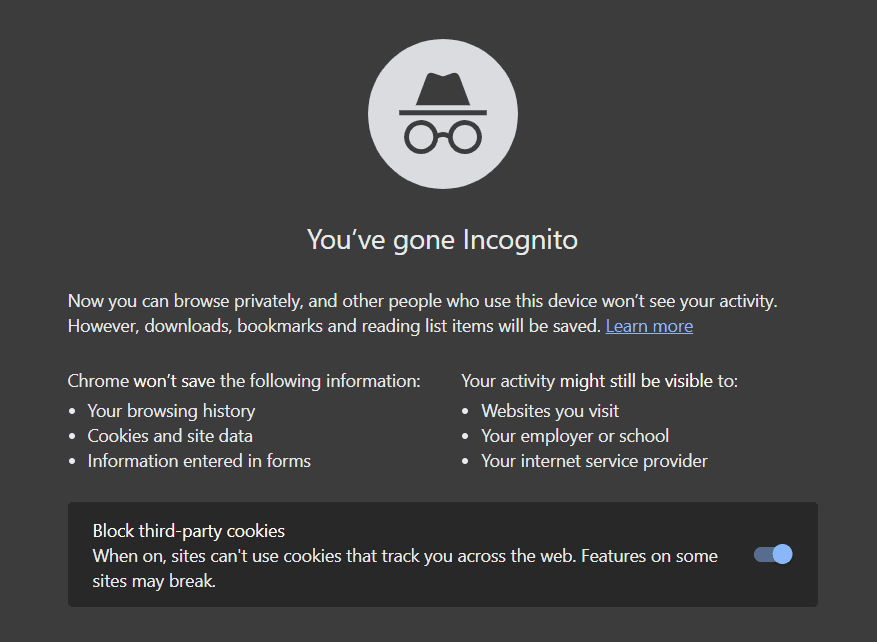
image1.png

While the information provided by Google is accurate, the presentation of Incognito mode- along with a “spy guy” icon- can deceive the end user as to what Incognito mode actually does, as noted by the Court.

Google’s privacy policy also mentions Incognito browsing as a way to “manage your privacy” in Incognito mode, further adding to the confusion. Last but not least, the splash screen conveniently omits that online activity is visible to Google itself and only mentions websites, ISPs, and network owners.

According to the Court, Google knew that consumers misunderstood what Incognito mode does. In other words, the company was aware of the ambiguity and took advantage of it.

Google’s strategy of ambiguous communication is evident from the splash screen itself. While not incorrect, the information is unnecessarily dubitative and impersonal in tone. “Your activity might be visible to websites” is a correct but heavily sugar-coated statement. “Google tracks you while you browse in Incognito mode” would get the point across much better.

This strategy of ambiguous communication fits a general trend of taking “technically true” statements and sugar-coating them to the point where they become misleading.

Google’s mantra that it does not sell personal information is another of Google’s sugar-coated half truths.

This is technically correct: you cannot pay Google to disclose personal information. But the company discloses plenty of personal information to third parties and plays a crucial role in the RTB system, a.k.a. history’s largest and still ongoing data breach. It also profits from this disclosure system.

From a practical viewpoint, it is entirely irrelevant that these disclosures are not a sale in a strict legal sense. Privacy-wise, we would all be better off if Google sold personal information rather than disclosing it to hundreds of unaccountable third parties with every single ad exchange.

Placebo buttons

Most of the close door buttons in elevators do nothing. They are a placebo that gives you a reassuring sense of control over the door.

Chrome’s Incognito mode is one of the many placebo buttons of digital privacy, and there are many more. Some of them outright lie to users while others- like Incognito mode- take advantage of ambiguous communication. Either way, these placebo buttons trick users into a false sense of security.

Google’s location settings are another placebo button. The company has a history of deceiving users on how location data are processed, leading to countless lawsuits. Hardly a day goes by without Google reaching an eight or nine figures settlement over location tracking in some US Court. This deception is based on complicated, confusingly worded privacy controls that give the user a sense of security but change little or nothing in the way Google processes location data.

Meta’s ad-free subscriptions are a placebo button as well- and one you pay for!

Regardless of its claims, Meta still profiles paid users to better target them with content- and gets paid for it by content creators who are trying to build or expand their audience. This is not technically targeted advertising because Meta serves content, not ads. But it is similar enough and equally invasive.

Update

We have some good news: according to the CNN, Google also agreed to delete billions of data records as part of the settlement. As of April 2024, the amount of the settlement is still unkown,

Final Thoughts

It is not just Big Tech, either. Many websites worldwide write cookies regardless of user choice but still display a cookie banner to give an illusion of choice.

It is about time we wise up to the trick and demand privacy buttons that actually work.

Stuff like this is the reason we started building real privacy-friendly products such as Simple Analtyics. We believe in an independent internet where visitors are treated fairly. If this resonates with you, then feel free to check out what we are building here.