









TL;DR
- A new study by SafetyDetectives reveals Google's widespread tracking across the web.
- Especially through Google Analytics, AdSense, and YouTube embeds.
- Even using DuckDuckGo doesn't fully protect users (up to 40% of sites still sent data to Google in the US!).
- Geography matters: Sweden and Switzerland showed lower tracking, thanks to stricter privacy laws.
- Content type also plays a role (YouTube and shopping pages trigger more tracking than platforms like Wikipedia).
Think DuckDuckGo keeps you safe from Google? Well think again. A new study shows that even with a privacy-focused search engine, Google's trackers follow you around the web (mostly through analytics, ads, and video embeds). The research by SafetyDetectives compares four countries and reveals just how hard it is to avoid Google online.
- Explanation
- Impact and implications
- Final thoughts
Explanation
The study analyzed browsing patterns in the US, UK, Switzerland, and Sweden. They used a virtual machine and VPN to simulate users in these countries. By comparing searches on Google and DuckDuckGo, researchers found Google still managed to collect data (often without the user knowing).
 Source: SafetyDetectives
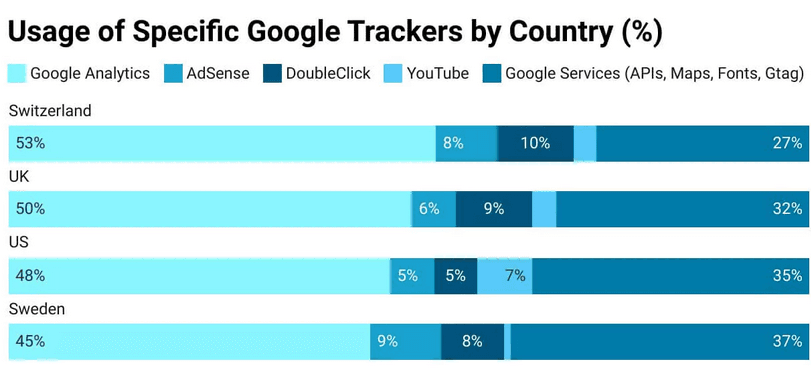
Here's how: Google doesn’t just track people through Search or Gmail. Its invisible code runs on millions of sites through Google Analytics, AdSense ads, YouTube embeds, and other background services like Fonts or Maps. That means even if you’re using DuckDuckGo, you’re not totally out of Google’s reach.
In Switzerland and Sweden, using DuckDuckGo cut Google tracking by half. But in the US, more than 40% of visited pages still sent data back to Google, despite using a privacy search engine. That’s largely because many US websites rely on Google’s tools for ads and traffic analysis.
 Source: SafetyDetectives
Impact and implications
This isn’t just about search engines. It’s about how deeply Google is embedded into the internet’s infrastructure. Privacy-conscious users often assume that switching to DuckDuckGo or Brave is enough. This research says otherwise.
For users: You need more than just a private browser or search engine to reduce tracking. Google’s reach comes from third-party scripts that websites willingly add.
For site owners: If your website uses Google Analytics or YouTube embeds, you’re contributing to this tracking, often without realizing the full scope of data being collected. Even in countries with strict laws like the GDPR, Google's trackers are still everywhere. That raises questions about how effective these regulations really are in practice.
For the privacy ecosystem: This highlights the importance of choosing independent, privacy-first tools at every layer, not just for browsing, but also for web hosting, analytics, and advertising. And it shows how regulation alone isn’t enough without strong enforcement and real alternatives.
Final thoughts
This study makes one thing clear: escaping Google's tracking online is harder than we think. Even privacy-friendly tools like DuckDuckGo can only go so far when Google’s infrastructure is baked into the websites we visit every day. The best way forward? Reduce reliance on Google services (both as users and as website owners).
At Simple Analytics, we built a privacy-first, cookie-free analytics platform that respects your visitors. It’s a straightforward alternative to Google Analytics without the tracking. Feel free to give it a spin!