









Job Thomas is Automattic’s interim Chief Customer Experience Officer.
At the Customer Experience Management Africa Summit in Cape Town, I encountered the same point in several different conversations: AI in support is amplifying a bad pattern, not creating a new one.
Most companies run tiered support. When a customer has a problem, they enter at Tier 1; when it becomes clear their problem is too complex for Tier 1, you’ll move to Tier 2. When all but the final tier is exhausted, the customer finally ends up with the most technical support team.
As a result, the people with the most complex, difficult problems are asked to make the most effort to get help. They have to prove they’ve exhausted all previous options before they are allowed to access our top tier of skilled people.
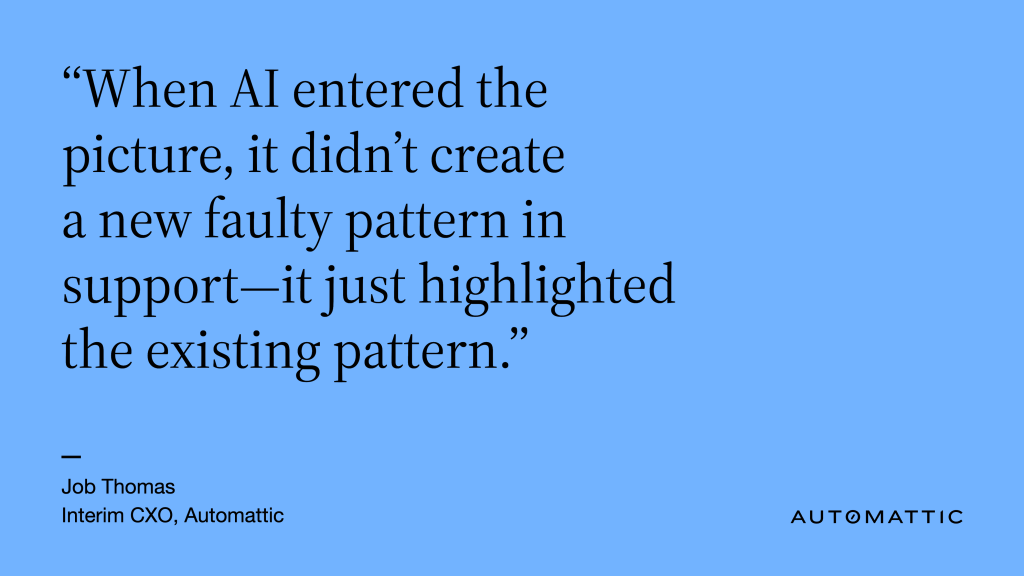
When AI entered the picture, it didn’t create a new faulty pattern in support—it just highlighted the existing pattern. Many people I’ve encountered are frustrated about getting the right help. Those people often chalk their problems up to a need to “speak to a human,” but that’s not quite it. At heart, they are frustrated that getting the right help is so difficult.
This isn’t an AI problem; it’s a philosophy problem. AI is making the bad philosophy more obvious. As long as a company’s AI deflection rate remains a primary metric for success, that company will end up with frustrated customers. After all, an AI deflection rate isn’t a measurement of customer success—it’s a measure of how good we are at not talking to customers.
We’re not perfect at Automattic. We make mistakes. But our intent is different. We do not approach support by wondering how we might reduce contacts. Instead, we want to know how we might provide a customer with the right help as soon as possible, or maybe even make it unnecessary to ask for help in the first place.
We have a few practices that already reflect these efforts:
Improving support starts with a shift in philosophy. If what you want is fewer interactions with customers, AI will deliver that, with fewer negative customer experiences. But if your top concern is providing the right help fast, then you build for the customer.
此内容由惯性聚合(RSS阅读器)自动聚合整理,仅供阅读参考。 原文来自 — 版权归原作者所有。