



惯性聚合 高效追踪和阅读你感兴趣的博客、新闻、科技资讯
阅读原文 在惯性聚合中打开

推荐订阅源

C
Cisco Blogs
爱范儿
爱范儿
有赞技术团队
有赞技术团队
博客园 - 【当耐特】
Jina AI
Jina AI
Project Zero
Project Zero
宝玉的分享
宝玉的分享
Martin Fowler
Martin Fowler
WordPress大学
WordPress大学
Simon Willison's Weblog
钛媒体:引领未来商业与生活新知
钛媒体:引领未来商业与生活新知
T
Tenable Blog
F
Fortinet All Blogs
大猫的无限游戏
大猫的无限游戏
Last Week in AI
Last Week in AI
月光博客
月光博客
雷峰网
雷峰网
G
Google Developers Blog
V
V2EX
T
Tor Project blog
罗磊的独立博客
Schneier on Security
Know Your Adversary
Know Your Adversary
W
WeLiveSecurity
freeCodeCamp Programming Tutorials: Python, JavaScript, Git & More
P
Privacy International News Feed
S
Securelist
奇客Solidot–传递最新科技情报
奇客Solidot–传递最新科技情报
P
Proofpoint News Feed
Blog — PlanetScale
Blog — PlanetScale
Threat Intelligence Blog | Flashpoint
小众软件
小众软件
Scott Helme
Scott Helme
I
Intezer
T
Threat Research - Cisco Blogs
The GitHub Blog
The GitHub Blog
N
Netflix TechBlog - Medium
C
CERT Recently Published Vulnerability Notes
Security Archives - TechRepublic
酷 壳 – CoolShell
酷 壳 – CoolShell
L
LINUX DO - 最新话题
N
News | PayPal Newsroom
L
Lohrmann on Cybersecurity
T
Troy Hunt's Blog
Google DeepMind News
P
Proofpoint News Feed
人人都是产品经理
人人都是产品经理
Latest news
Latest news
AWS News Blog
AWS News Blog
Apple Machine Learning Research

Blog — PlanetScale

Keeping a Postgres queue healthy — PlanetScale Patterns for Postgres Traffic Control — PlanetScale Graceful degradation in Postgres — PlanetScale High memory usage in Postgres is good, actually — PlanetScale Stripe Projects partnership: Provision PlanetScale Postgres and MySQL databases from the Stripe CLI — PlanetScale Enhanced tagging in Postgres Query Insights — PlanetScale Behind the scenes: How Database Traffic Control works — PlanetScale Introducing Database Traffic Control — PlanetScale Scaling Postgres connections with PgBouncer — PlanetScale Drizzle joins PlanetScale — PlanetScale Video Conferencing with Postgres — PlanetScale Faster PlanetScale Postgres connections with Cloudflare Hyperdrive — PlanetScale Introducing the PlanetScale MCP server — PlanetScale Database Transactions — PlanetScale Automating our changelog with Cursor commands — PlanetScale Postgres 18 is now available — PlanetScale Using MotherDuck with PlanetScale — PlanetScale $50 PlanetScale Metal is GA for Postgres — PlanetScale AI-Powered Postgres index suggestions — PlanetScale $5 PlanetScale is live — PlanetScale Announcing Vitess 23 — PlanetScale $50 PlanetScale Metal — PlanetScale Report on our investigation of the 2025-10-20 incident in AWS us-east-1 — PlanetScale $5 PlanetScale — PlanetScale Benchmarking Postgres 17 vs 18 — PlanetScale Larger than RAM Vector Indexes for Relational Databases — PlanetScale Partnering with Cloudflare to bring you the fastest globally distributed applications — PlanetScale Processes and Threads — PlanetScale PlanetScale for Postgres is now GA — PlanetScale Postgres High Availability with CDC — PlanetScale Announcing Neki — PlanetScale Caching — PlanetScale The principles of extreme fault tolerance — PlanetScale Announcing PlanetScale for Postgres — PlanetScale Benchmarking Postgres — PlanetScale Announcing Vitess 22 — PlanetScale The Real Failure Rate of EBS — PlanetScale IO devices and latency — PlanetScale Announcing PlanetScale Metal — PlanetScale PlanetScale Metal: There’s no replacement for displacement — PlanetScale Upgrading Query Insights to Metal — PlanetScale Automating cherry-picks between OSS and private forks — PlanetScale Database Sharding — PlanetScale Anatomy of a Throttler, part 3 — PlanetScale Introducing sharding on PlanetScale with workflows — PlanetScale Announcing Vitess 21 — PlanetScale Announcing the PlanetScale vectors public beta — PlanetScale Anatomy of a Throttler, part 2 — PlanetScale Instant deploy requests — PlanetScale Anatomy of a Throttler, part 1 — PlanetScale Increase IOPS and throughput with sharding — PlanetScale Tracking index usage with Insights — PlanetScale Faster backups with sharding — PlanetScale Building data pipelines with Vitess — PlanetScale The State of Online Schema Migrations in MySQL — PlanetScale Optimizing aggregation in the Vitess query planner — PlanetScale Dealing with large tables — PlanetScale Announcing Vitess 20 — PlanetScale Self-managed Vitess vs Managed Vitess with PlanetScale — PlanetScale Achieving data consistency with the consistent lookup Vindex — PlanetScale The MySQL adaptive hash index — PlanetScale Introducing global replica credentials — PlanetScale Profiling memory usage in MySQL — PlanetScale Summer 2023: Fuzzing Vitess at PlanetScale — PlanetScale How PlanetScale makes schema changes — PlanetScale Identifying and profiling problematic MySQL queries — PlanetScale The Problem with Using a UUID Primary Key in MySQL — PlanetScale Announcing Vitess 19 — PlanetScale PlanetScale forever — PlanetScale Introducing schema recommendations — PlanetScale Amazon Aurora Pricing: The many surprising costs of running an Aurora database — PlanetScale Three common MySQL database design mistakes — PlanetScale OAuth applications are now available to everyone — PlanetScale Deprecating the Scaler plan — PlanetScale PlanetScale branching vs. Amazon Aurora blue/green deployments — PlanetScale Databases at scale — PlanetScale Considerations for building a database disaster recovery plan — PlanetScale Working with Geospatial Features in MySQL — PlanetScale PlanetScale vs Amazon Aurora replication — PlanetScale Introducing the Vantage and PlanetScale integration — PlanetScale MySQL isolation levels and how they work — PlanetScale Introducing the schemadiff command line tool — PlanetScale $ pscale ping — PlanetScale Announcing foreign key constraints support — PlanetScale The challenges of supporting foreign key constraints — PlanetScale What is HTAP? — PlanetScale Introducing Insights Anomalies — PlanetScale Webhook security: a hands-on guide — PlanetScale Announcing the Fivetran integration — PlanetScale Introducing webhooks — PlanetScale What is MySQL replication and when should you use it? — PlanetScale Sync user data between Clerk and a PlanetScale MySQL database — PlanetScale Introducing database reports — PlanetScale Distributed caching systems and MySQL — PlanetScale What is MySQL partitioning? — PlanetScale MySQL High Availability: Connection handling and concurrency — PlanetScale Personalizing your onboarding with Markdoc — PlanetScale PlanetScale vs. Amazon Aurora — PlanetScale PlanetScale vs. Amazon RDS — PlanetScale PlanetScale is bringing vector search and storage to MySQL — PlanetScale
Debugging database errors with Insights — PlanetScale
Rafer Hazen · 2022-09-27 · via Blog — PlanetScale

Rafer Hazen |

As much as we want to avoid them, all applications eventually encounter errors interacting with their database. What’s important is that you have the ability to easily view and understand these errors so you can quickly solve the underlying issue.

To help with that, we’ve introduced a new error tracking feature to Insights that will help you get to the bottom of things quickly. To show this new feature off in action, let’s walk through an example of how the PlanetScale team used this internally to troubleshoot an issue.

Investigating an error

After releasing Insights error tracking for PlanetScale staff, we noticed occasional upticks in the new "Query errors" graph on our main production database.
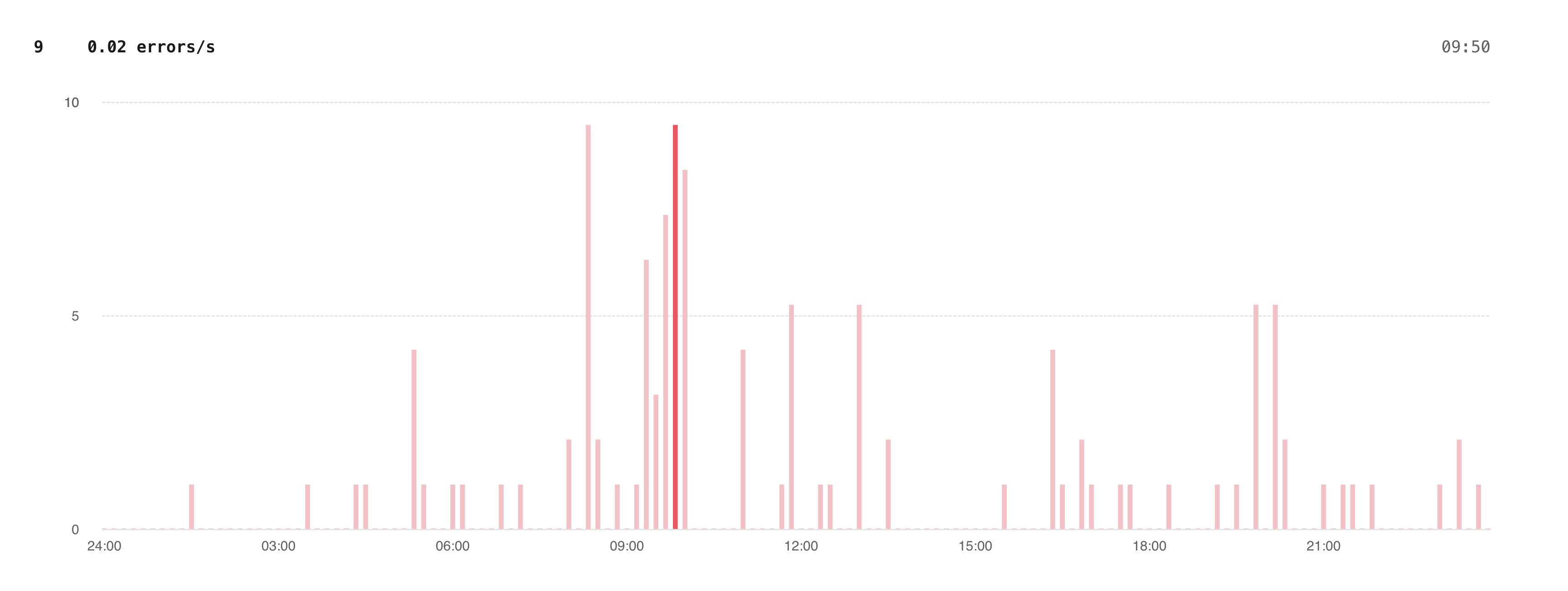
Bar graph showing high frequency of errors

In the errors tab, we saw a fair number of AlreadyExists errors on the database_branch_password table. These errors weren’t alarmingly frequent — we receive a few 10s to a few hundred per day — but we wanted to dig in to ensure that we weren’t causing our users frustration with failed requests.

List of errors

Our first step is to click on the error to see a list of recent occurrences.
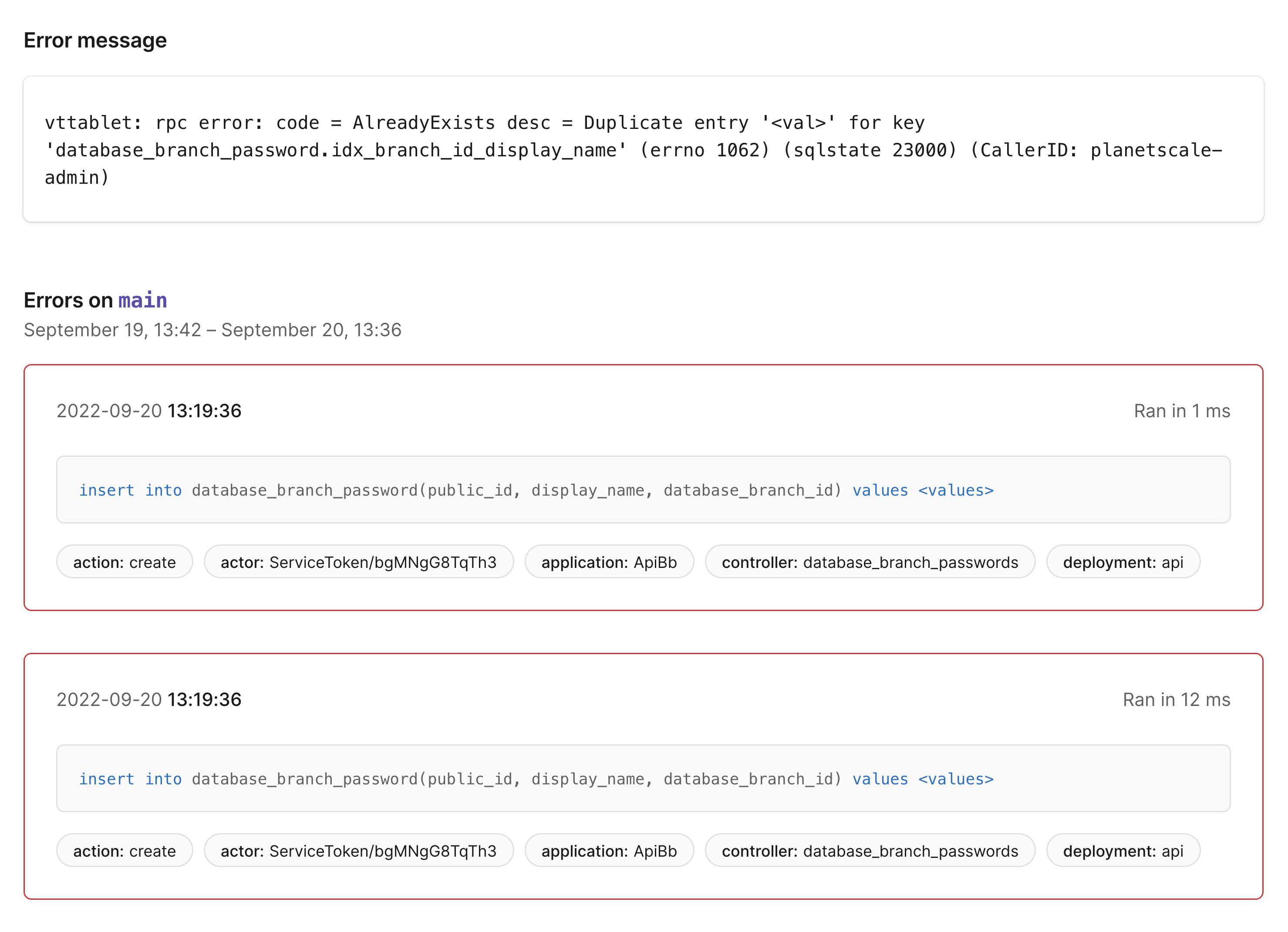
List of queries tied to error message

This page shows the full error message and lists individual occurrences of the errors with the timestamp, normalized SQL query, and any associated tags. This page has a few interesting things to tell us:

  • The error is coming from the DatabaseBranchPasswords#create action
  • Occurrences of these errors come in small batches with nearly identical timestamps
  • The actor tag for each batch of errors is always the same

The index with duplicate entries is defined as follows in our Rails schema file:

t.index ["database_branch_id", "display_name"], name: "idx_branch_id_display_name", unique: true

Given the error message and the index definition, we can infer that our application is attempting to insert multiple rows with the same values for the database_branch_id and display_name columns, and MySQL is rejecting the insert. To debug this from the application side, the tags show us that the create action of DatabaseBranchPasswordsController is the place to start. This action ultimately ends with a call to the create method of the DatabaseBranchPassword ActiveRecord model. In DatabaseBranchPassword we have the following uniqueness validation, which should return errors on the model if the uniqueness constraint in question is violated:

class DatabaseBranchPassword < ApplicationRecord
  ...
  validates :display_name, uniqueness: { scope: [:database_branch_id]
---
  ...
end

Next, we verified in a development environment that the uniqueness validation seemed to be working correctly: when we try to create two identical DatabaseBranchPassword rows, we get an ActiveRecord error showing that the name has already been taken. So, with the validation working as expected, what could be going on here?

This is where another piece of information we learned from the errors page comes into play: the queries that attempt to insert duplicate rows came in at nearly the same time, leading us to suspect that a race condition could be involved. Could it be possible that two attempts to create a row with the same values both pass the Rails uniqueness validation and get sent to the database? Turns out: yes!

The uniqueness validation queries the database to see if the display_name has been taken, and if it hasn’t, ActiveRecord attempts to persist the row. If two (or more) requests to our password create API are initiated at nearly the same time, it’s possible that two separate application threads could both query the database at the same time, before either thread had created the record, and then proceed as if there was no issue. The database, as the final arbiter of uniqueness, would then only allow one of these queries to succeed and the other would receive the error we see in Insights.

Now that we know this error occurs when multiple nearly-simultaneous API requests are issued, our next step was to determine who or what was issuing these requests. Because we tag all queries from authenticated requests with information about the actor, it was easy to look them up and determine that an internal tool was issuing multiple password create requests in parallel. Our solution was simply to modify the script to avoid that behavior. Because an interactive user is unlikely to issue password creates quickly enough to trigger this behavior, we were content to call this issue solved.

In addition to including tags in Insights errors, we’ve also improved how tags work for Insights in general. Most notably, you can now search both queries and errors based on tags. Searching queries by tag has one caveat: to associate tags, a query pattern must have had at least one query that took more than 1 second, read more than 10k rows, or resulted in an error. We find that most of the queries we want to search for have met these conditions.

Queries can be filtered by tag with the following syntax: tag:tag_name:tag_value.
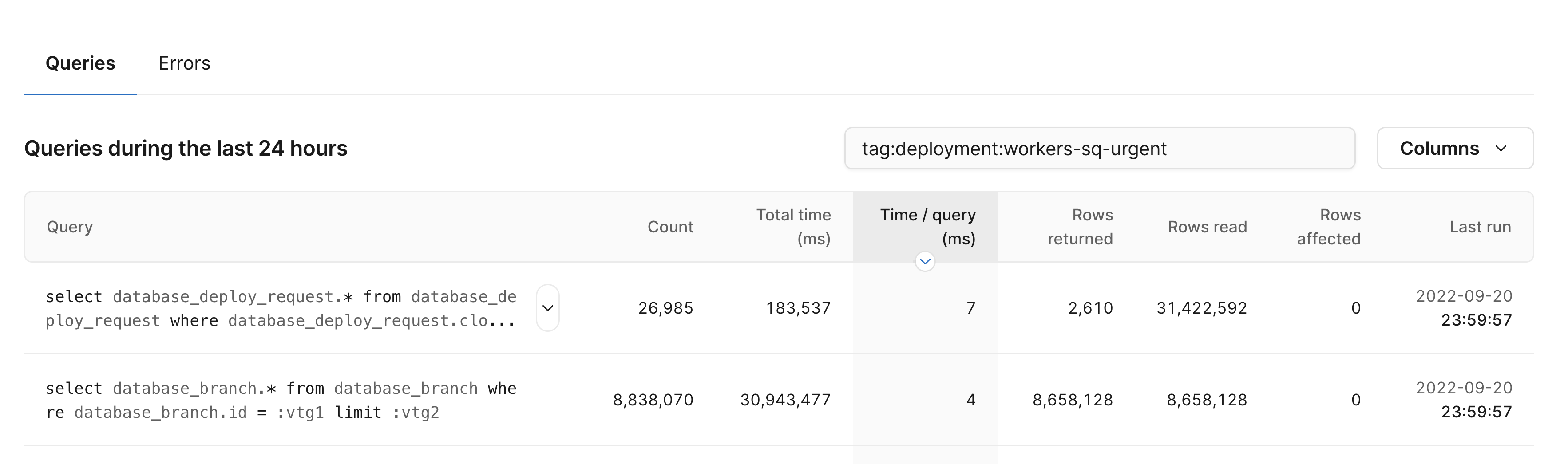
List of queries filtered by tag

To show all queries that have a particular tag key present, regardless of the value, use tag:tag_name.
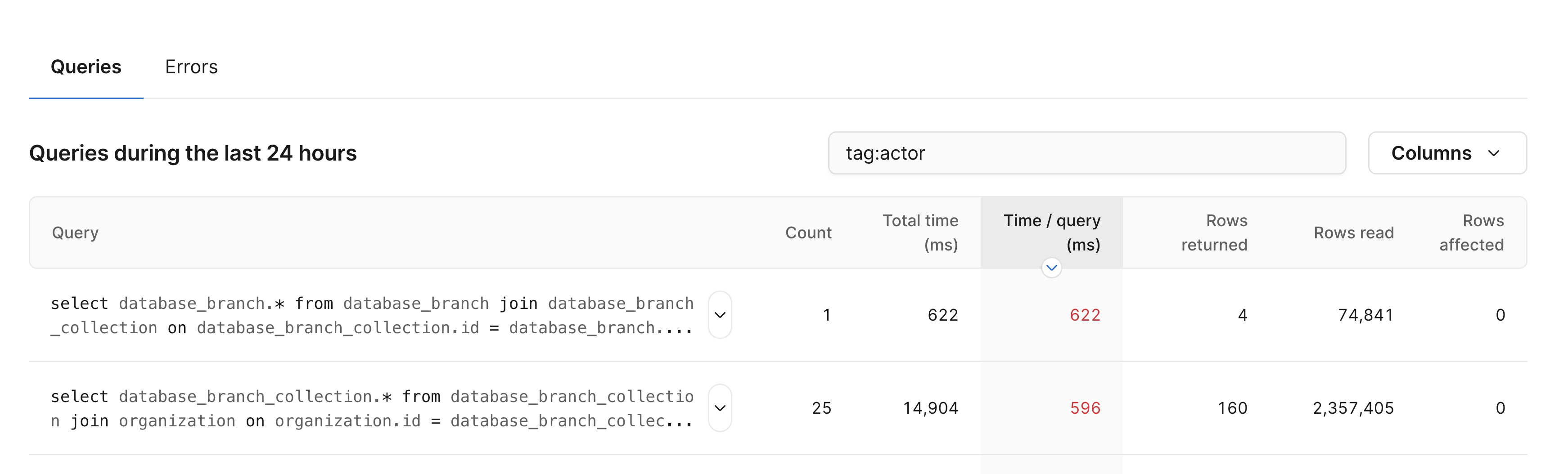
Query list using tag:tag_name

Try it out now!

Insights errors and improved tag searching functionality are available for all plans now. Try it out and let us know what you think!

For more information, check out the Query Insights documentation.