惯性聚合 高效追踪和阅读你感兴趣的博客、新闻、科技资讯
阅读原文 在惯性聚合中打开

推荐订阅源

Martin Fowler
Martin Fowler
Threat Intelligence Blog | Flashpoint
博客园 - 聂微东
IT之家
IT之家
GbyAI
GbyAI
奇客Solidot–传递最新科技情报
奇客Solidot–传递最新科技情报
Y
Y Combinator Blog
博客园 - 【当耐特】
The Cloudflare Blog
宝玉的分享
宝玉的分享
罗磊的独立博客
钛媒体:引领未来商业与生活新知
钛媒体:引领未来商业与生活新知
让小产品的独立变现更简单 - ezindie.com
V
Visual Studio Blog
小众软件
小众软件
博客园_首页
Last Week in AI
Last Week in AI
J
Java Code Geeks
V
V2EX
雷峰网
雷峰网
Apple Machine Learning Research
阮一峰的网络日志
阮一峰的网络日志
腾讯CDC
博客园 - 司徒正美
Engineering at Meta
Engineering at Meta
The GitHub Blog
The GitHub Blog
H
Hackread – Cybersecurity News, Data Breaches, AI and More
D
DataBreaches.Net
博客园 - 三生石上(FineUI控件)
MyScale Blog
MyScale Blog
云风的 BLOG
云风的 BLOG
The Register - Security
M
MIT News - Artificial intelligence
Microsoft Azure Blog
T
The Blog of Author Tim Ferriss
N
Netflix TechBlog - Medium
F
Full Disclosure
B
Blog
H
Help Net Security
C
Check Point Blog
WordPress大学
WordPress大学
人人都是产品经理
人人都是产品经理
Cyber Security Advisories - MS-ISAC
Jina AI
Jina AI
酷 壳 – CoolShell
酷 壳 – CoolShell
Blog — PlanetScale
Blog — PlanetScale
L
LangChain Blog
P
Proofpoint News Feed
D
Docker
Microsoft Security Blog

Blog — PlanetScale

Keeping a Postgres queue healthy — PlanetScale Patterns for Postgres Traffic Control — PlanetScale Graceful degradation in Postgres — PlanetScale High memory usage in Postgres is good, actually — PlanetScale Stripe Projects partnership: Provision PlanetScale Postgres and MySQL databases from the Stripe CLI — PlanetScale Enhanced tagging in Postgres Query Insights — PlanetScale Behind the scenes: How Database Traffic Control works — PlanetScale Introducing Database Traffic Control — PlanetScale Scaling Postgres connections with PgBouncer — PlanetScale Drizzle joins PlanetScale — PlanetScale Video Conferencing with Postgres — PlanetScale Faster PlanetScale Postgres connections with Cloudflare Hyperdrive — PlanetScale Introducing the PlanetScale MCP server — PlanetScale Database Transactions — PlanetScale Automating our changelog with Cursor commands — PlanetScale Postgres 18 is now available — PlanetScale Using MotherDuck with PlanetScale — PlanetScale $50 PlanetScale Metal is GA for Postgres — PlanetScale AI-Powered Postgres index suggestions — PlanetScale $5 PlanetScale is live — PlanetScale Announcing Vitess 23 — PlanetScale $50 PlanetScale Metal — PlanetScale Report on our investigation of the 2025-10-20 incident in AWS us-east-1 — PlanetScale $5 PlanetScale — PlanetScale Benchmarking Postgres 17 vs 18 — PlanetScale Larger than RAM Vector Indexes for Relational Databases — PlanetScale Partnering with Cloudflare to bring you the fastest globally distributed applications — PlanetScale Processes and Threads — PlanetScale PlanetScale for Postgres is now GA — PlanetScale Postgres High Availability with CDC — PlanetScale Announcing Neki — PlanetScale Caching — PlanetScale The principles of extreme fault tolerance — PlanetScale Announcing PlanetScale for Postgres — PlanetScale Benchmarking Postgres — PlanetScale Announcing Vitess 22 — PlanetScale The Real Failure Rate of EBS — PlanetScale IO devices and latency — PlanetScale Announcing PlanetScale Metal — PlanetScale PlanetScale Metal: There’s no replacement for displacement — PlanetScale Automating cherry-picks between OSS and private forks — PlanetScale Database Sharding — PlanetScale Anatomy of a Throttler, part 3 — PlanetScale Introducing sharding on PlanetScale with workflows — PlanetScale Announcing Vitess 21 — PlanetScale Announcing the PlanetScale vectors public beta — PlanetScale Anatomy of a Throttler, part 2 — PlanetScale Instant deploy requests — PlanetScale Anatomy of a Throttler, part 1 — PlanetScale Increase IOPS and throughput with sharding — PlanetScale Tracking index usage with Insights — PlanetScale Faster backups with sharding — PlanetScale Building data pipelines with Vitess — PlanetScale The State of Online Schema Migrations in MySQL — PlanetScale Optimizing aggregation in the Vitess query planner — PlanetScale Dealing with large tables — PlanetScale Announcing Vitess 20 — PlanetScale Self-managed Vitess vs Managed Vitess with PlanetScale — PlanetScale Achieving data consistency with the consistent lookup Vindex — PlanetScale The MySQL adaptive hash index — PlanetScale Introducing global replica credentials — PlanetScale Profiling memory usage in MySQL — PlanetScale Summer 2023: Fuzzing Vitess at PlanetScale — PlanetScale How PlanetScale makes schema changes — PlanetScale Identifying and profiling problematic MySQL queries — PlanetScale The Problem with Using a UUID Primary Key in MySQL — PlanetScale Announcing Vitess 19 — PlanetScale PlanetScale forever — PlanetScale Introducing schema recommendations — PlanetScale Amazon Aurora Pricing: The many surprising costs of running an Aurora database — PlanetScale Three common MySQL database design mistakes — PlanetScale OAuth applications are now available to everyone — PlanetScale Deprecating the Scaler plan — PlanetScale PlanetScale branching vs. Amazon Aurora blue/green deployments — PlanetScale Databases at scale — PlanetScale Considerations for building a database disaster recovery plan — PlanetScale Working with Geospatial Features in MySQL — PlanetScale PlanetScale vs Amazon Aurora replication — PlanetScale Introducing the Vantage and PlanetScale integration — PlanetScale MySQL isolation levels and how they work — PlanetScale Introducing the schemadiff command line tool — PlanetScale $ pscale ping — PlanetScale Announcing foreign key constraints support — PlanetScale The challenges of supporting foreign key constraints — PlanetScale What is HTAP? — PlanetScale Introducing Insights Anomalies — PlanetScale Webhook security: a hands-on guide — PlanetScale Announcing the Fivetran integration — PlanetScale Introducing webhooks — PlanetScale What is MySQL replication and when should you use it? — PlanetScale Sync user data between Clerk and a PlanetScale MySQL database — PlanetScale Introducing database reports — PlanetScale Distributed caching systems and MySQL — PlanetScale What is MySQL partitioning? — PlanetScale MySQL High Availability: Connection handling and concurrency — PlanetScale Personalizing your onboarding with Markdoc — PlanetScale PlanetScale vs. Amazon Aurora — PlanetScale PlanetScale vs. Amazon RDS — PlanetScale PlanetScale is bringing vector search and storage to MySQL — PlanetScale PlanetScale Managed is now PCI compliant — PlanetScale
Upgrading Query Insights to Metal — PlanetScale
Rafer Hazen · 2025-03-11 · via Blog — PlanetScale

Rafer Hazen |

Since PlanetScale Metal is now generally available, I wanted to share a post describing our experience migrating the PlanetScale database that powers the Query Insights feature to Metal.

Data collection in Query Insights

First, a bit about how we collect the data for Query Insights. The basic steps are:

  • Collect query-pattern telemetry from the Vitess layer of your PlanetScale database
  • Publish the data to Kafka
  • Consume the data from Kafka and write to several MySQL tables, aggregated by time.

The primary scalability concern in the Query Insights pipeline is ensuring that we can process and write data to the database quickly enough to keep up with the inbound volume. To accomplish this, we read Kafka messages in batches, coalesce data in memory to avoid unnecessary writes, and hand the writes off to a thread pool in each Kafka consumer.

The result is that the Query Insights database is very write-heavy. As of this writing, we execute approximately 10k UPDATE/INSERT statements per second. These writes come from 32 consumer processes, each with 25 writer threads for a total max concurrency of 800 threads.

The Query Insights PlanetScale database has 8 shards and, prior to our upgrade to Metal, we'd had to provision more IOPS to the EBS volumes backing MySQL in our sharded keyspace to keep up with the telemetry volume. Since this workload had demonstrated a sensitivity to I/O latency, we figured it would be a good candidate for upgrading to Metal.

To do this, we picked 1 of our 8 MySQL shards, the busiest one, to upgrade first.

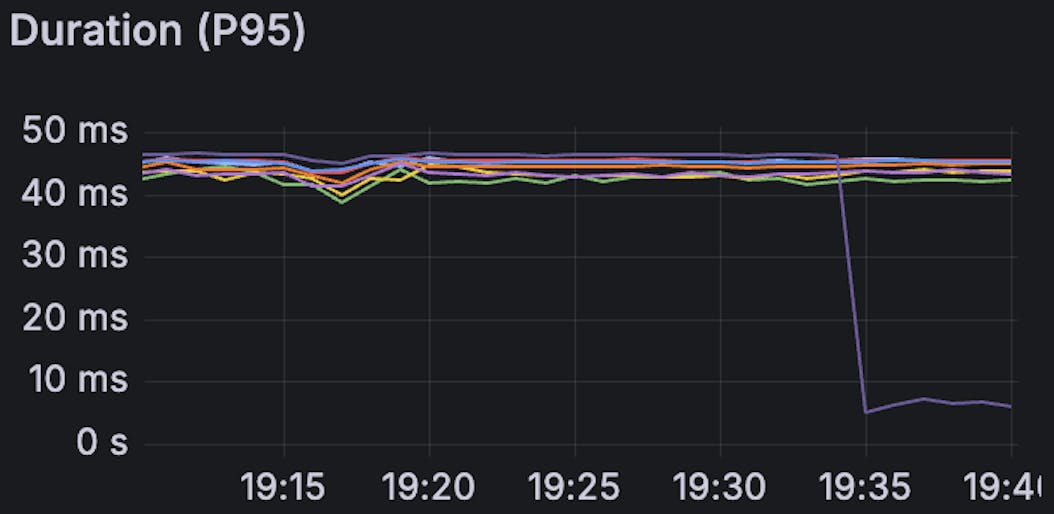
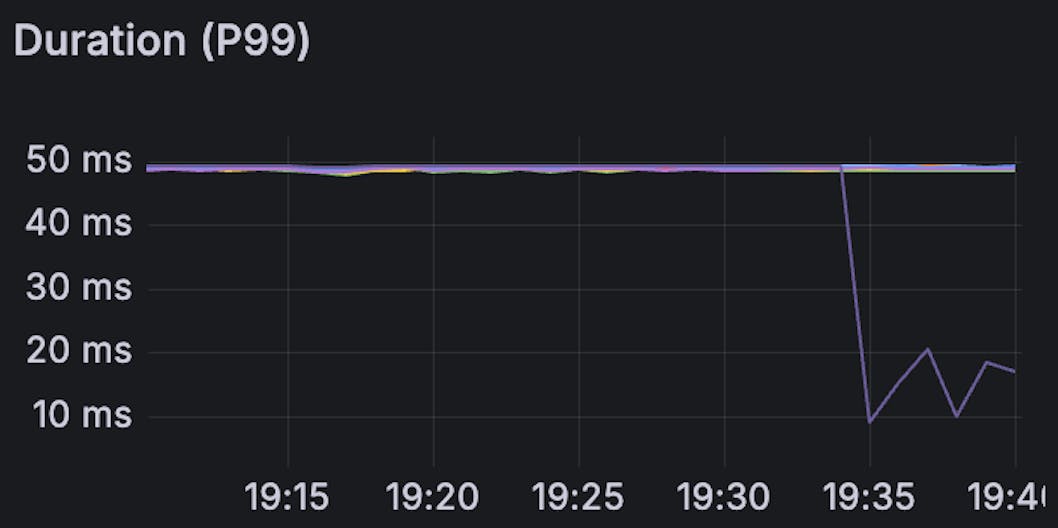
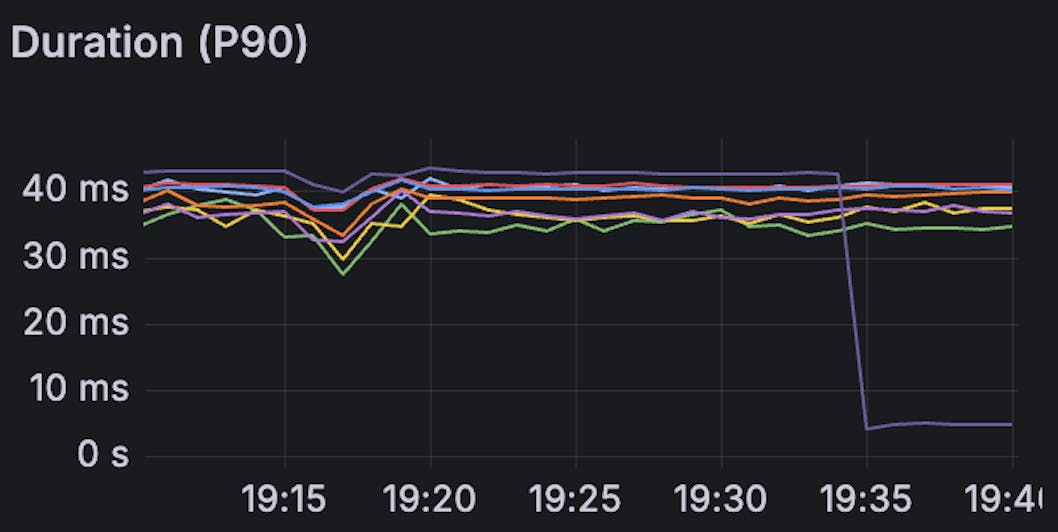
The following graphs show the query latency at various percentiles. The lines shows the latency for the 8 primaries of the Insights database. The purple line corresponds to our busiest shard, which was upgraded to Metal around 19:35.
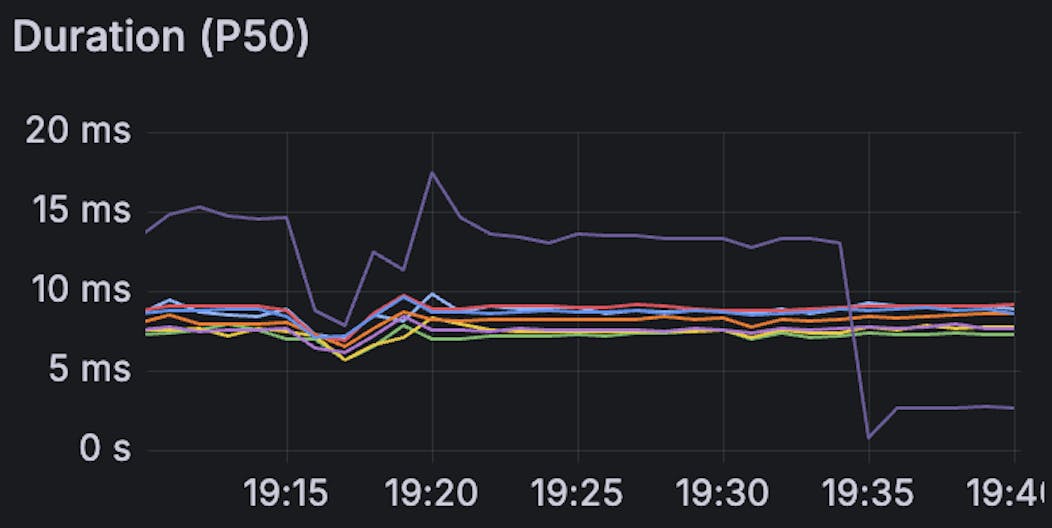
Insights Metal Upgrade Shard Latency P50

Insights Metal Upgrade Shard Latency P90

Insights Metal Upgrade Shard Latency P95

Insights Metal Upgrade Shard Latency P99

Upgrading a test shard to Metal causes a substantial decrease in latency across all the measured percentiles. After the Metal upgrade, our busiest shard with the highest latencies started executing queries faster than the other shards by a significant margin.

After letting the first upgrade soak for a few days, we upgraded the remaining shards and saw nearly identical improvement in performance.

Without making any changes to our application, architecture, or sharding configuration, we were able to realize substantial performance improvements by upgrading to PlanetScale Metal. This resulted in a lower average backlog in our Kafka consumers, and has given us additional capacity to handle increasing message volume in the future.