
惯性聚合 高效追踪和阅读你感兴趣的博客、新闻、科技资讯
阅读原文 在惯性聚合中打开

推荐订阅源

K
Kaspersky official blog
Threat Intelligence Blog | Flashpoint
AI
AI
SecWiki News
SecWiki News
宝玉的分享
宝玉的分享
Scott Helme
Scott Helme
D
Darknet – Hacking Tools, Hacker News & Cyber Security
Exploit-DB.com RSS Feed
Engineering at Meta
Engineering at Meta
博客园 - 叶小钗
The GitHub Blog
The GitHub Blog
Microsoft Azure Blog
N
News and Events Feed by Topic
Cloudbric
Cloudbric
B
Blog
Cisco Talos Blog
Cisco Talos Blog
V
Vulnerabilities – Threatpost
N
News and Events Feed by Topic
V
Visual Studio Blog
A
Arctic Wolf
奇客Solidot–传递最新科技情报
奇客Solidot–传递最新科技情报
U
Unit 42
S
Security @ Cisco Blogs
博客园 - 聂微东
T
Threat Research - Cisco Blogs
OSCHINA 社区最新新闻
OSCHINA 社区最新新闻
Apple Machine Learning Research
Y
Y Combinator Blog
G
GRAHAM CLULEY
L
LINUX DO - 热门话题
量子位
NISL@THU
NISL@THU
Webroot Blog
Webroot Blog
让小产品的独立变现更简单 - ezindie.com
T
Troy Hunt's Blog
Application and Cybersecurity Blog
T
Tenable Blog
月光博客
月光博客
S
Security Affairs
K
KPMG report finds enterprise disconnect between AI and its ROI | CIO
The Hacker News
The Hacker News
Spread Privacy
Spread Privacy
D
Docker
www.infosecurity-magazine.com
雷峰网
雷峰网
博客园 - 司徒正美
T
The Exploit Database - CXSecurity.com
Hugging Face - Blog
Hugging Face - Blog
Help Net Security
Help Net Security
D
DataBreaches.Net

Blog — PlanetScale

Keeping a Postgres queue healthy — PlanetScale Patterns for Postgres Traffic Control — PlanetScale Graceful degradation in Postgres — PlanetScale High memory usage in Postgres is good, actually — PlanetScale Stripe Projects partnership: Provision PlanetScale Postgres and MySQL databases from the Stripe CLI — PlanetScale Enhanced tagging in Postgres Query Insights — PlanetScale Behind the scenes: How Database Traffic Control works — PlanetScale Introducing Database Traffic Control — PlanetScale Scaling Postgres connections with PgBouncer — PlanetScale Drizzle joins PlanetScale — PlanetScale Video Conferencing with Postgres — PlanetScale Faster PlanetScale Postgres connections with Cloudflare Hyperdrive — PlanetScale Introducing the PlanetScale MCP server — PlanetScale Database Transactions — PlanetScale Automating our changelog with Cursor commands — PlanetScale Postgres 18 is now available — PlanetScale Using MotherDuck with PlanetScale — PlanetScale $50 PlanetScale Metal is GA for Postgres — PlanetScale AI-Powered Postgres index suggestions — PlanetScale $5 PlanetScale is live — PlanetScale Announcing Vitess 23 — PlanetScale $50 PlanetScale Metal — PlanetScale Report on our investigation of the 2025-10-20 incident in AWS us-east-1 — PlanetScale $5 PlanetScale — PlanetScale Benchmarking Postgres 17 vs 18 — PlanetScale Larger than RAM Vector Indexes for Relational Databases — PlanetScale Partnering with Cloudflare to bring you the fastest globally distributed applications — PlanetScale Processes and Threads — PlanetScale PlanetScale for Postgres is now GA — PlanetScale Postgres High Availability with CDC — PlanetScale Announcing Neki — PlanetScale Caching — PlanetScale The principles of extreme fault tolerance — PlanetScale Announcing PlanetScale for Postgres — PlanetScale Benchmarking Postgres — PlanetScale Announcing Vitess 22 — PlanetScale The Real Failure Rate of EBS — PlanetScale IO devices and latency — PlanetScale Announcing PlanetScale Metal — PlanetScale PlanetScale Metal: There’s no replacement for displacement — PlanetScale Upgrading Query Insights to Metal — PlanetScale Automating cherry-picks between OSS and private forks — PlanetScale Database Sharding — PlanetScale Anatomy of a Throttler, part 3 — PlanetScale Introducing sharding on PlanetScale with workflows — PlanetScale Announcing Vitess 21 — PlanetScale Announcing the PlanetScale vectors public beta — PlanetScale Anatomy of a Throttler, part 2 — PlanetScale Instant deploy requests — PlanetScale Anatomy of a Throttler, part 1 — PlanetScale Increase IOPS and throughput with sharding — PlanetScale Tracking index usage with Insights — PlanetScale Faster backups with sharding — PlanetScale Building data pipelines with Vitess — PlanetScale The State of Online Schema Migrations in MySQL — PlanetScale Optimizing aggregation in the Vitess query planner — PlanetScale Dealing with large tables — PlanetScale Announcing Vitess 20 — PlanetScale Self-managed Vitess vs Managed Vitess with PlanetScale — PlanetScale Achieving data consistency with the consistent lookup Vindex — PlanetScale The MySQL adaptive hash index — PlanetScale Introducing global replica credentials — PlanetScale Profiling memory usage in MySQL — PlanetScale Summer 2023: Fuzzing Vitess at PlanetScale — PlanetScale How PlanetScale makes schema changes — PlanetScale Identifying and profiling problematic MySQL queries — PlanetScale The Problem with Using a UUID Primary Key in MySQL — PlanetScale Announcing Vitess 19 — PlanetScale PlanetScale forever — PlanetScale Introducing schema recommendations — PlanetScale Amazon Aurora Pricing: The many surprising costs of running an Aurora database — PlanetScale Three common MySQL database design mistakes — PlanetScale OAuth applications are now available to everyone — PlanetScale Deprecating the Scaler plan — PlanetScale PlanetScale branching vs. Amazon Aurora blue/green deployments — PlanetScale Databases at scale — PlanetScale Considerations for building a database disaster recovery plan — PlanetScale Working with Geospatial Features in MySQL — PlanetScale PlanetScale vs Amazon Aurora replication — PlanetScale Introducing the Vantage and PlanetScale integration — PlanetScale MySQL isolation levels and how they work — PlanetScale Introducing the schemadiff command line tool — PlanetScale $ pscale ping — PlanetScale Announcing foreign key constraints support — PlanetScale The challenges of supporting foreign key constraints — PlanetScale What is HTAP? — PlanetScale Introducing Insights Anomalies — PlanetScale Webhook security: a hands-on guide — PlanetScale Announcing the Fivetran integration — PlanetScale Introducing webhooks — PlanetScale What is MySQL replication and when should you use it? — PlanetScale Sync user data between Clerk and a PlanetScale MySQL database — PlanetScale Introducing database reports — PlanetScale Distributed caching systems and MySQL — PlanetScale What is MySQL partitioning? — PlanetScale MySQL High Availability: Connection handling and concurrency — PlanetScale Personalizing your onboarding with Markdoc — PlanetScale PlanetScale vs. Amazon Aurora — PlanetScale PlanetScale vs. Amazon RDS — PlanetScale PlanetScale is bringing vector search and storage to MySQL — PlanetScale
Announcing Vitess 18 — PlanetScale
Vitess Engin · 2023-11-07 · via Blog — PlanetScale

Vitess Engineering Team |

MySQL compatibility improvements

Vitess 18 is now generally available, with a number of new enhancements designed to improve usability, performance, and MySQL compatibility.

Foreign key constraints

In the past, foreign key constraints had to be managed outside Vitess. This was a significant blocker for adoption. We are now able to support Vitess-managed foreign key constraints within the same shard. This includes the ability to import data into Vitess from an existing MySQL database with foreign key constraints. We plan to extend foreign key constraint support to cross-shard relationships in a future release.

Note

Foreign key constraints are supported in PlanetScale. You can enable them in your database settings page.

General compatibility

The Vitess query planner has been significantly enhanced, paving the way for advanced query capabilities. The newly revamped version is more robust and flexible. This allows Vitess to provide better support for complex aggregations, sophisticated subqueries, and derived tables. Complex queries on sharded databases will perform better as a result of these changes.

Usability enhancements

Cobra

The Vitess CLI has been migrated to cobra. In addition to standardizing and modernizing our CLI infrastructure, this change provides two major benefits.

We now auto-generate reference documentation for both released and development versions of Vitess.

This means that developers spend less time performing mechanical documentation changes and more time on features, bug fixes, and more in-depth documentation. End users benefit from more reliably up-to-date reference docs.

In addition, Vitess commands now support shell completion:
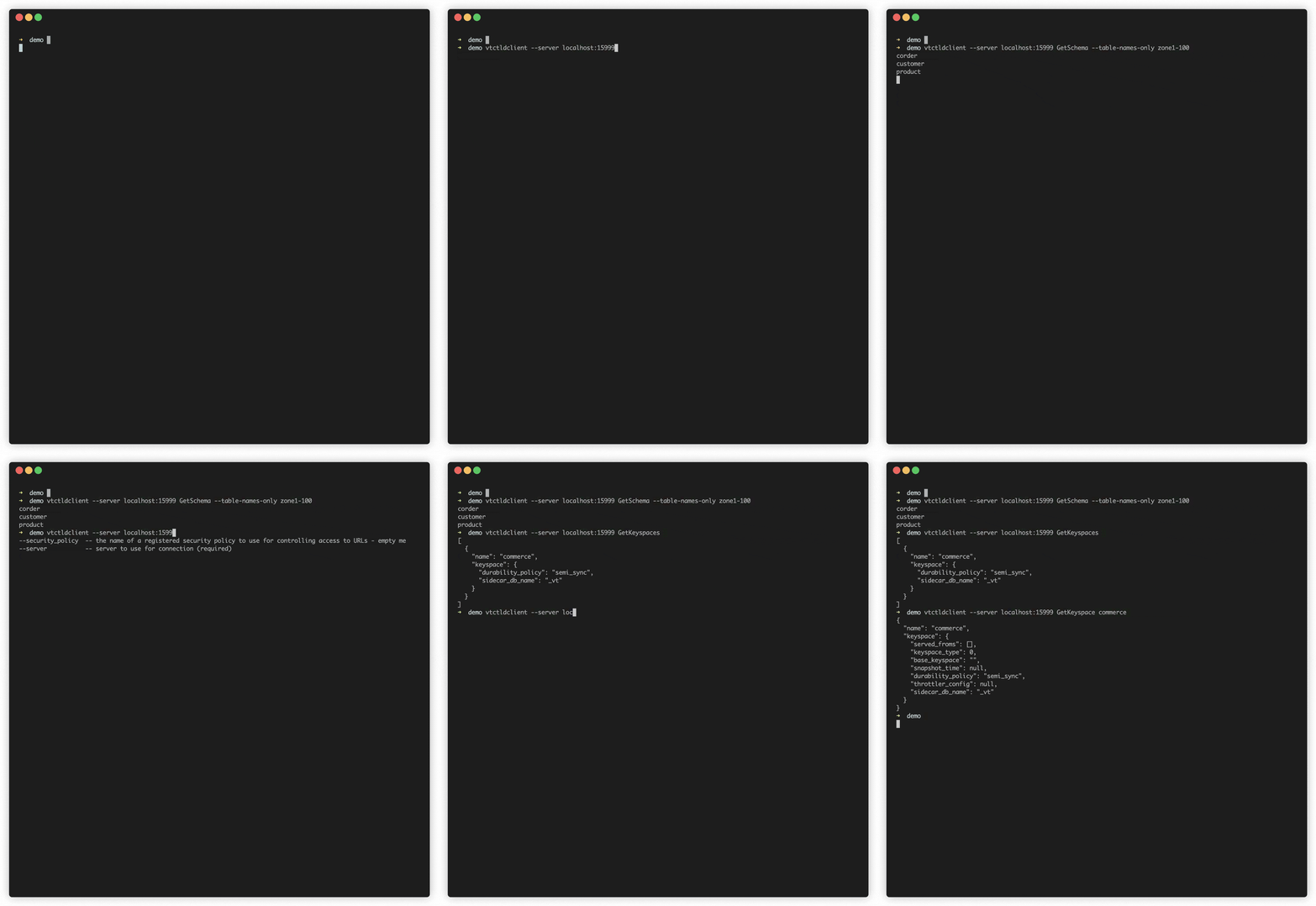
Vitess commands support shell completion

Vtctldclient

We have completed the migration of all client commands to vtctldclient. The legacy vtctl/vtctlclient binaries are now fully deprecated and we plan to remove them in Vitess 19.

This migration provides several benefits:

  • Clean separation of commands makes it easier to develop new features without impacting other commands.
  • It presents an API that other clients (both Vitess and third-party) can use to interface with Vitess.
  • It enables future features. For example, we can now use configuration files and start building support for dynamic configuration.

VReplication and online DDL

We now have the ability to import data with foreign key relationships in a way that properly maintains those relationships.

Additionally, we now support near-zero downtime migration of data from an external database. Previously, there was a perceptible cutover duration during which queries would error out.

Online DDL can now provide better progress estimates.

Point in time recoveries

While Vitess has supported Point in Time Recovery for years, the functionality was dependent on running a binlog server and was not widely used. In this release, we've added the ability to restore to a specific timestamp without relying on an external binlog server. Recovery to a known GTID position without a binlog server has been supported since Vitess 17.

The old functionality that relied on a binlog server is now deprecated and will be removed in a future release.

Tablet throttler

The throttler now uses gRPC for communication with other tablets instead of HTTP, except as a fallback during version upgrades. The use of HTTP was a security concern and will be removed in the next release.

Arewefastyet

Arewefastyet, our benchmarking system, now has a new look aimed at improving the reliability and usability of the website. We have also made several bug fixes and enhancements to the benchmarking system.

Try it out

We are very pleased with the great strides we have made with v18 and hope you will be as well. We encourage all current Vitess users and everyone who has been considering it to try this new release! We also look forward to your feedback, which can be provided via Vitess GitHub issues or the Vitess Slack.