


Sonia Fernández-Vidal has spent her career making the strange world of quantum physics feel tangible: first in the laboratory, then on the page, and now in the gallery. A doctor in Quantum Optics and Information from the Universitat Autonoma de Barcelona, she has conducted research at some of the world’s most presigious institutions, including CERN in Switzerland and Los Alamos National Laboratory in the U.S., and is a full academic member of the European Royal Academy of Doctors.
But it is her parallel life as a science communicator that sets her apart. She is the author of The Door of the Three Locks (La Puerta de los Tres Cerrojos), a surprise 2011 bestseller that grew into a book series introducing children and adults alike to the magic of the quantum world. And she is the curator of Quantum Revolution, a new exhibition that blends art and science to explore the foundations and implications of quantum physics, which opened May 7 at Espacio Fundación Telefónica in Madrid.
The following Q&A is translated and adapted from Computerworld Spain, where Esther Macías interviewed Fernández-Vidal by video conference just hours before the exhibition’s doors opened. They discussed the real state of quantum computing, how enterprises should be preparing, and why she believes talking about quantum technology is not science fiction, but a civic responsibility.
The advances generated in the past by the application of the principles of quantum physics and mechanics have been immense in many fields, but how do you view the current shift taking place with the Second Quantum Revolution, which has a particular impact on the technological field?
We are at the dawn of the so-called Second Quantum Technological Revolution, whose impact we cannot even begin to imagine, although it has already gone beyond the confines of research centers and is beginning to find applications in industry. Evidence of this real impact can be seen in advances in metrology and quantum sensors, which are essentially sensors with far greater precision than current ones and are already being applied, for example, to underground exploration to locate gas or oil.
These technologies, therefore, could revolutionize current energy resource exploration techniques. On the other hand, in the field of medicine, the use of these sensors can accelerate the detection of tumor or cancer cells and improve diagnosis and, consequently, treatment. There will also be a revolution in communications. Work is already underway on the quantum internet, where Spain’s Institute of Photonic Sciences plays a leading role in Europe. Also within the field of communications, advances are currently being made in quantum cryptography so that organizations are prepared for the risks that may arise in current cryptographic systems once the quantum computer emerges. Banks, for example, are already working on these types of solutions; many tech companies and startups have also already developed new encryption systems. And, as the final step on this path, we come to what the media loves most: the much-anticipated quantum computers.
Do you think there’s a bubble surrounding them, despite the progress made by tech giants like Google or IBM?
There’s a lot of hype surrounding this, and, naturally, a lot of sensationalist news. But if I look back 20 years, the reality is that expectations from that time regarding the evolution of quantum computing and communications have already been surpassed. Things are moving faster than expected. Sometimes the leaps that occur aren’t continuous and are subtle, but there are milestones that make the transformation happen very quickly. That’s why it’s not easy to predict when these technologies will reach the market.
And, yes, the two players mentioned are leading the race for quantum technologies—a race that is also taking place internationally between the United States and China and that reminds me of the one that occurred in the late 1970s in the space sector.
“If I look back 20 years, the reality is that the expectations we had back then for the evolution of quantum computing and communications have already been surpassed.”
And then there’s Europe…
It’s the other player, yes. Europe isn’t on the podium, but we’re developing quite a few projects here, especially thanks to the European Horizon programs. And it’s not all about developing quantum computers. By the way, I’d like to delve into how these work first before addressing the geopolitical issue.
Of course.
A classical computer operates with bits of information, which are the basic unit of information: 1 if a current flows, 0 if it doesn’t. And from this, we develop the algorithms that all users work with constantly, even if we don’t notice it. But quantum computing isn’t based on bits, but on quantum bits, or qubits—that is, zeros and ones simultaneously. Therefore, we use phenomena from quantum mechanics such as superposition, allowing us to use both zeros and ones, or what amounts to Schrödinger’s cat, which is simultaneously alive and dead.
We have finally managed to manipulate atoms at the individual level and reproduce more or less controlled superposition states in laboratories—one of the great challenges of quantum computing. We can also reproduce entanglement systems in the laboratory—entangled states are that strange phenomenon described by Albert Einstein in 1935 when he explained that if we separated two pairs of particles that had been born together to different locations in the universe, whatever happened to one would instantly affect the other. And this ability to manipulate these quantum phenomena has allowed us to use them to try to create quantum computers with these highly exotic properties of quantum mechanics.
“Sometimes we think that a quantum computer is going to be much faster and more powerful than a classical computer, but that’s not the case […]. That’s not what it’s about”
And here I must clarify: sometimes we think that a quantum computer will be much faster and more powerful than a classical computer, but that is not the case. It’s true that it can be exponentially faster, but that’s not the point. What we need to understand is that quantum and classical computing are completely different technologies, with different algorithmic systems and different types of hardware. To put it simply: it’s the same with communication via smoke signals and over the phone; both are forms of communication, but they’re completely different.
In short, quantum computing is completely different and therefore very promising, but I don’t think it will replace classical computing, since we’re not talking about more powerful computers, but different ones. My prediction for the future on this, though it involves looking into a crystal ball, is that we’ll likely use a combination of classical and quantum computing, connecting to the cloud when we need to run a quantum computing algorithm. And as for applications, well, obviously many of them will be unpredictable, as is the case when a technology of this kind emerges. But the simple fact of being able to simulate materials at the atomic level—that is, at the level of subatomic particles—something that hasn’t been possible until now, will be key to creating new materials or medications, as well as to optimizing, for example, flight management—where there are so many variables that it’s basically impossible—or current encryption methods. With quantum computers, these will be easy problems to solve, although, as we saw, new risks and dangers will also arise. And here we come to the geopolitics we were talking about earlier, with the two opposing blocs: China and the United States.
What will happen when one of the two has a working quantum computer?
It will undoubtedly have extraordinary geopolitical advantages; not only will it be able to decrypt the opponent’s information, but it will also have an exponential technological advantage that it can apply to the advances we discussed earlier in medicine, materials science, etc.
And we must not forget that behind this are not only governments or research centers, but also companies like Google or IBM. In short, this is a new scenario, different from what we’ve seen so far, and one that, on the other hand, also reminds me not only of the space race, but of a more catastrophic one: the struggle between the Manhattan Project and the Uranium Club. Because, in the end, science is not a cornucopia from which only benefits for humanity emerge: from its bosom were also born the atomic bombs that, unfortunately, cloud the horizon of world peace. We must be very aware that science is a double-edged sword, with great power for good, but also for evil.
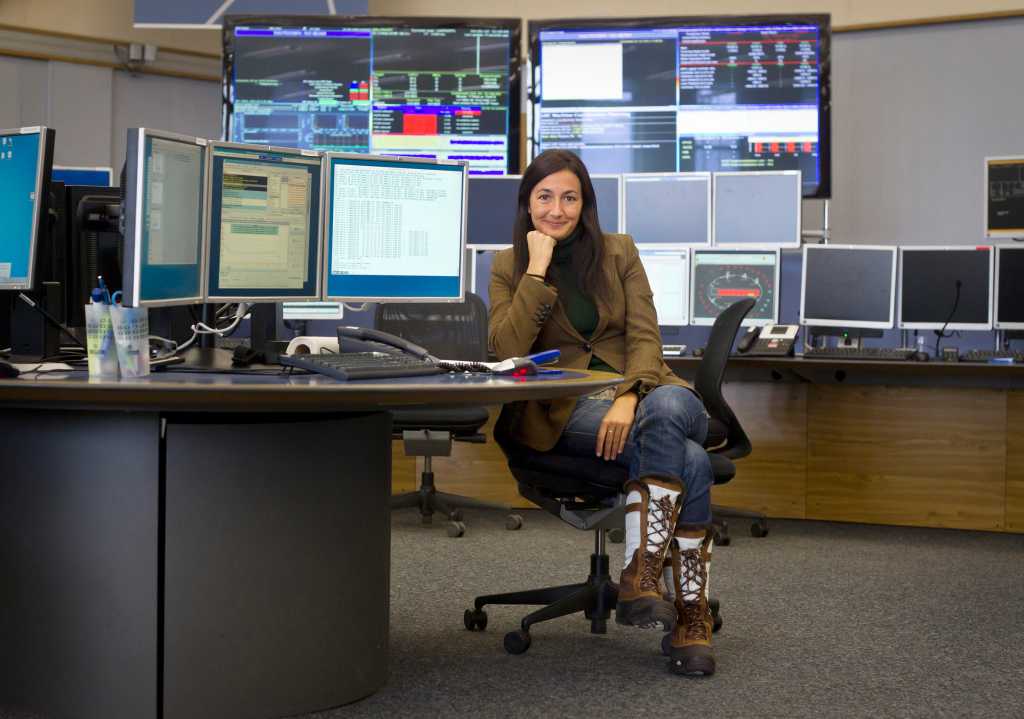
Scientist Sonia Fernández-Vidal, Ph.D. in Optics and Quantum Information, during her time at CERN.
SFV
“Being the first to have an operational quantum computer means having extraordinary geopolitical advantages”
That is why it is important to effectively communicate what these sciences and technologies are. As Carl Edward Sagan [American astronomer, astrophysicist, and science communicator] said in Cosmos, we have based our societies on highly advanced science and technology, but we have structured them in such a way that no one knows anything about them. What he warned of is that, in the end, the combination of highly advanced science and technology and widespread ignorance on the part of civilization regarding how they work will end up being explosive.
Given that everything today is based on such powerful technologies, who will make decisions in the future regarding our children? Because very few people understand how they work—not even politicians. And throughout human history, this has never led to anything good.
For all these reasons, I believe that talking about quantum technologies or quantum computers is not science fiction but a civic responsibility. And it is a policy of the 21st century to ensure that we all have an understanding of how these technologies work. And I am not just referring to quantum technologies but also to artificial intelligence. Let’s recall the phrase [spoken by Nobel Peace Prize laureate Christian Lous Lange in the 1920s] that “technology is a useful servant, but a dangerous master.”
And how do you view the combination of AI and quantum computing? As an explosive cocktail?
When these two fields of knowledge collide, well, as we said before, it will be a double-edged sword, but there will undoubtedly be extraordinary developments. Applying machine learning algorithms to quantum computing will be very appealing; in fact, work on these types of algorithms is already underway, though I recall that we still lack the hardware—the physical quantum computers—to run them.
There are already experiments, as we mentioned earlier, involving quantum and classical computing working simultaneously. Would you dare to give a date for when a purely quantum computer will be fully operational?
We’ve reached what’s called ‘quantum supremacy’—a term, by the way, that sounds a bit off and is being phased out—but, for now, these computers aren’t yet functional, and work is underway on different hardware models. When will they be ready? The most optimistic estimates say five years; the most pessimistic, ten. In other words, we’ll see it soon. We’re starting to see a fairly advanced path; we’re also seeing many very interesting startups , such as Qilimanjaro in Spain, which, by the way, has donated one of its quantum computing chips to us for the exhibition we’re putting on at Telefónica.
How would you describe the European and Spanish landscape in quantum computing?
Clearly, there is greater agility for technology startups in the United States than in Europe and, particularly, in Spain. We’ve seen this in the field of AI as well.
Regarding research, in Europe we do have excellent centers, such as the Institute of Photonic Sciences, as well as the Barcelona Supercomputing Center, which has a quantum group that has also collaborated on the exhibition. In Spain, therefore, we are well-represented in the quantum ecosystem at the research level; the problem is the lack of investment, which is far below that of the United States and China. But in Europe, we must commit to developing all these new technologies at home; we only need to look back to see what happened with the chip market. We stopped producing them here, thinking that they would be manufactured faster and cheaper elsewhere, and in the end, we realized that this was a strategic mistake. The Quantum Flagship projects subsequently promoted by the EU to support the creation of these next-generation quantum chips were launched so we wouldn’t be left behind in this race. Because we can’t afford to be. Because we’ve realized that we can’t afford to make the same mistake again in Europe.
In the past, you have worked at CERN [the European Organization for Nuclear Research, which operates theworld’s largestphysicslaboratory] and at Los Alamos National Laboratory in the United States. What lessons would you bring back to Spain and Europe from these major centers?
I was very young when I was at CERN, the cathedral of modern knowledge. There, I didn’t work in the field of quantum physics, but in particle physics. It was undoubtedly a very interesting experience because of the close collaboration that takes place there among researchers from all countries, nationalities, and ethnicities… A collaboration that serves as a case study in prestigious business schools. And I think it works because everyone there works toward the same common goal: unraveling the origins of the universe to understand how it is formed. It is a mission so powerful that it transcends all barriers. I have sometimes been asked if I felt discriminated against in any way there for being a young woman at that time; the truth is, I did not. There, we all see ourselves as brains on legs.
That’s fantastic.
Yes. Sometimes it’s good to remember—especially now that we’re experiencing more and more conflict, division among people, and fear—that when humanity has a common purpose, all barriers fade away.
Many of our readers are IT professionals and executives from organizations of all kinds. What advice do you have for them in light of the coming quantum revolution?
It’s a good idea for them to start working—as banks already do—on quantum encryption, but also on the optimization that can come from using this technology, risk simulations, and so on.
I would also advise them to exercise caution and not make hasty decisions. I recommend the same with AI. We cannot assume that it will replace all the analysts we have; that is an oversimplification of the issue, and I believe many tech companies will have to reverse some of the hasty decisions they are making.
We need to clearly understand what AI can and cannot do. I see it as an Iron Man suit, which multiplies what humans can do, but it doesn’t work without them. The same applies to quantum technologies. But the important thing in the face of technological advances, as I was saying, is, first, to be well-informed, and second, not to panic over these changes. There isn’t a single functional quantum computer yet. We don’t know exactly where we’ll run into limits, so we have to be cautious.
“There isn’t a functional quantum computer yet. We don’t know exactly where the limits will be, so we have to be cautious.”
Are you concerned about the changes in the job market that may be coming—or are already happening—with the democratization of new types of generative and agentive AI?
I’m no expert on artificial intelligence, far from it, but the picture being painted for us is indeed frightening, especially for our children, because… which professions will still exist and which will cease to exist? That said, humanity has already gone through this kind of change—just look at industrialization. When it began, it also completely revolutionized the society we lived in. We will likely have to go through another similar change.
What job profiles will we need in the quantum era?
Physicists and mathematicians are the professionals who are likely best equipped to handle all the changes ahead. It’s no coincidence that the university degree program encompassing both fields of knowledge has the highest cutoff score for university admission in Spain. On the other hand, I imagine that from now on, universities will also begin offering quantum engineering programs.
As a researcher, what would you say to political leaders?
That research isn’t a switch you can turn off and then turn back on as if nothing had happened. Cuts to research have consequences, and investment is necessary and must be sustained over time. Let’s remember that the richest countries aren’t the ones that invest in R&D; rather, investing in R&D makes countries richer. We must be very aware of this and of the need to invest in technology. Otherwise, we’ll be relegated to bringing up the rear, with all the disadvantages—including geopolitical ones—that entails. And this is an issue that concerns us all as citizens, not just a community of scientists. As citizens, we not only have the right to inform ourselves about how technologies work so we can make informed decisions, but we also have the duty and responsibility to do so.
And you contribute to this goal through your outreach work. I haven’t asked you about your books, which are aimed at a broader and younger audience than the one that usually follows our publication, but these novels are a success.
My intention with them is to spark an interest in learning more.
Read the full article in Computerworld Spain.
SUBSCRIBE TO OUR NEWSLETTER
From our editors straight to your inbox
Get started by entering your email address below.