



惯性聚合 高效追踪和阅读你感兴趣的博客、新闻、科技资讯
阅读原文 在惯性聚合中打开

推荐订阅源

S
Schneier on Security
A
Arctic Wolf
S
Security Affairs
O
OpenAI News
SecWiki News
SecWiki News
TaoSecurity Blog
TaoSecurity Blog
H
Heimdal Security Blog
T
Threat Research - Cisco Blogs
Hacker News: Ask HN
Hacker News: Ask HN
N
News | PayPal Newsroom
Google Online Security Blog
C
Cisco Blogs
The Hacker News
The Hacker News
cs.AI updates on arXiv.org
C
CXSECURITY Database RSS Feed - CXSecurity.com
P
Privacy International News Feed
V
Vulnerabilities – Threatpost
cs.CV updates on arXiv.org
酷 壳 – CoolShell
酷 壳 – CoolShell
H
Hacker News: Front Page
T
Tenable Blog
T
The Exploit Database - CXSecurity.com
Recent Commits to openclaw:main
Spread Privacy
Spread Privacy
人人都是产品经理
人人都是产品经理
www.infosecurity-magazine.com
V2EX - 技术
V2EX - 技术
L
LINUX DO - 最新话题
The GitHub Blog
The GitHub Blog
博客园 - 三生石上(FineUI控件)
T
The Blog of Author Tim Ferriss
OSCHINA 社区最新新闻
OSCHINA 社区最新新闻
V
Visual Studio Blog
The Cloudflare Blog
N
News and Events Feed by Topic
量子位
Google DeepMind News
Application and Cybersecurity Blog
L
LINUX DO - 热门话题
P
Palo Alto Networks Blog
Stack Overflow Blog
Stack Overflow Blog
K
KPMG report finds enterprise disconnect between AI and its ROI | CIO
Attack and Defense Labs
Cyber Security Advisories - MS-ISAC
Hacker News - Newest:
Hacker News - Newest: "LLM"
Apple Machine Learning Research
The Register - Security
Microsoft Security Blog
Know Your Adversary
Know Your Adversary
Webroot Blog
Webroot Blog

AI demand is so high, AWS customers are trying to buy out its entire capacity | Network World

Cisco: Latest news and insights 2026 network outage report and internet health check Selector targets the network visibility gap in multi-cloud infrastructure AI reshapes cybersecurity workforce priorities as IT teams brace for new risks Top network and data center events of 2026 How AI is transforming network incident response (and where it still falls short) Google opens TPUs to enterprises beyond its own cloud via Blackstone JV AI, cybersecurity skills top IT pay premiums Startup Bolt Graphics promises 5x performance over Nvidia’s best GPU Wireless security is a battle of AI vs. AI NetOps teams look to AI to automate Day 2 operations Network outages, power failures strain data center resiliency Five takeaways from Cisco's blowout quarter and what it means to customers Cisco to cut nearly 4,000 jobs despite strong growth in AI, enterprise networking Startup SPAN teams with Nvidia to put data center nodes in your backyard Hard drive shortage affecting enterprise storage needs Wi-Fi 8 is closer than you think. Here’s what you need to know Cisco open-sources agentic AI security spec HPE revamps private cloud stack for enterprises rethinking VMware Versa takes aim at fragmented enterprise security with CSPM, orchestration update, and AI agent controls Red Hat opens Ansible to AI agents, within limits Red Hat offers endless Linux support — for a fee Red Hat: Sovereignty is more than just compliance Tech job postings hit three-year high as AI demand fuels hiring rebound HPE memory server targets compute-heavy and agentic AI workloads PCI group begins work on new spec to support bandwidth-hungry apps like AI, HPC Q&A: Quantum physicist Sonia Fernández-Vidal on why classical computing isn't going anywhere OpenAI-led consortium seeks to address AI processing bottlenecks AWS hit by US-East-1 outage after data center thermal event Gluware's Titan rises to meet Mythos network vulnerability challenge AMD launches AI-targeted PCIe cards for current servers Supply constraints, optical advances dominate Arista's Q1 Lumen advances cloud networking vision with $475M Alkira buy HPE bolsters autonomous network operations for Mist, Aruba Central Netskope launches AI agents for SOC and NOC automation Intel, behind in AI chips, bets on quantum and neuromorphic processors Switch storm coming: Gartner forecasts price hikes, long lead times for enterprise data center switches Extreme moves toward autonomous networking with advanced AI agent, management tools Broadcom bets big on VMware Cloud Foundation 9.1 IBM unveils its blueprint to help enterprises run AI at the core of their business Ruckus Networks on the move again, this time acquired by Belden for $1.85 billion AMD and Intel partner to deliver AI performance advancement Cisco grabs Astrix to secure AI agents Beyond the pitch: A look at Atlético Madrid's connected stadium StarlingX 12.0 is right on time for mixed-hardware edge deployments Cisco nerds out: May the Fourth be with your AI assistant Memory shortage and cost surge push enterprises toward the cloud Extreme Networks: Memory advantage, Wi-Fi 7 and competitive flux drive momentum Scenes from the great data center revolt Enterprise Spotlight: Transforming software development with AI When 170,000 people show up: Network refresh readies Churchill Downs for Kentucky Derby IT certification pay surges as noncertified skills slump QuEra claims quantum error correction breakthrough with 2-to-1 qubit ratio HPE expands ProLiant line with rugged edge servers Deconstructing the data center: A massive (and massively liberating) project Cisco bolsters security, AI support in latest SD-WAN release The era of chatbot AIOps is fading as agentic AI gains traction Auvik bets agentic AI can fill the networking skills gap AI data flows force rethink of data center networking at Backblaze Nvidia's 'AI insurance policy' balances immediate and future AI approaches Cirrascale to offer on-prem Google Gemini models Space data-center news: Roundup of extraterrestrial AI endeavors Network jobs watch: Hiring, skills and certification trends Cisco switch aimed at building practical quantum networks How AI is changing copper, fiber networking Almost 40% of data center projects will be late this year, 2027 looks no better It’s the end of set-and-forget security Google bets on workload-specific TPUs with 8t and 8i launch SUSE bets automated migration can break VMware's grip on virtualization How Zero Networks is closing the network enforcement gap for AI agents Cloudflare wants to rebuild the network for the age of AI agents AI fuels wireless talent shortage Broadcom's Facebook friend will help train it to accelerate AI workloads Data centers are costing local governments billions Equinix offering targets automated AI-centric network operations AI shifts IT roles from operator to orchestrator IBM unveils security services for thwarting agentic attacks, automating threat assessment Maine to put brakes on big data centers as AI expansion collides with power limits Satellite backhaul service Globalstar has a new, rich owner amid challenging market conditions DNS security is often inadequate, and network engineers should get more involved Curious about quantum? Check out training options from ISC2, IBM, AWS and more Cisco just made moves to own the AI infrastructure stack Data centers are moving inland, away from some traditional locations Fixing encryption isn't enough. Quantum developments put focus on authentication Intel: Latest news and insights Linux 7.0 debuts with some big changes for networking Intel secures Google cloud and AI infrastructure deal OpenAI puts part of Stargate project on hold over runaway power costs Broadcom strikes chip deals with Google, Anthropic Cisco to acquire Galileo for AI observability Neoclouds gain momentum in a supply-constrained world Lumen: Upstream network visibility is enterprise security's new front line Yael Nardi joins Minimus as Chief Business Officer to head growth strategy Nvidia Rubin GPUs may be delayed, slowing the next phase of AI infrastructure What is AI networking? How it adds intelligence to your infrastructure Google owns the most AI compute, and it built it its way Aria Networks raises $125M and debuts its approach for AI-optimized networks Intel bets on Terafab to help it reassert itself in the AI chip race New v2 UALink specification aims to catch up to NVLink Cisco joins Anthropic’s multivendor effort to secure AI software
Digital twins reshape network and data center management
2026-05-15 · via AI demand is so high, AWS customers are trying to buy out its entire capacity | Network World

Contributing Writer

Feature

May 15, 20267 mins

The complexity of modern networks and data centers has made it impossible to rely solely on manual oversight.

Hybrid cloud architectures, SD-WAN overlays, and multi-vendor environments have created configuration sprawl that teams cannot track by hand. At the same time, GPU clusters have pushed data center power loads well beyond what traditional facility planning handles. Average rack density was just 7 kW in 2021, according to AFCOM. AI training racks now routinely exceed 30 kW, and Nvidia’s GB200 NVL72 systems can spike past 150 kW per rack, according to the Uptime Institute.

Digital twin technology addresses these problems: Build an accurate model of the real environment, then use it to test changes before they reach production.

For network teams, digital twin technology provides a continuously updated behavioral model built from device configuration and state data. For data center engineers, it provides a virtual replica of the physical facility where rack layouts, cooling configurations and power loads can be simulated before hardware is touched.

What a digital twin actually does

A digital twin is a virtual representation of an environment and it synchronizes with the live environment continuously, which distinguishes it from static simulations built during a project’s design phase.

For networks, that means collecting configuration and state data continuously across every device, including routers, switches, firewalls, load balancers and cloud environments. All that information is updated in the model as the infrastructure changes. Network teams query the model to evaluate the impact of a planned change, test different approaches and validate that an update accomplishes its goals before pushing it to production.

For data centers, the twin uses computational fluid dynamics and electrical simulation to model the facility. Engineers can test rack layout changes, cooling strategy shifts and equipment additions to identify hot spots, power overloads and containment failures before any physical work begins.

Where each type of twin proves out

Network twins and data center twins address the same categories of operational risk, applied to different infrastructure layers:
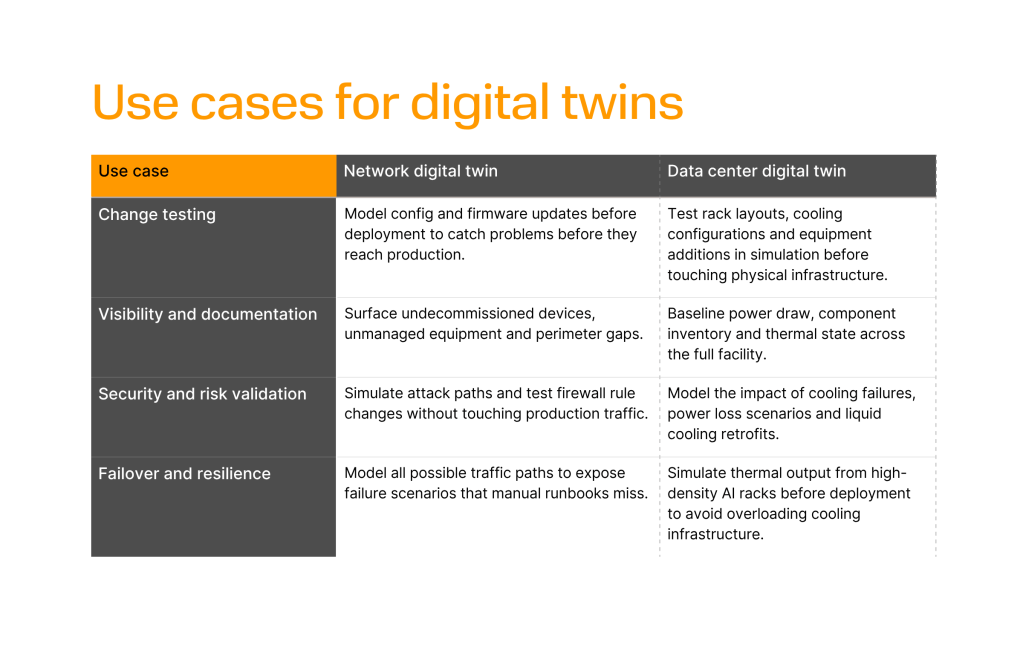
Table showing use cases for digital twins

Foundry

On the network side, Gartner estimates that organizations modeling configuration and firmware updates through a digital twin can reduce unplanned outages by 70%.

A Network World report on enterprise digital twin deployments found that one Asperitas Consulting client running failover simulations uncovered failure scenarios that had never appeared in manual testing. Documentation failures compound the risk. Poor documentation is a near-universal problem in enterprise networks, and a Network World report on Fiserv’s deployment of Forward Networks’ platform found devices that were never properly decommissioned, along with circuits that should have been retired years earlier. Without that visibility, unknown devices go unpatched and perimeter risk from untracked CVEs goes unmanaged.

How AI layers onto both types of twin

AI is being applied to digital twins in two distinct ways: as a querying and reasoning layer that makes the model easier to work with, and as an autonomous agent that acts on the model.

Querying and natural language interfaces. On the network side, engineers can now query a digital twin in plain English rather than writing structured queries against the underlying data model. The twin answers questions about network state, policy conflicts and the predicted impact of a planned change. The reason this works reliably is the twin itself: because the model is mathematically verified against the live network, AI outputs are grounded in accurate data rather than probabilistic inference. Without a verified twin as a foundation, language model outputs in network operations carry significant misconfiguration risk.

On the data center side, AI-accelerated simulation tools can compress hours-long CFD calculations into seconds, enabling engineers to run what-if scenarios during planning rather than waiting for overnight simulation jobs.

Agentic operations. The more significant shift is AI systems that plan and execute multi-step workflows autonomously. On the network side, this means agents that can take a trouble ticket, gather relevant context from the digital twin, run diagnostic path traces and return a root cause assessment, without a human driving each step.

What’s next for networking and data center digital twins

Uptime Institute’s 2026 data center predictions report identified reinforcement learning and hybrid digital twins for cooling and power optimization as the near-term operational focus for the industry, with the stated goal being reduced manual effort and improved consistency rather than full autonomy.

The same trajectory applies to network operations: routine troubleshooting, change validation and compliance checks are increasingly handled with less human intervention, with the digital twin providing the verified data foundation that makes autonomous action reliable.

Deployment of both network and data center digital twins is still concentrated in large, complex environments: organizations with enough infrastructure sprawl, configuration risk, or AI-driven rack density to justify the investment. That profile is expanding. Hybrid cloud architectures are pushing network complexity beyond what manual oversight can manage. AI workloads are pushing data center power density beyond what traditional facility planning handles.

Digital twins are no longer a large-enterprise edge case. They are becoming a baseline planning tool for networks and data centers of all sizes.

SUBSCRIBE TO OUR NEWSLETTER

From our editors straight to your inbox

Get started by entering your email address below.

Contributing Writer

Sean Michael Kerner is an IT consultant, technology enthusiast and tinkerer, and has been known to spend his spare time immersed in the study of the Klingon language and satellite pictures of Area 51. He has pulled Token Ring, configured NetWare and has been known to compile his own Linux kernel. He consults to industry and media organizations on technology issues.

Sean's writing has appeared in VentureBeat, InternetNews, TechTarget, ITPro Today, Data Center Knowledge, and TechCrunch, among other outlets.

More from this author