






On March 27, 2026, Zhipu AI quietly pushed an update to their open-weight model line. GLM-5.1, they claim, now performs at 94.6% of Claude Opus 4.6 on coding benchmarks. That's a 28% improvement over GLM-5, which was released just six weeks prior.
The open-source story is not slowing down. It's accelerating.
And yet, most of the teams celebrating these headlines can't run the models they're celebrating. Self-hosting GLM-5 requires roughly 1,490GB of memory.
The gap between open and proprietary AI has closed on benchmarks, but "open" and "accessible" aren't the same word. Treating them as synonyms is the most expensive mistake a team can make these days.
What follows is a look at the benchmarks that matter, the infrastructure reality the press releases leave out, and a decision framework for teams that need to ship something.
The two models at the center of this comparison are GPT-5.4, OpenAI's most capable, frontier model for professional work, released on March 5, 2026, and GLM-5, the 744-billion-parameter open-weight model from China's Zhipu AI, released on February 11.
GPT-5.4 represents the current ceiling of proprietary AI: a model that unifies coding and reasoning into a single system with a one-million token context window, native computer use, and the full weight of OpenAI's platform behind it.
GLM-5 represents something different: the first open-weight model to crack the Intelligence Index score of 50, trained entirely on domestic Chinese hardware, available for free under an MIT license.
The question now shifts from which model scores higher on a given leaderboard to what the gap between them means for teams making real infrastructure decisions.
What We'll Cover:
What GLM-5 Achieved
GLM-5 is a 744-billion-parameter model with 40 billion active parameters per forward pass. It uses a sparse MoE architecture and was trained on 28.5 trillion tokens.
The model was released February 11, 2026, by Zhipu AI, a Tsinghua University spin-off that IPO'd in Hong Kong and raised $558 million in its last funding round. The license is MIT, which means it's commercially usable without restrictions.
The Artificial Analysis Intelligence Index v4.0 is an independent benchmark that aggregates 10 evaluations spanning agentic tasks, coding, scientific reasoning, and general knowledge.
Unlike single-task benchmarks, it's designed to measure a model's overall capability across the kinds of work people actually pay AI to do. Scores are normalized so that even the best frontier models sit around 50 to 57, preserving meaningful separation between them.
GLM-5 scores 50 on this index, the first time any open-weight model has cracked that threshold. GLM-4.7 scored 42. The eight-point jump came from improvements in agentic performance and a 56-percentage-point reduction in the hallucination rate.
On Arena (formerly LMArena), the human-preference benchmark initiated by UC Berkeley, GLM-5 ranked number one among open models in both Text Arena and Code Arena at launch, putting it on par with Claude Opus 4.5 and Gemini 3 Pro overall. That's a human preference, not an automated benchmark.
SWE-bench Verified: 77.8%, the number one open-source score. The only models scoring higher are Claude Opus 4.6 (80.8%) and GPT-5.2 (80.0%). On Humanity's Last Exam with tools enabled, GLM-5 scores 50.4, beating GPT-5.2's 45.5.
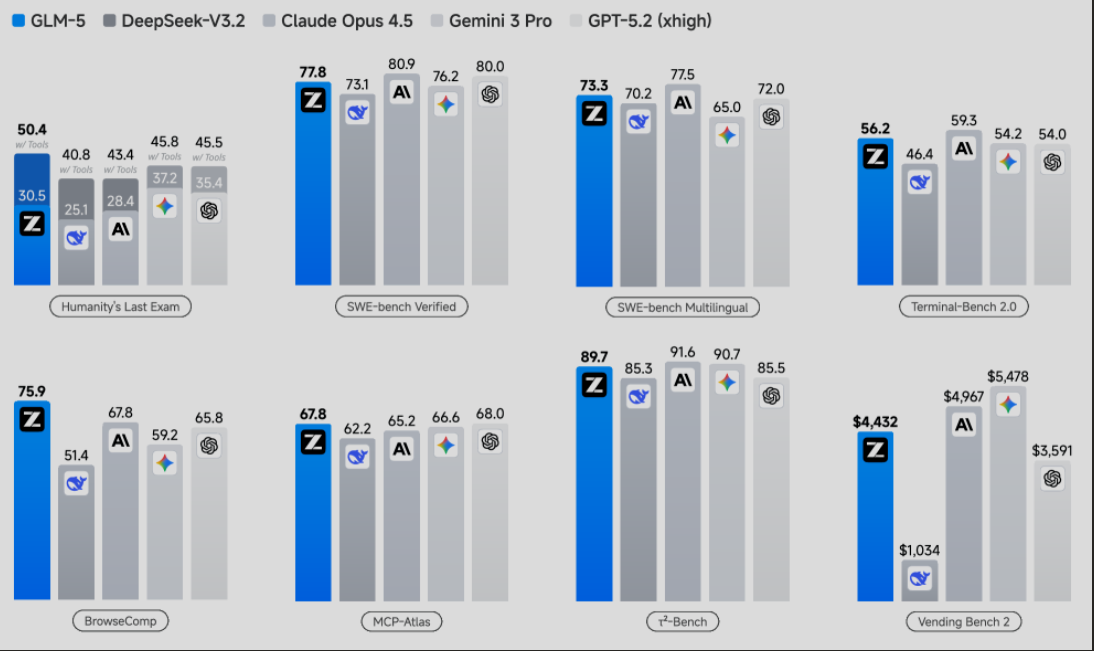
So GLM-5 is genuinely competitive. But competitive at what, exactly? The Intelligence Index gap tells part of the story. The rest lives in specific benchmarks where GPT-5.4 still pulls ahead.
Where GPT-5.4 Still Has the Edge
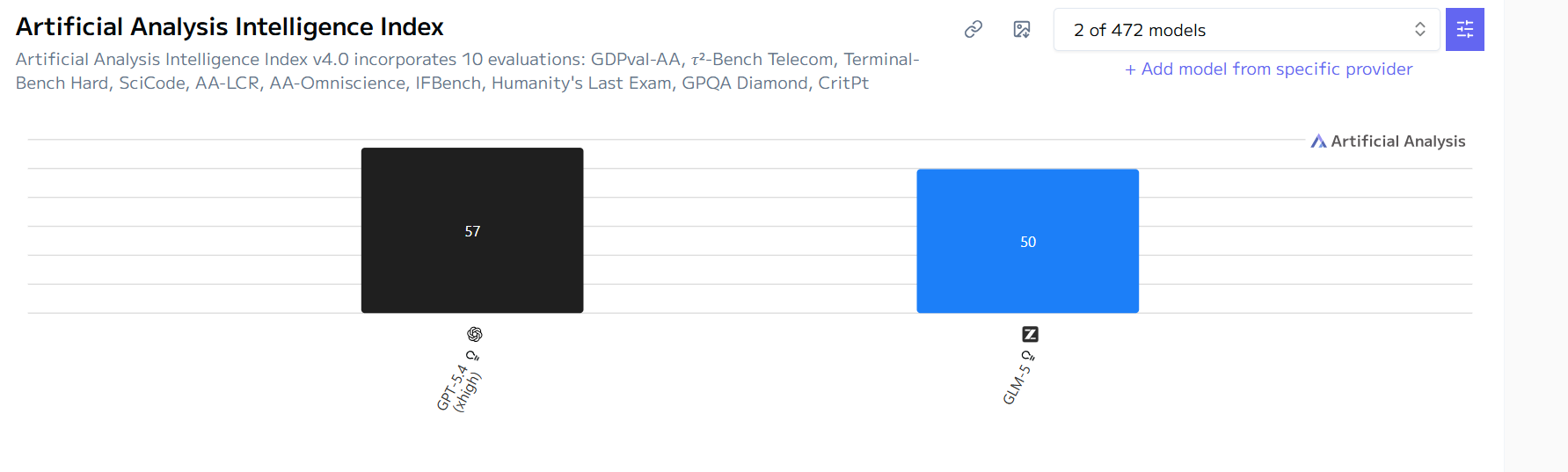
The gap is not imaginary. On the Artificial Analysis Intelligence Index, GPT-5.4 scores 57 to GLM-5's 50, tied with Gemini 3.1 Pro Preview for number one out of 427 models.
Terminal-Bench is where the gap is most evident. It measures how well a model performs real-world terminal tasks in actual shell environments: file editing, Git operations, build systems, CI/CD pipelines, and system debugging.
Unlike benchmarks that test whether a model can write code in isolation, Terminal-Bench evaluates whether it can operate a computer the way a developer does.
According to OpenAI's API documentation, GPT-5.4 scores 75.1%, a 9.7-point lead over the next proprietary model. If your team does DevOps, infrastructure-as-code, or CI/CD debugging, this benchmark maps directly to your actual job.
Context window is another differentiator. GPT-5.4 handles 1.05 million tokens, while GLM-5 caps at 200,000. For agentic workflows that need to plan across large codebases or synthesize multi-document research, this is not a spec difference but a capability difference.
Native computer use is another advantage. This means the model can interact directly with desktop software through screenshots, mouse commands, and keyboard inputs, without requiring a separate plugin or wrapper.
GPT-5.4 is the first general-purpose OpenAI model with this capability built in, while GLM-5 is text-only with no image input. If you're building agents that interact with UIs or need multimodal reasoning, you can't use GLM-5 for that.
OpenAI also claims a 47% token reduction in tool-heavy workflows through something called tool search, a real efficiency gain if you are paying per token.
On pricing, GPT-5.4 at \(2.50 per million input and \)15.00 per million output is 4.2 times more expensive than GLM-5's API. But long-context pricing doubles above 272,000 tokens to $5.00 per million inputs, a tax you'll feel if you run large-context agents.
There's a deeper issue the benchmark numbers don't capture, and it's most likely to trip up teams who rush to adopt open source.
"Open" Does Not Mean "Accessible"
The MIT license is real, and the weights are downloadable, but running GLM-5 in native BF16 precision requires roughly 1,490GB of memory. The recommended production setup for the FP8 model is eight H200 GPUs, each with 141GB of memory. That's a GPU cluster, not something you spin up on a single workstation.
In dollar terms, a used or leased H100 runs \(15,000 to \)25,000. Eight H200S is not a startup purchase. The infrastructure cost of self-hosting GLM-5 rivals or exceeds that of just calling the OpenAI API for most real-world usage volumes.
There is a quantization path. Quantization is a technique that reduces a model's memory footprint by representing its weights at lower numerical precision – for example, compressing from 16-bit to 2-bit values. It makes large models runnable on smaller hardware, but at the cost of some accuracy.
Unsloth's 2-bit GGUF reduces memory usage to 241GB, which fits within a Mac's 256GB unified memory. But quantization degrades model quality. That 77.8% SWE-bench score is for the full-precision model, and the number you get from a quantized local deployment will be lower.
The honest alternative is to use a hosted GLM-5 API. DeepInfra charges \(0.80 per million input tokens, and Novita charges \)1.00 per million input tokens. You can get the model without the hardware, but then you're not self-hosting. You're just using a cheaper API, and the data sovereignty, privacy, and vendor lock-in arguments all evaporate.
"Open weight" in 2026 increasingly means open to enterprises with GPU clusters, open to researchers with cloud credits, and open to teams willing to accept quality trade-offs from quantization. It doesn't mean open to the median developer who wants to avoid their API bill.
The paradox is real: open weights, but not open access. That doesn't mean the choice is impossible. It just means the choice has to be honest.
The Right Question Is Not Which Model Wins
| GLM-5 via API | GPT-5.4 | Self-hosted GLM-5 | |
|---|---|---|---|
| Best for | Cost-sensitive, under 200K context | Terminal, computer use, long context | Regulated environments with existing GPU infra |
| Pricing | $0.80 per million input (DeepInfra) | $2.50 per million input | Hardware cost only |
| Context window | 200K tokens | 1.05M tokens | 200K tokens |
| Image input | No | Yes | No |
| Data sovereignty | No | No | Yes |
| Self-hosting required | No | No | Yes |
The right model depends entirely on what your team is trying to optimize.
Use GLM-5 via API when cost efficiency is the primary constraint, when data residency isn't a concern for Chinese-origin models, when your workflow doesn't require multimodal or image input, and when context demands stay under 200,000 tokens.
It's also the right choice if you want to experiment with open-weight research or contribute back to it. The GLM-5 API is cheap, and if tokens per dollar is your dominant variable, it's hard to beat.
Use GPT-5.4 when your workflow is terminal-heavy or involves computer use, when long-context coherence above 200,000 tokens matters, when you need multimodal input, or when your team is already embedded in the OpenAI ecosystem.
If response consistency at scale is non-negotiable, the premium you pay is real, but for some workloads, the consistency and capabilities justify it.
Consider self-hosting GLM-5 only when your organization already has GPU cluster infrastructure or the budget to build one, when data sovereignty concerns are documented and specific rather than hypothetical, and when you have the ML infrastructure capabilities to manage deployment, updates, and monitoring. Self-hosting a 744-billion parameter model is not a weekend project.
The break-even math is worth doing. At roughly \(0.80 per million tokens via DeepInfra, a team would need to process over one billion tokens per month before self-hosting on \)15,000 H100 hardware begins to pay off. Most teams don't hit that volume, and the ones that do probably already have the infrastructure.
With this decision framework in place, the question shifts to a larger one. What does this moment mean for how teams should think about open source and proprietary AI?
What This Moment Means
The benchmark gap has closed. It's real, significant, and historic. The MMLU gap between open and proprietary models was 17.5 points in late 2023 and is now effectively zero. GLM-5, scoring 50 on the Intelligence Index, the first open-weight model to do so, is a genuine milestone.
But the way the gap closed matters as much as the fact that it closed. It closed through architectural ingenuity like DSA sparse attention, MoE efficiency, and asynchronous reinforcement learning, not through democratized compute.
The models that have closed the gap are still large, still expensive to deploy at full fidelity, and still dominated by Chinese labs with significant institutional backing.
The proprietary moat is no longer because they have better models. It's now a better platform, a better ecosystem, a better context window, better enterprise support, and a deployment path that doesn't require a GPU cluster. It's a narrower moat, but it's still a moat.
The question for 2026 is not whether to choose open source or proprietary. It's what you're getting for the premium you pay, and whether that's worth it for your specific workflow. For some teams, the answer will flip. For many, it won't yet.
Most teams reading this won't do the math. They'll see "open source" and assume it means cheaper. They will see "GLM-5 matches GPT-5.4 on benchmarks" and assume they can swap one for the other with no trade-offs.
Those assumptions are how you end up with a $50,000 GPU cluster you don't know how to operate, or a production outage because your quantized model can't handle long context.
The gap between what a benchmark says and what a model does in your actual environment is where engineering judgment lives. If you outsource that judgment to headlines, you're not saving money. You're just deferring the cost until it shows up as an incident.
Learn to code for free. freeCodeCamp's open source curriculum has helped more than 40,000 people get jobs as developers. Get started