





I needed a break today from writing about Iran, Trump, and/or basketball, so let’s talk about another of my favorite topics: social media.
However, I will be conducting a Substack Live with Galen Druke at 12 noon tomorrow (Monday), where we’ll discuss what increasingly looks like both a foreign policy and a political crisis for the White House. You can join us on the Substack App in real time, or I’ll send the video out to subscribers later.
I’m also taking questions for SBSQ #31, which I’m hoping to get to sooner rather than later.
FiveThirtyEight (re)launched under Disney/ESPN in March 2014. In retrospect, our timing wasn’t great. Despite various missteps, we were trying to deliver a differentiated, engaging, high-quality product. But this was probably the single period since the web rose to prominence when the quality signal was least well-rewarded.1
Publishers believed that maximizing “reach”, particularly as measured by the number of monthly unique visitors, was the key to success. It didn’t matter how long someone stayed as long as they visited your site, for any length of time, at least once during the month. And no platform provided more opportunities to trawl the ocean depths for potential customers than Facebook, which was then close to the peak of its influence. Entire businesses like Upworthy were premised on gaming the News Feed algorithm, often through peculiar clickbait headlines such as “You Won’t Believe What Happened Next”.
You will believe what happened next: it didn’t work. The whole period was like the Underwear Gnomes meme come to life. Phase 1: Collect lots of low-quality traffic from Facebook. Phase 2: ???. Phase 3: Pivot to video.
It didn’t help that Facebook was constantly tinkering with News Feed, and grossly exaggerating metrics like average time spent watching videos. But more fundamentally, it was locked into a zero-sum, adversarial relationship with publishers. Facebook wanted readers to stay within its walled garden, to spend as much time as possible on Facebook. Publishers, meanwhile, regarded Facebook as the equivalent of the Port Authority Bus Terminal: a miserable, liminal space where you’d hopefully spend as little time as possible before booking a one-way ticket out of town.
FiveThirtyEight eventually matured to the point where it got quite a bit of web traffic — our 2016 election forecast was literally the most “engaged-with” piece of content on the English-language Internet that year as tracked by Chartbeat.2 But we never got much traffic from Facebook. One of the major reasons for this, I later learned from talking with media friends who were much more successful at this stuff, was that Facebook tended to reward emotional sentiment in headlines: surprise and delight on the one hand, or outrage on the other hand. And that was pretty much exactly the opposite of our editorial goals at FiveThirtyEight. Instead, we wanted to encourage cool, analytical, nuanced reactions to things that people are ordinarily quite passionate about, such as electoral politics.
But every now and then, a FiveThirtyEight article would “go viral” on News Feed. When this happened, it seemed literally almost completely random. It wasn’t even particularly well-correlated with the headline. And it was inversely correlated with the depth and quality of the article. But here’s the thing: that “viral” traffic was almost worthless. A lot of it quite literally consisted of people who visited the site for 5 to 30 seconds, read a paragraph or two, and never returned.
Twitter, then also near the peak of its influence, was a comparatively better platform for us, often producing more overall engagement for FiveThirtyEight, even though Twitter was always much smaller. Back in the mid-2010s, Twitter rewarded newsworthiness, subject-matter expertise, and a certain kind of nerdy and snarky but relatively cerebral argumentativeness, all things we were pretty good at. Furthermore, the pre-Elon versions of Twitter were always surprisingly happy to let you direct traffic off of their platform.
By the late 2010s, Twitter would “evolve” in a direction that was more partisan, less pluralistic, and dominated by quote-tweets and dunks. For lack of a better term, it also became much more woke. The enforcement of groupthink was rigid, not unlike what Bluesky has become today. There was always a “main character,” someone who was the subject of the pile-on or the struggle session of the day. Your goal was supposedly never to become the main character. I spectacularly failed at this. Without exaggeration, I was probably a “trending topic” on Twitter (also something you never wanted to be) more often than all but a half-dozen or so other writers and journalists.
So, between my bad experiences with mid-2010s Facebook and late-2010s Twitter, I am elated in some ways that social media has become less and less relevant to media business strategy. For Silver Bulletin, social media is a rounding error. According to Substack’s internal dashboard, the share of Silver Bulletin traffic attributable to external social channels has consistently fallen to the point where it was just 0.7 percent of overall site views in March. And yet, the aggregate number of views of Silver Bulletin content increased by 40 percent from the first three months of 2025 to the first three months of 2026.3
Before you make too much of that data, or ask why we even bother to post to Twitter at all (in fact, we’ve started a Silver Bulletin X account just for shits and giggles) note that there are a number of caveats. Social media traffic is hard to measure. There’s direct traffic in the form of “dark social” where the source of origin is lost. There’s also indirect traffic in the form of the overall amount of buzz you might attribute to an article. Furthermore, that Substack data ironically isn’t counting traffic from Substack-specific social media channels. Substack increasingly considers itself a social media company (among other things), and we have quite a lot of readers who follow one or more Silver Bulletin-related accounts on Substack Notes but who opt out of email delivery of our newsletters. What’s more, the traffic you do get from Twitter and other social media channels tends to convert to subscriptions at relatively high rates. So we do very much appreciate it when you share Silver Bulletin articles. I should probably get more in the habit of including share buttons in articles like this one:
Nonetheless, I feel confident in asserting that social media is a secondary source of business for us and is trending toward being a tertiary one — and that this is probably also true for most other publishers. That’s very different from a decade ago, when Facebook was considered the Golden Goose.
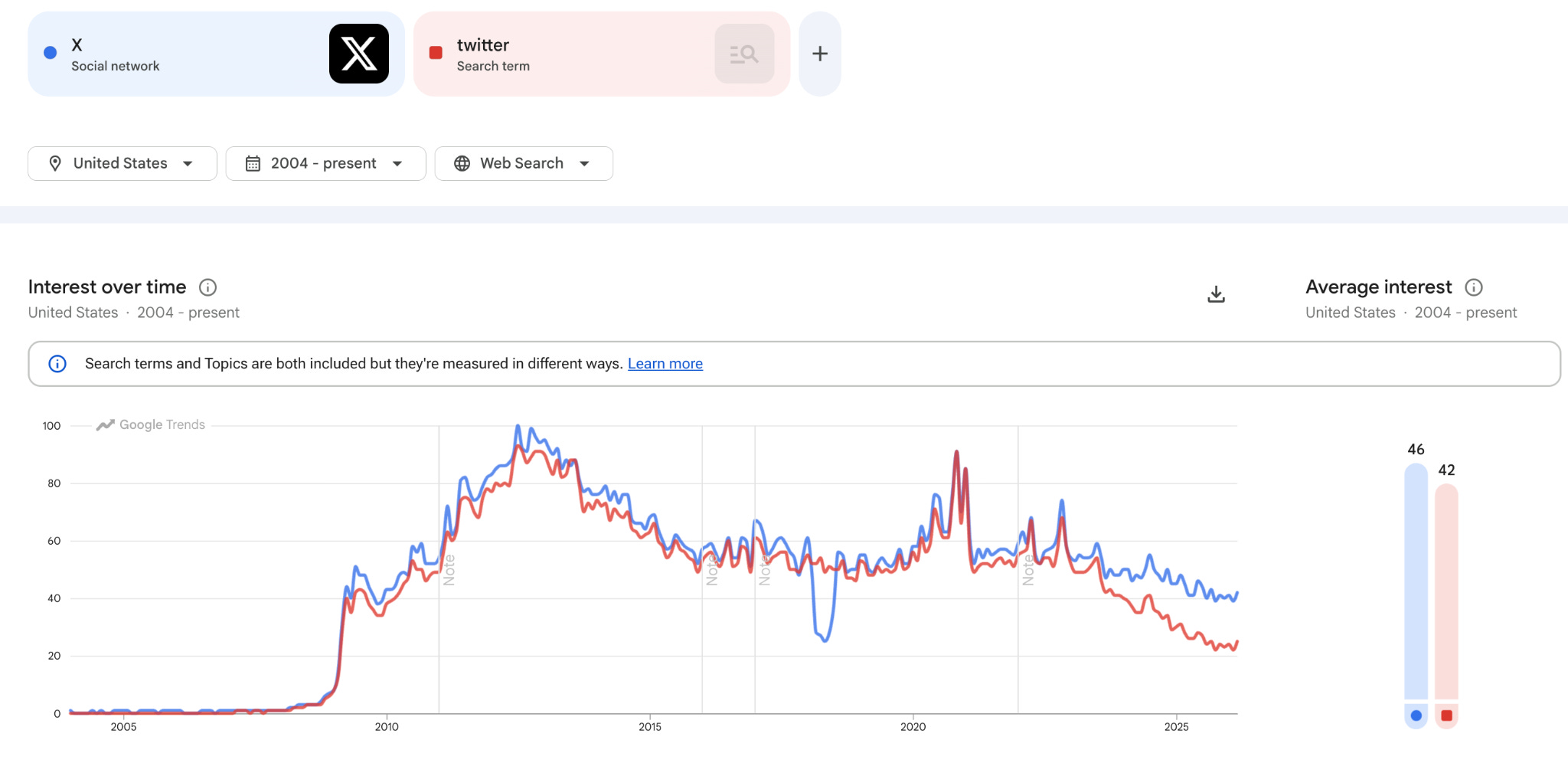
And yet, while Facebook is now almost completely irrelevant to the political discourse, that isn’t quite true for Twitter. Google search traffic in the U.S. for the precise term “twitter” is down quite a lot, but that’s not fair to X because the platform now has a new name. Broader traffic for search topics related to Twitter/X is also down, by more than half relative to the peak in late 2012. But the recent decline has been more gradual: about 20 percent as compared to two years ago. That seems to track with other third-party data showing a slow-but-steady decline in Twitter engagement, though nobody can be quite sure since X is no longer a public company.
But what does that remaining traffic consist of? I recently came across a bubble chart depicting the Twitter accounts that had received the most “engagement” in February 2026. It was depressing: most of the top accounts were extremely low-quality and highly partisan. I hadn’t even heard of many of them and only follow a handful of the top accounts. So I tracked down the original data myself and, with help from Claude, made my own improved version of the chart. Here, voilà, are the Twitter accounts with the most engagement so far in 2026:
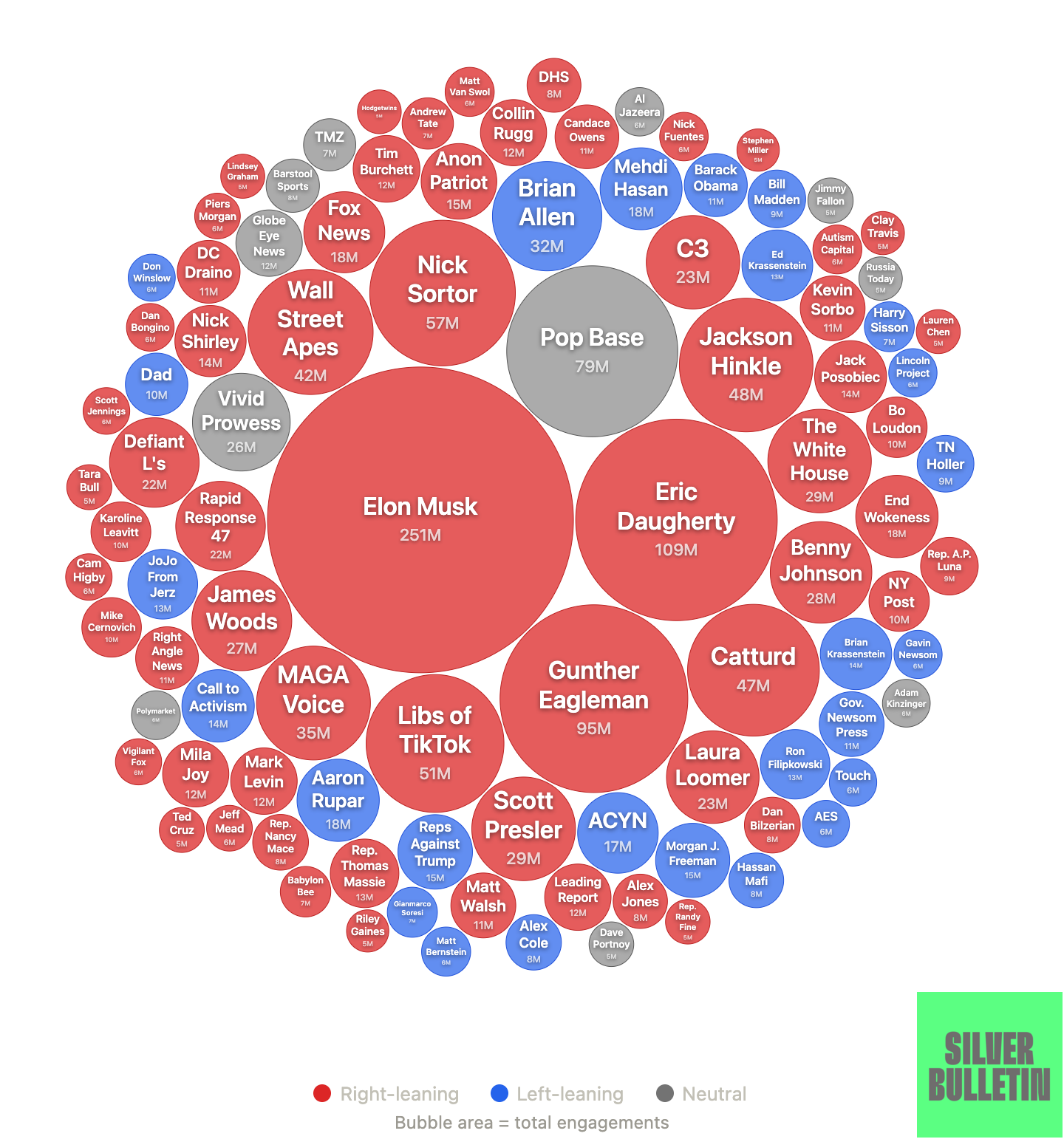
It’s not hard to notice that Twitter has become extremely right-leaning. But I’d argue there’s an equally important trend: the top accounts are of incredibly low quality. Elon, with the algorithmic boost he built in for himself, is at the eye of the storm, of course. But “Catturd” literally gets far more engagement than the New York Times, for instance. There are a lot of tweets like this one, from former hunky actor turned minor conservative media star Kevin Sorbo, which is approaching a million views:
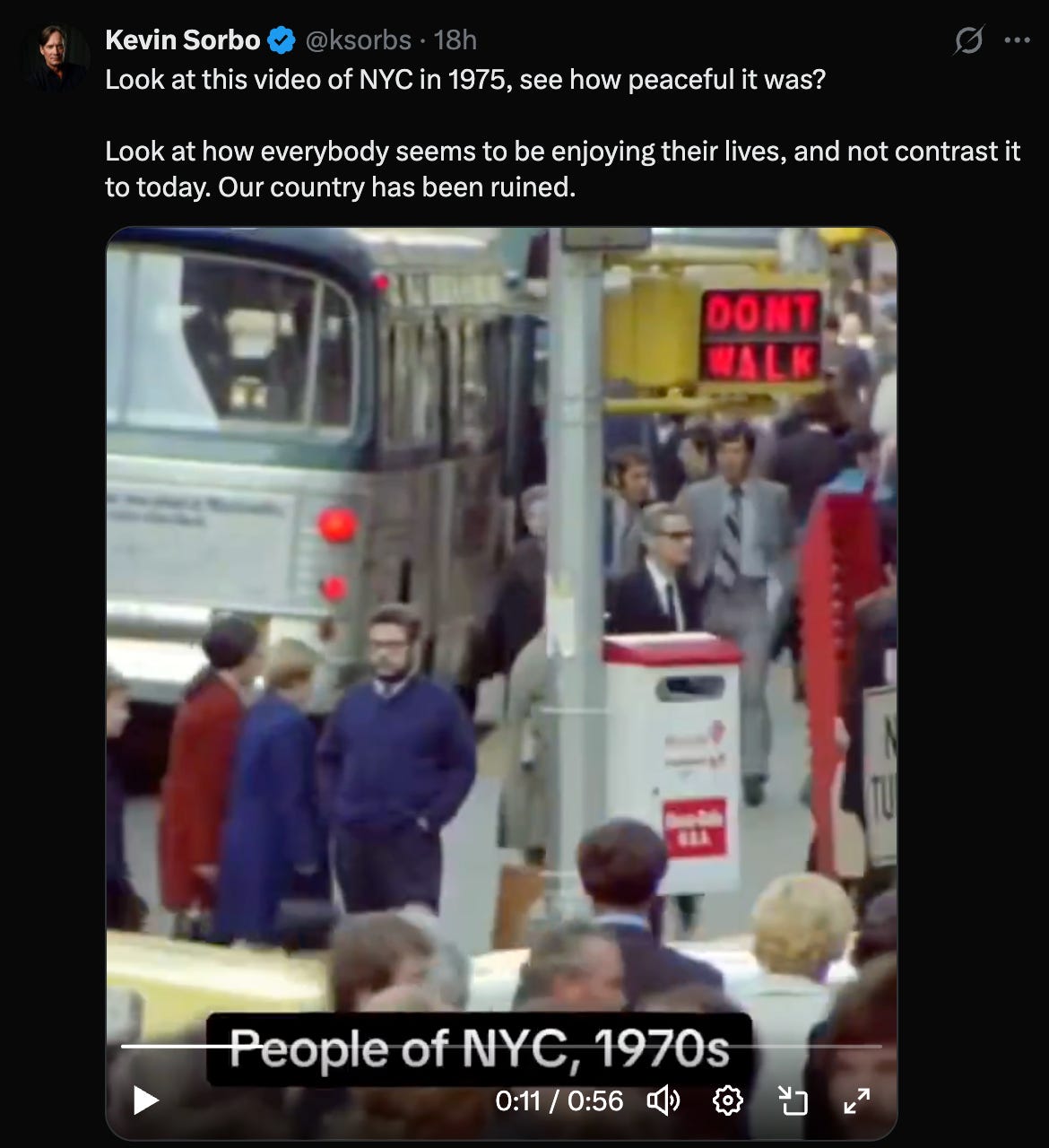
I’m admittedly a fierce defender of New York City, where I’ve lived since 2009. But anybody who knows the least thing about New York knows that 1975 was one of the lowest points in the city’s history, literally the year of “FORD TO CITY: DROP DEAD” because the city was on the brink of bankruptcy. This was the era of Taxi Driver, the Son of Sam and The Bronx is Burning, the beginning of a long period of elevated crime rates. Setting some B-roll to nostalgic music doesn’t erase that.
Without really wanting to comment on individual accounts — there are some exceptions — the liberal-leaning accounts that remain prominent on Twitter aren’t much better. They’re partisan and combative, sometimes peddling misinformation. They’re almost like a dark-mirror-world, Waluigi version of the conservative “influencers”, crafted in Elon’s jaded image of what liberals are like. It’s no coincidence that one of the most successful ones is the Gavin Newsom Press Office account, which literally mimics President Trump’s style in a sometimes funny, sometimes cringeworthy way.
Having lived through several eras of social media and web publishing business models, I tend to think of them as ecological systems. There are founder effects, predators and prey, and a lot of different survival strategies, often including mimicry. Most of all, there are selection effects. Some “species” are particularly fit for the peculiarities of the ecosystem and the economic incentives it produces, and within six months to a year, they tend to crowd out all others.
During the Peak Facebook Era, there was sometimes an air of faux scientific precision about the efforts to manipulate News Feed. I have no doubt that some of the people engaged in Moneyball-like algorithmic optimization tactics during this period were smart about it. But it’s important to emphasize that these ecosystems often reflect the “rules of the game” and the quirks of the algorithm rather than deeper truths about human nature or what people really want to read. The hack-ish strategies are often highly fragile and don’t survive changes in the environment. Few of the businesses that were considered hot shit during the mid-2010s are thriving today.
Certainly, I’m subject to my own biases: in thinking, for instance, that early/mid-2010s Twitter or today’s Substack are comparatively healthy ecosystems because they happen to work well for my business model. I certainly don’t think Substack is above critique, for instance. It also produces its share of mimicry. There were probably too many anti-woke newsletters during the early 2020s. But today, the Substack politics leaderboard is dominated by Resistance Lib publications of varying quality. To be fair, we still have roughly two years and nine months to go in Trump’s second term, which is an eternity in the media business. And what thrives on Substack often reflects a correction from oversights by executives in the mainstream media, who often chase away their best customers in an effort to fight the last war or to pursue their own political or ideological objectives.
Nonetheless, today’s social media ecosystem is particularly unhealthy, I’d argue. I’ve written about Bluesky previously, and I’m not sure there’s much more to say about it: it’s small, it’s continuing to get smaller, and last month its CEO announced she was stepping down. But at least when you look at the leaderboard of top Bluesky accounts, it’s fairly predictable: mostly reasonably prominent left-progressives, though almost nobody who is going to challenge Democratic Party orthodoxy from either the center or the left. The problems with Bluesky are less about the individuals who find success on the platform and more about the high school cafeteria behavior that follows when you put them all in a small, confined space together.
X, despite its much larger overall reach, also feels increasingly siloed. There are rarely consensus “main characters” anymore, and although I still do get dunked on more than your average bear, I usually discover this only when it’s force-fed to me by the “For You” tab; there’s often no sign of the pile-on from the 1,736 accounts that I follow. On the flip side, even when a tweet seems to generate a lot of favorable buzz on Twitter — increasingly rare — it’s at best a weak signal for predicting the metrics we really care about, namely engagement on Silver Bulletin itself and especially new subscriptions.4
And “siloed” is on a good day: at other times, Twitter feels like a ghost town. It’s still useful for some topics: the AI discourse on the platform is often relatively robust, for instance. But for something like the war in Iran, it’s next to useless. Links to external websites are substantially punished, and none of the workarounds are particularly helpful. So the tangible rewards from still having 3 million followers can be surprisingly marginal. However, my account is hardly alone in this regard. The New York Times has 53 million followers, and yet its tweets often produce only a few hundred likes, retweets, and replies even when they reveal urgent, breaking news.5
As with Facebook before it, the suppression of external links and the desire to maximize engaged minutes on X and turn it into an “everything app” is short-sighted. X is neither a particularly pleasant place to be, nor a prestigious one. To his credit, Elon now does offer some degree of monetization to verified accounts, although in my experience (my account was grandfathered into the program by virtue of having more than 1 million followers), it’s relatively modest, perhaps paying for a dinner out every other month.
If you’re capable of building up a truly valuable audience, however, there are much better ways to monetize it — including Substack, where you keep about 86 percent6 of all gross revenues and maintain control of your email list and your voice. Without the ability to consistently drive traffic outside the platform, the people who select into X as their main thing are inherently kind of bush league.
There’s a principle in ecology known as the island effect. I’m sure I’m not getting this precisely right, but that basic idea is that when there’s a lack of competition in an isolated environment, strange things tend to happen. There are all sorts of weird mutations that might not be survivable in a more competitive environment that can actually become fitness advantages on an island. Big animals tend to get smaller, and small animals tend to get bigger — like the Komodo dragon, whose range is limited to a few isolated islands in Indonesia.
So this is what Twitter looks like, basically, only with Catturd and the Gavin Newsom Press Office accounts locked in combat instead of a couple of (cute?) lizards:

Thank you for reading Silver Bulletin, which is also an island unto itself — but on its best days, we hope, an island of sanity. Back to Trump and Iran tomorrow.
此内容由惯性聚合(RSS阅读器)自动聚合整理,仅供阅读参考。 原文来自 — 版权归原作者所有。