







Some quick thoughts on the hardware prices Apple increased — and didn’t increase — today. Here’s a table with most of the base models whose prices increased:
| Original | New | Change | |
|---|---|---|---|
| Vision Pro | $3500 | $3700 | 6% |
| HomePod | $300 | $350 | 17% |
| HomePod Mini | $100 | $130 | 30% |
| Apple TV 64 GB | $130 | $200 | 54% |
| Apple TV 128 GB | $150 | $250 | 67% |
| iPad | $350 | $450 | 29% |
| iPad Mini | $500 | $600 | 20% |
| iPad Air | $600 | $750 | 25% |
| iPad Pro | $1000 | $1200 | 20% |
| MacBook Neo | $600 | $700 | 17% |
| MacBook Air | $1100 | $1300 | 18% |
| MacBook Pro | $1700 | $2000 | 18% |
| iMac | $1300 | $1500 | 15% |
| Mac Mini | $600 | $800 | 33% |
| Mac Studio M4 Max | $2000 | $2500 | 25% |
| Mac Studio M3 Ultra | $4000 | $5300 | 33% |
Apple TV 4K was hit particularly hard on a percentage basis, with the 64 GB base model going up 54% and the 128 GB model (which also includes a Thread radio and Ethernet) rising 67%. These increases especially hurt for a product that was already perceived — fairly or unfairly — as being too expensive compared to its competition. A Roku Ultra costs $100 and Roku Streaming Sticks start at $30, as do Amazon’s Fire TV Sticks. A replacement Siri Remote for Apple TV alone costs $60. It’s clearly the SSD storage in the Apple TV 4K that prompted this, but because people use them to “stream”, consumers don’t even think of Apple TV as having “storage”.
Poor Vision Pro’s meager 6% price increase feels more like a pep talk than a meaningful change. A signifier that Apple has not forgotten it exists. “Don’t worry, buddy, you’re getting a price increase too, just like everyone else. We’ll bump you up ... I don’t know ... how about $200? There you go. Here’s a pat on the head too. Keep your chin up, kid.”
iPad prices mostly went up 20–25%, but the hardest hit was the no-adjective base model, which rose almost 30%, from $350 to $450. That’s a big increase for a product meant to appeal to buyers for whom price is obviously their biggest concern.
MacBook and iMac prices went up 15–20%, but Mac Minis and Mac Studios went up by almost twice as much on a percentage basis.
Apple did not raise prices on three of its most popular product lines: iPhone, Apple Watch, and AirPods. With iPhone and Apple Watch, I guess they think they can hold the line until September, when new models will be announced. But the rumor mill strongly suggests that the only new iPhones coming in September are the iPhone 18 Pro and the new foldable “Ultra”.1 I can’t help but wonder if, alongside the introduction of new iPhones, that the existing ones slated to be updated in early 2027 (iPhone Air, iPhone 17, iPhone 17e) will go up in price. In normal years, those of us in the know generally discourage friends and family from buying new iPhones or Appple Watches in the summer, encouraging them to wait until September. This year, it might make sense to encourage people to buy now, if they’re price conscious. Based on these other products, surely iPhones and Apple Watches will soon rise in price 15–25 percent. Whether “soon” means “next week” or “September”, I don’t know. But as this moment, iPhones and Apple Watches are selling for bargain prices relative to iPads and Macs, and the iPhone 18 Pro is going to cost a lot more than the 17 Pros. Plus, orange?
Perhaps it’s unsurprising that AirPods did not go up in price. They don’t use SSD storage and they don’t use RAM like other products do.
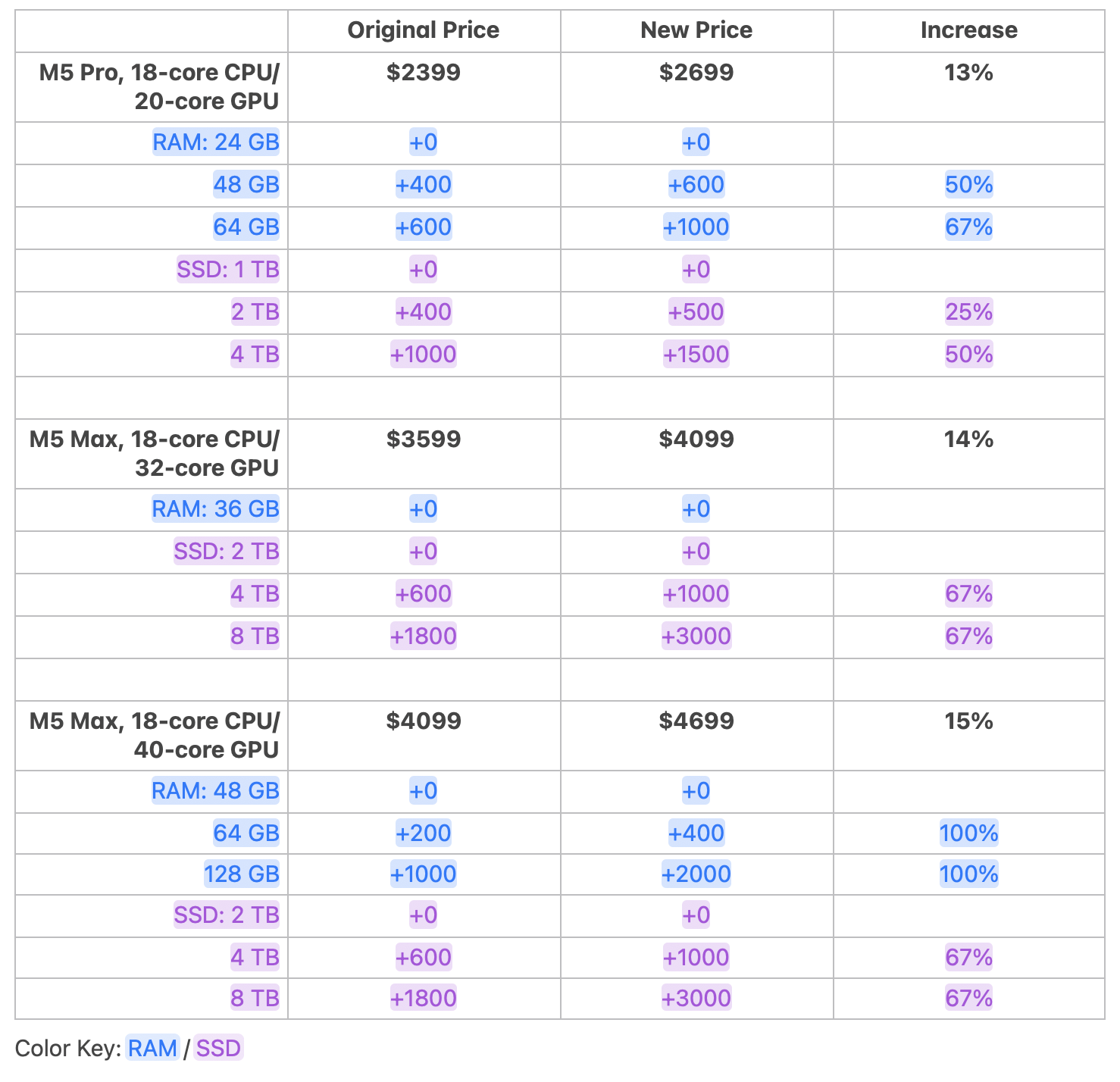
Because these price increases were driven entirely by RAM and SSD component pricing, the hardest-hit products are the professional tier models, with the most RAM and largest SSDs. Here’s a table I put together in Apple Notes, which (forgive me) I’m going to paste as a screenshot.
Notes:
The base model prices for these M5 Pro and M5 Max MacBook Pros only went up 13–15%. But RAM and SSD upgrades increased, in most configurations, by a whopping 50–67%. The 64 and 128 GB RAM upgrades for the M5 Max doubled in price.
Example configurations:
Add $300 to those prices if you prefer 16-inch — which brings the maxed-out configuration to $10,150, and still hits an even $10K if you omit the nano-texture option.
That second one is the configuration I personally would want to buy to replace my beloved but aging M1 Max MacBook Pro (64 GB RAM, 4 TB SSD) from 2021. I knew prices would go up if I waited another year, but I hadn’t really considered that they’d go up by 40%. For that $2,800 price increase, one used to be able to purchase 16 spare wheels for the late great Mac Pro.
此内容由惯性聚合(RSS阅读器)自动聚合整理,仅供阅读参考。 原文来自 — 版权归原作者所有。