


 All posts
Summary
- 💰 GiveDirectly is launching an ambitious program delivering unconditional cash to 6,000+ households in climate-vulnerable communities in Uganda
- 🌍 Most climate adaptation finance never reaches the people most affected. We want to understand how unconditional cash can most effectively tackle this issue
- 🔬 The program is built around a learning agenda: a set of questions designed to test how cash transfers can best support climate adaptation
9% of the global population lives in extreme poverty. Climate change alone could double that by 2050. Climate impacts also hit the world’s poorest communities hardest – the people least responsible for the emissions driving them.
In the meantime, climate adaptation finance is shrinking. But the problem isn’t just the size of the pot – it’s where the money goes.
Cash can empower bottom-up climate solutions
Less than a third of climate finance even mentions local communities in project documentation. Just 0.4% describes itself as “locally led.” The people most exposed to climate change – the people who understand their own needs best – are largely invisible in the system designed to help them. Climate finance doesn’t make it into their hands.
This isn’t because unconditional cash transfers don’t work. It’s because the system wasn’t built for them. The Green Climate Fund, the Adaptation Fund, bilateral climate finance – these mechanisms favor government-to-government flows and large, multi-year programs. Accessing them typically requires years of institutional accreditation, detailed project proposals, and reporting frameworks that few community-level organizations can navigate. The result is that most adaptation finance flows through intermediaries, not to the people it’s meant to help.
Unconditional cash transfers challenge that model by putting resources and decision-making power directly in the hands of people who understand their own situation best – enabling bottom-up climate solutions rather than top-down ones. We’ve already seen what happens when we give people cash and trust them to choose. GiveDirectly’s evidence shows they invest in health, education, food, and livelihoods. What if we trusted them to do the same for preparing their houses, assets, and livelihoods for a changing environment?
Cash transfers have been shown to reduce vulnerability to climate-related disasters. They enable people living in poverty to diversify income, save more, and build skills and awareness to prepare for shocks. What we don’t yet have is a robust evidence base for how unconditional cash supports climate adaptation specifically – particularly for slower-onset climate change. We do know that unconditional cash transfers can be impactful for people facing a changing climate, though.
We’re testing how cash can maximize climate adaptation outcomes
GiveDirectly is launching a Cash for Climate Adaptation program targeting over 6,000 households in some of Uganda’s most climate-vulnerable communities. We’re targeting two districts facing different climate shocks:
- 🏜️ Chronic drought stress — Pastoralist and agricultural communities face changing rainfall patterns and prolonged dry spells that are threatening crop yields and livestock.
- 💧 Landslides and flooding — Communities highly dependent on agriculture are exposed to increasingly unpredictable rainfall, with direct threats to food security and livelihoods.
Each household will receive an unconditional cash transfer of $644. The program is structured around a learning agenda – a set of questions designed with our research and product teams to generate evidence that’s useful beyond this program.
Our key questions are:
- 💰 Does unconditional cash alone help people adapt to climate change?
- 📄 Does pairing cash with simple information about local climate risks — and/or planning tools — change how people choose to invest it?
- 💸 Do outcomes differ for different types of climate threat, whether that’s drought or flooding?
- ⏱️ Does the timing of cash delivery matter, relative to planting seasons, harvests, and lean periods?
We don’t assume we know the answers. We have hypotheses from our past climate- and agriculture-focused programs in Uganda, Kenya, and Mozambique. But this program will test them rigorously.
👇 Rosa’s story from Mozambique demonstrates how cash can be a transformative climate adaptation solution
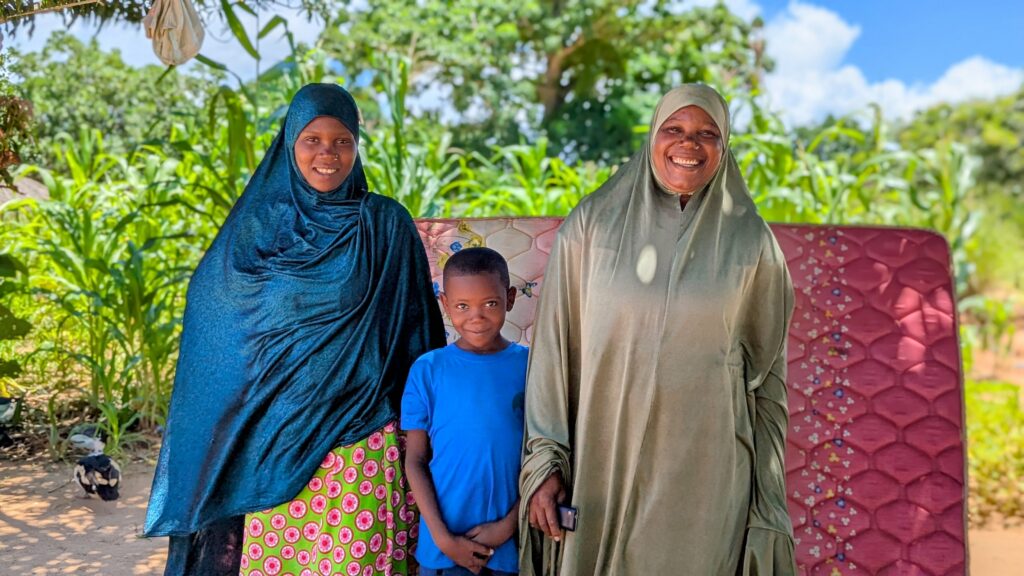
When heavy rains tore the roof off Rosa’s family’s home, repairing it was beyond what they could afford. Rosa used part of her unconditional cash transfer to buy farmland, which now fully belongs to her family, while her husband invested in his fish business, to help build their financial resilience. She used the rest of the transfer to buy cement, iron sheets, and timber, and — with help from two of her sons, who contributed part of their own transfers — built a home that could withstand the storms. “Today our home stands firm even when the rains return,” she says. “These walls represent more than shelter — they represent dignity, security, and the chance for my family to move forward.”
We’re at the early phases of learning – and we welcome discussion on cash for climate adaptation
Our Uganda program will generate learning to inform future GiveDirectly programs and our advocacy in the climate space. A key component is finding the lightest-touch intervention that maximizes climate adaptation outcomes. Simpler interventions cost less to administer, which means more funding reaches people who need it most. And simple designs are easier for governments and other organizations to deliver at scale.
We’ll share what we learn as we learn it. The program is in its early stages, but we’re sharing our learning agenda now because we think the questions themselves are worth discussing – particularly as more funders consider how to deploy climate adaptation finance in ways that actually reach the people who need it.
If you’re working in climate finance, adaptation, or social protection and want to follow the program’s progress, get in touch. We’re also presenting our approach to Cash for Climate Adaptation at London Climate Action Week in June 2026. If you’re working in this space, we’d like to talk — not just to share what we’re learning, but to challenge it, build on it, and help make the case that cash belongs at the center of the climate adaptation response.