





💡
Currently in beta This is a new feature in active development. If you run into issues or have feedback, please share it on the Ghost forum.
Ghost makes it possible to publish content online with a website, and to deliver your content via RSS feeds and email newsletters. Now, we’ve added a brand new way to distribute content, grow your audience, and expand your network — directly from your Ghost website.
The social web is a new technology that allows people across different open social platforms to follow, like, reply and interact with one another in real-time.
You’re probably already using social media platforms like X (formerly Twitter), Facebook, and others to share your content and promote your brand. It’s a strategy that can work well but there's a catch. These platforms (and their user data) are owned by a single company.
This means that anyone wanting to interact with you needs to also have an account on the same platform. As a publisher, you’re also at the mercy of their algorithms. They decide who sees your content and who doesn’t.
And, algorithms change all… the… time.
The social web is different. For a start, it’s open and decentralized which means no one company controls it. Instead, you're able to build a social connection to your fans and peers across platforms — directly from inside Ghost. Your audience is no longer limited only to people who use the same platform as you.
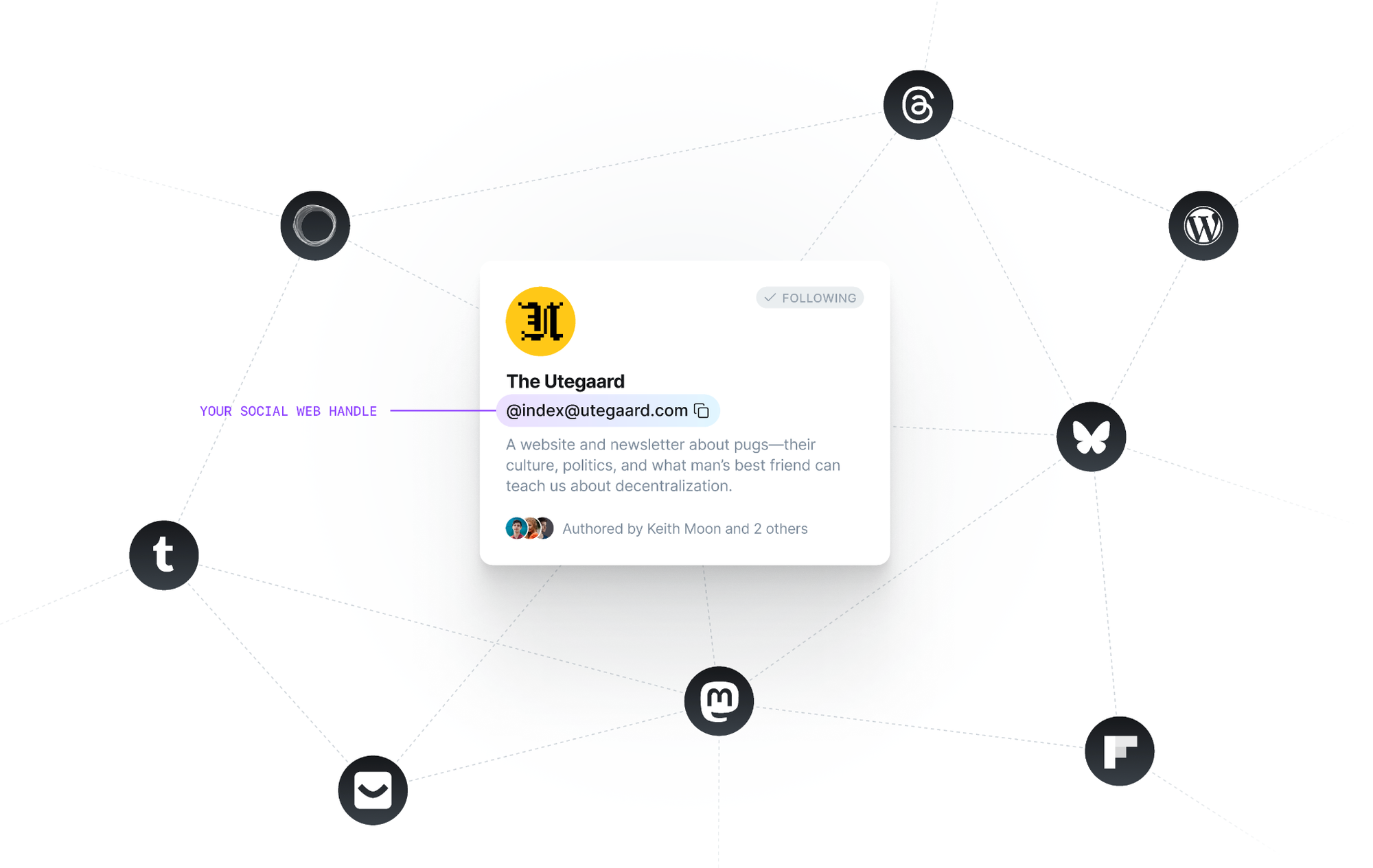
People on @gmail.com can interact with others on @hey.com or @fastmail.fm thanks to a set of shared technology standards known as a ‘protocol’. Because they all use the same protocol, content can be sent, received, and read by different email software. It's truly inter-operable and your contact list is owned by you, not whoever makes the software.
The social web is the same concept, applied to public content rather than private messaging. Your Ghost website now has a public profile on @index@yourdomain.com which people on any social web platform can find, follow, like, reply, repost and interact with.
There are no billionaires in control, no algorithms that demote links to external sites, and no risk of building an audience on a platform one day, only to watch it shut down and disappear the next.
Until now, most people who publish on their own website relied on social media network effects for marketing. Now, your Ghost website has network effects built-in, allowing your work to be shared across platforms like Ghost, WordPress, Mastodon, Threads, Flipboard, Bluesky, Pixelfed, WriteFreely and many, many more.
When you publish a new post on your website, it's automatically available on the social web. There's nothing you need to do, it all happens in the background.
People across the social web can find and follow your site using your handle, which is just like an email address, but with two @ symbols instead of one.
@index representing the home, or index of your publication. To customize this, go to Profile → Edit Profile@yoursite.comTo connect with your Ghost publication, people on the social web can search for your handle and bring up your public profile. They can also browse your posts and see who you follow — just like the social media platforms you already know.
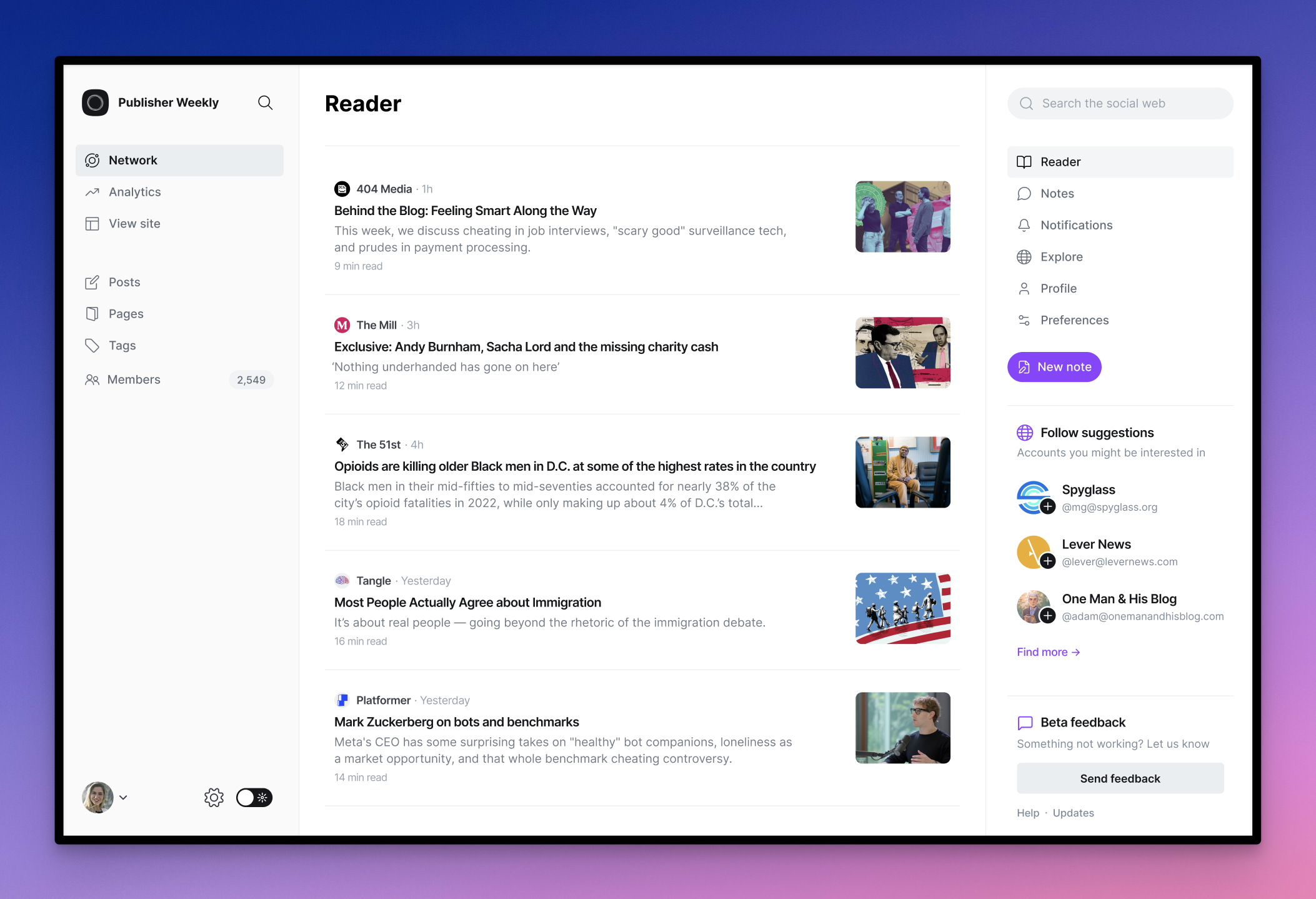
Ghost now has a social web reader built directly into admin, where you can receive and read posts from people you follow. Content is split into two areas: The Reader shows long-form content and articles, and Notes is where you'll find short-form content and everything else.
When you get started with the social web in Ghost you'll arrive on the Reader screen. Think of it like your email inbox. When you follow other publications on the social web, new long-form articles they publish will show up here.
Clicking on a post will open an inline reader view, right inside Ghost, and when you get to the end you'll be able to like, repost or reply.
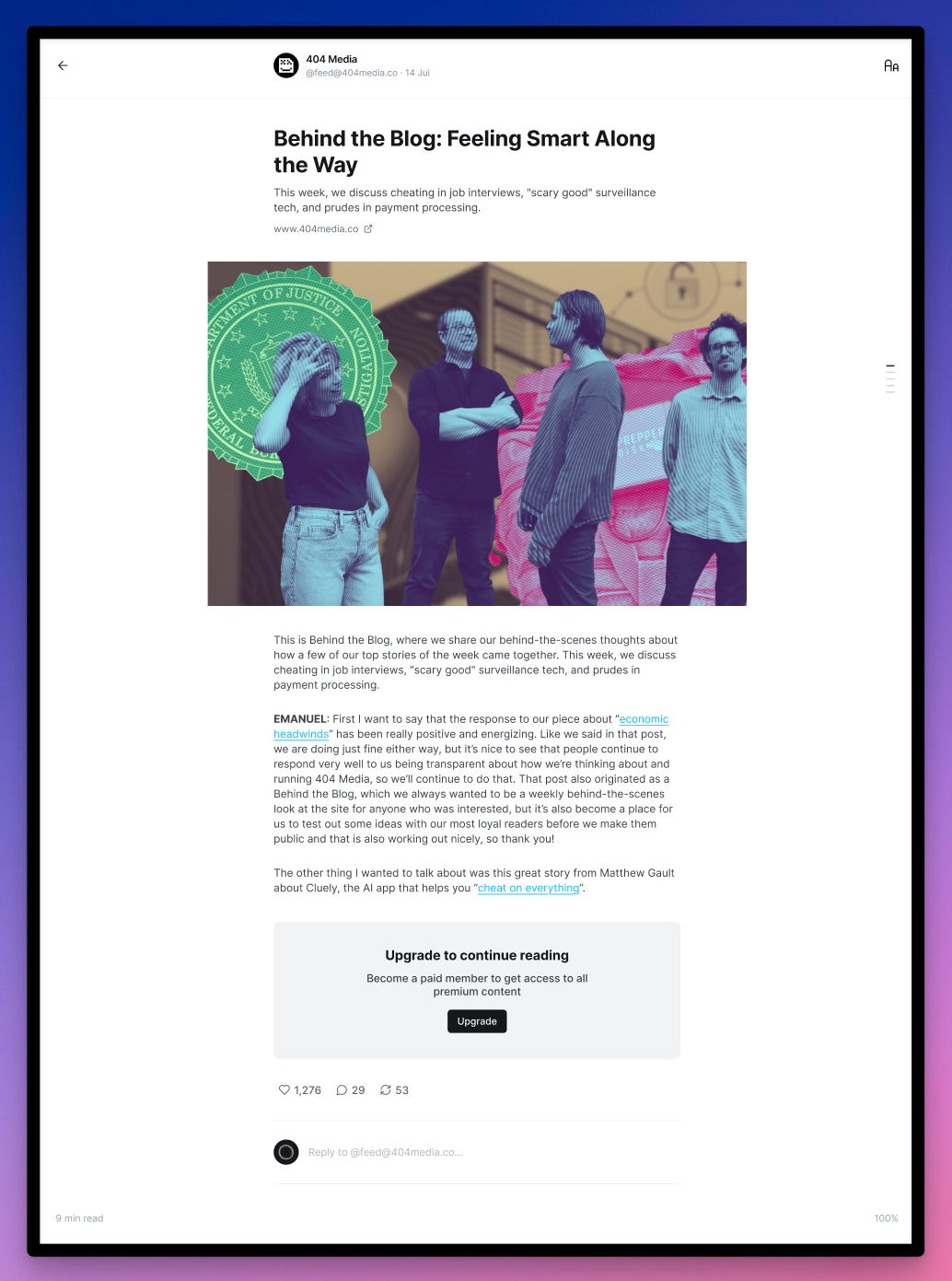
You're also able to adjust the background color, font, and text size for a more comfortable long-form reading experience.
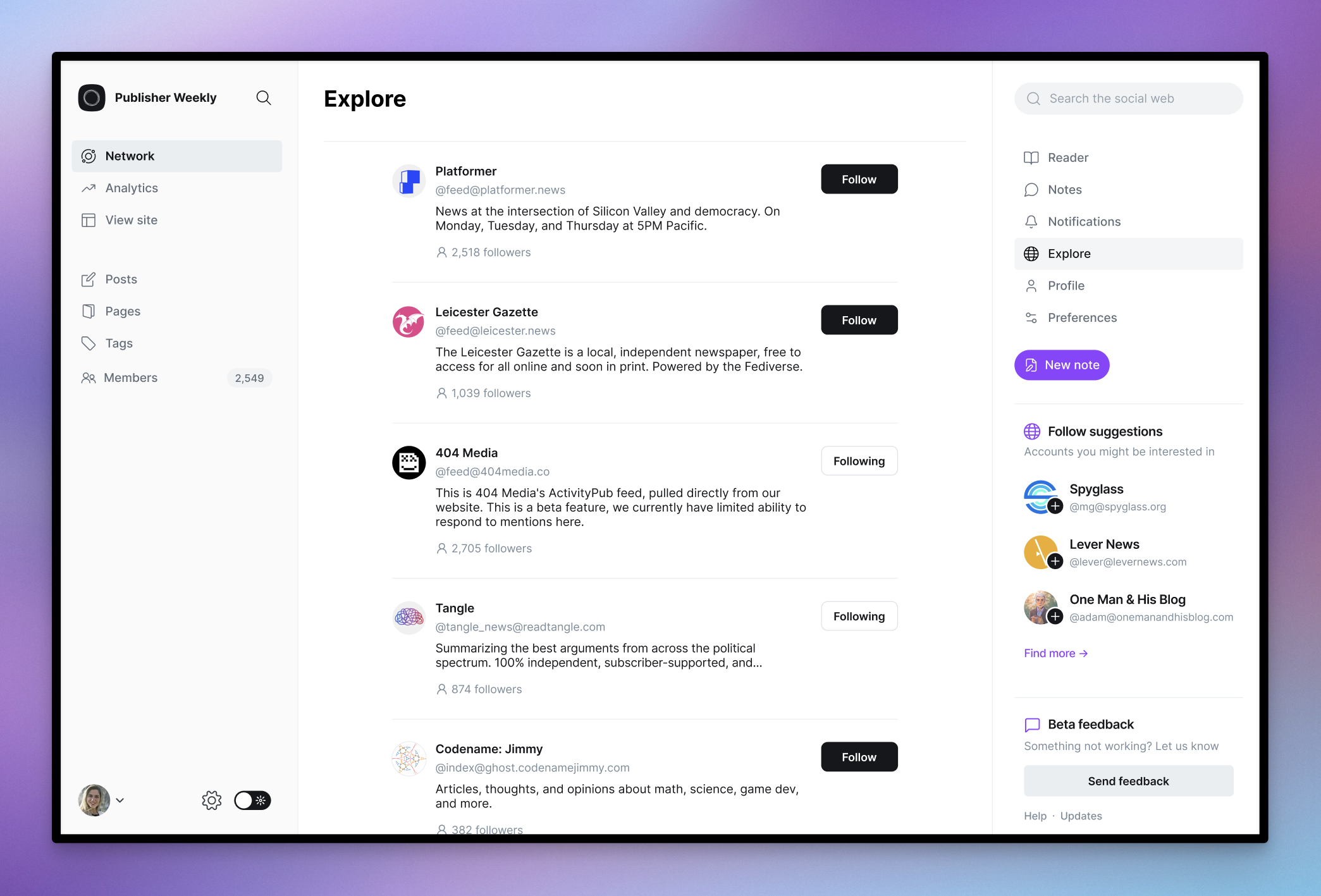
The best way to get people on the social web to discover your posts, is to follow and interact with the posts of others. While the appeal of the social web for most publishers is to increase their distribution so that more people can find and follow them, the secret to all social platforms is that they're built on two way interactions.
Aka: Being social.
The Explore screen shows suggested accounts that you can follow, or search for other accounts to follow using their handle.
No matter what type of content you create, following other people is a wonderful way to find inspiration for your next post; and connect with others.
For the first time, you can also publish short-form content, using Ghost.
The Notes screen gives you a timeline view of content from accounts you follow. Short-form posts from platforms like Mastodon and Threads will show up here. And when you interact with a like, reply, or repost — they'll be notified too.
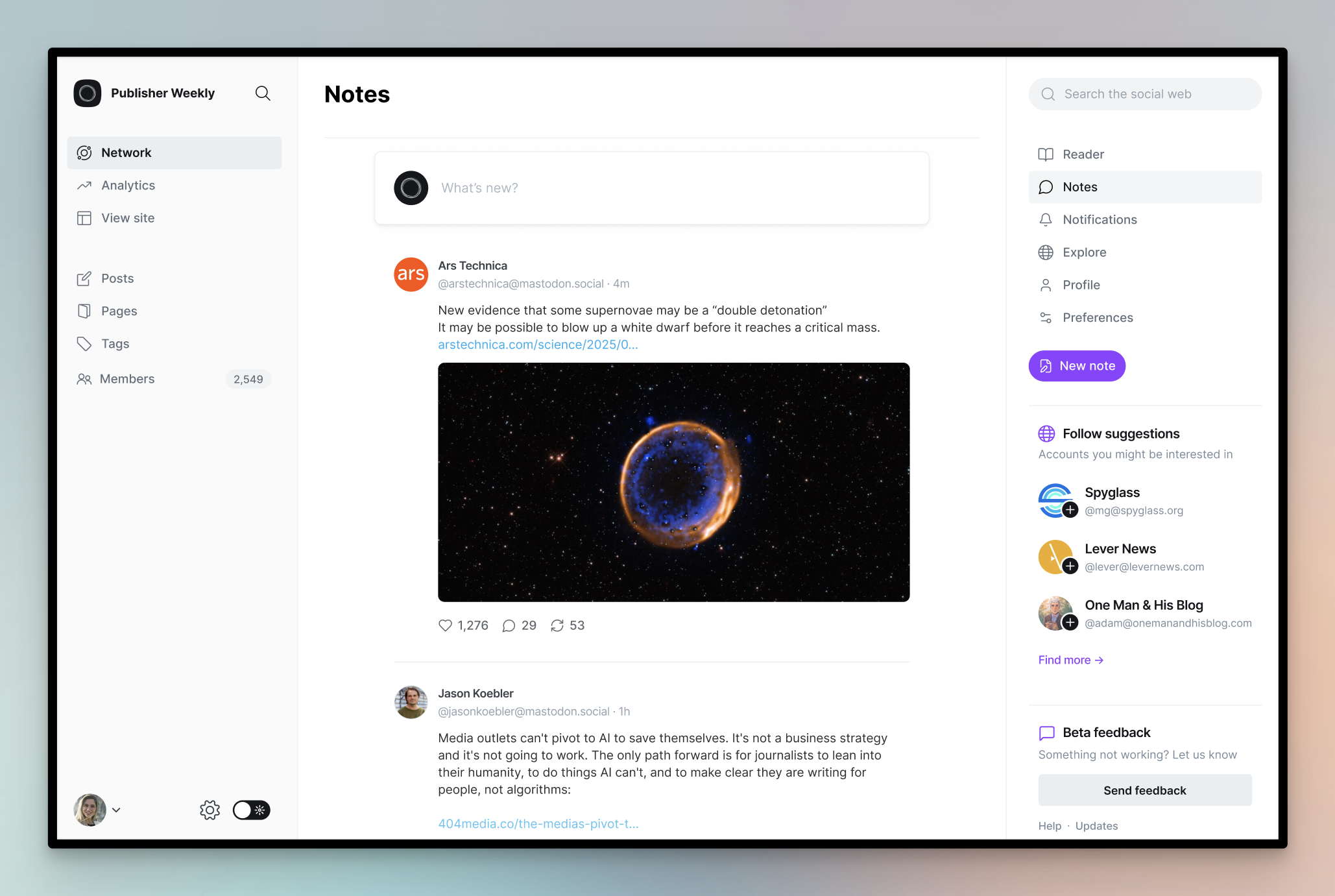
If you have something short that you want to share to the social web, you can do so. You don't need a separate platform just to tell the world what's on your mind.
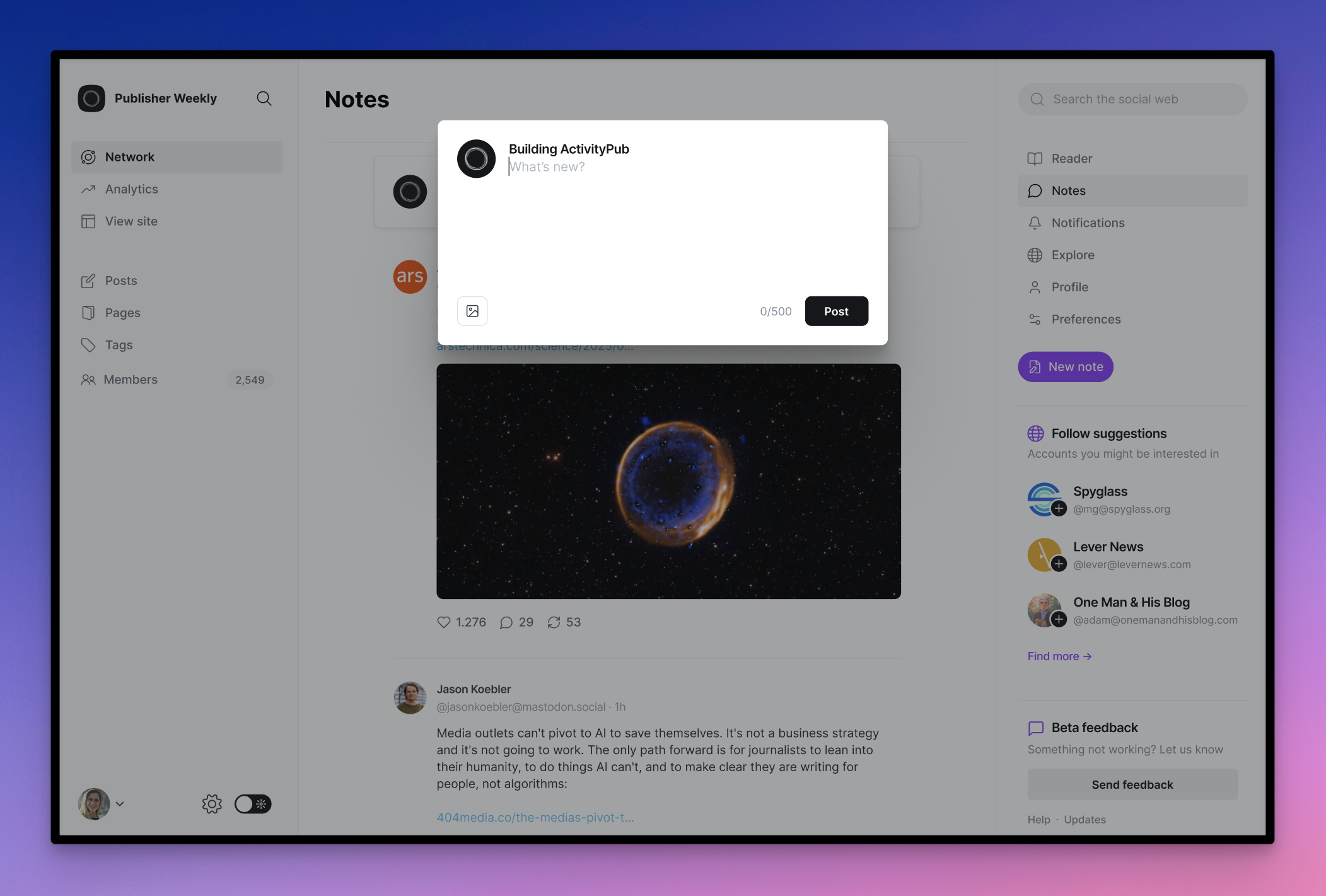
At the moment, short-form notes that you publish don't show up on your website. They just go out to your followers on the social web.
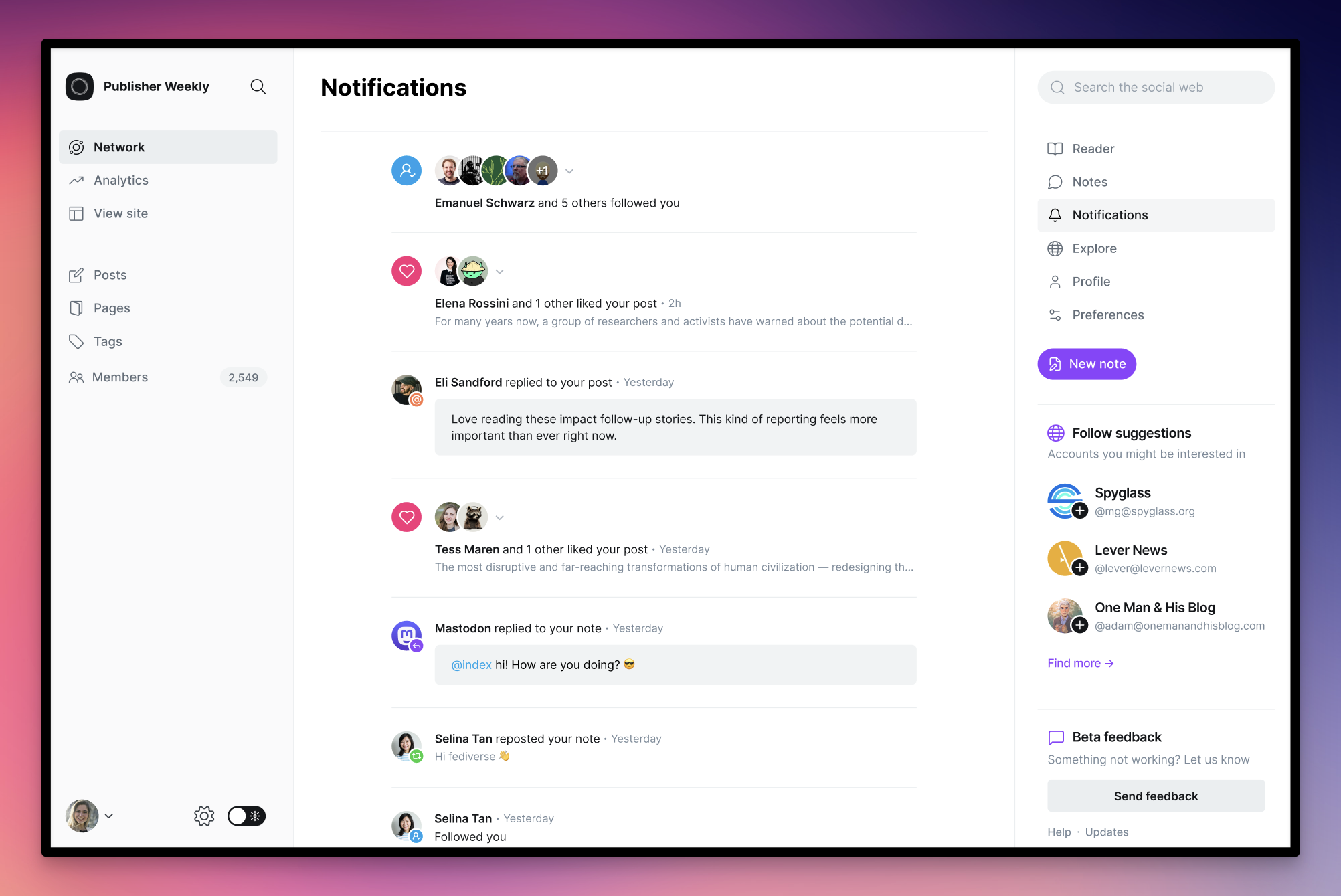
When people interact with you on the social web by following, liking, replying or reposting — you'll get notifications of what happened, giving you real-time feedback when things you share are resonating with others.
Finally, the Profile screen is where you can see a preview of your site's social web account, including following/followers, as well as all your posts – both long and short.
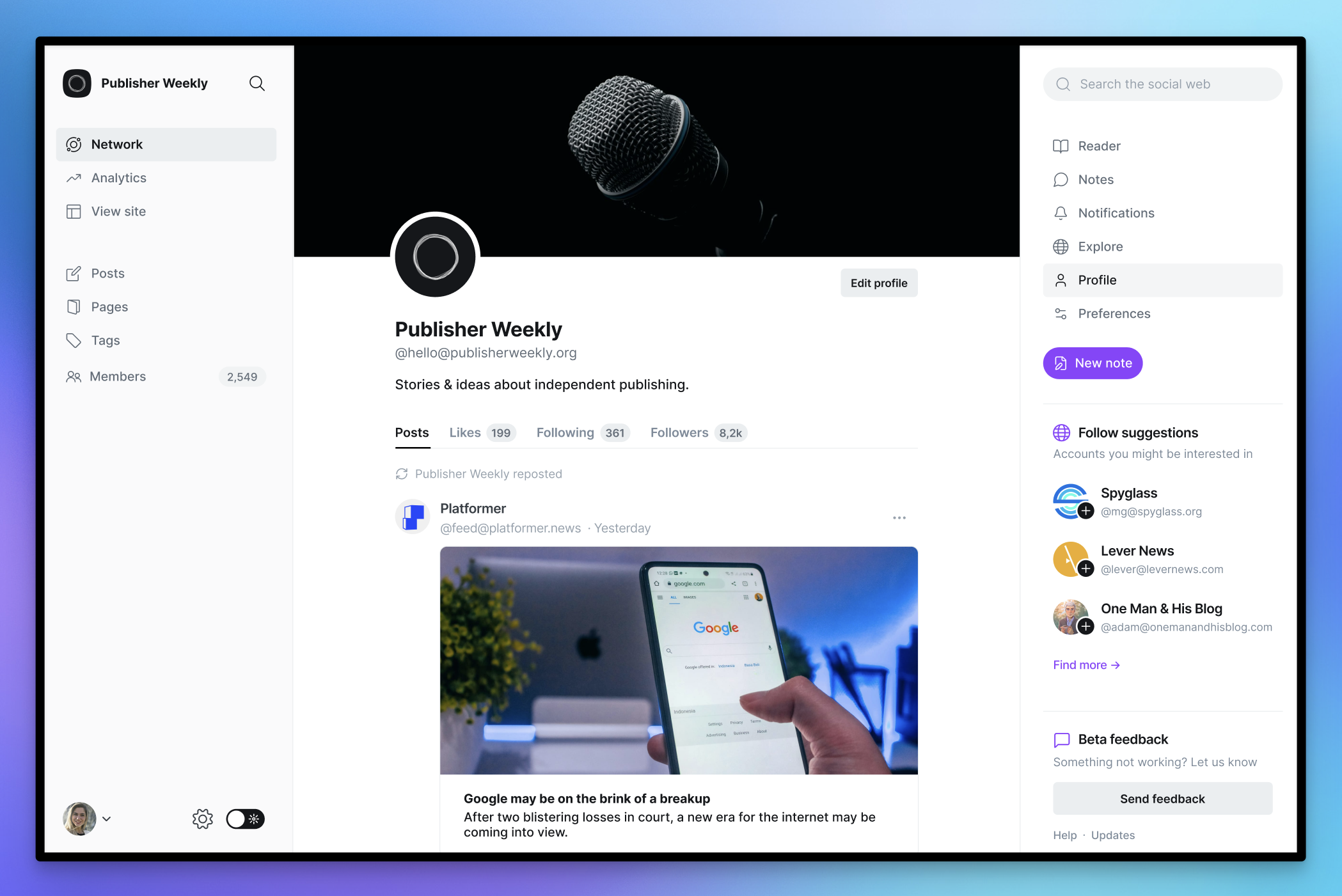
Your profile is populated automatically from your Ghost settings, so any changes you make to your site title and description there, will be reflected here.
In future, we hope to develop a deeper integration between your social web profile and followers <> and your public website and registered members. To start with, though, they operate independently from one another.
Your social web profile and followers are separate to the rest of your site and memberships, so you can think of it as a new, additional distribution channel.
If you want to promote your social web profile, you can optionally encourage people to follow by sharing your handle – @index@yoursite.com – on a page of your site, or in your Ghost theme.
To use social web in Ghost, your site must be using a custom domain:
yourdomain.com)yourdomain.com/blog is not supported)If your site is served from a subdirectory, social web won’t be available until a full custom domain is configured. Learn how to set up a custom domain →
We've got our social web integration for Ghost to a point where we're excited to have you try it out, but there's a lot of work still in progress and (as alluded to earlier) there are some significant rough edges.
You can send us feedback using the feedback widget in the sidebar of your social web reader inside Ghost Admin. Before you do, though, here are some things we already know about in advance:
There are a handful of features you'd probably expect to find which don't yet work, because we haven't finished building them. In particular:
These are already on our roadmap.
The social web is a new and emerging piece of technology, and the reality is that compatibility across different platforms is far from perfect at the moment. If you're here, you're an early adopter!
Some compatibility issues are things that we can fix in Ghost, while others are issues that need to be fixed by other platforms.
Here's a quick overview:
@bsky.brid.gy@bsky.brid.gy from your Ghost site, you can get your posts showing up there. More info on BridgyFed.It's relatively easy to build a closed social network with a single team and a single technology stack, but after trying that approach for the last 20 years we've ended up with a small number of platforms that control everything and everyone. Collectively, it doesn't seem like anyone is thrilled about where we've ended up.
Building an open social web is difficult, chaotic, messy work that involves organizing thousands of different humans and companies spread all over the world, all with disparate motivations and incentives. It always takes more time for open technology to develop, but it's usually worth the wait.
The world wide web and the dawn of the internet began much the same way. Not at the direction of a few giant corporations who wanted to profit from it, but as an emergent property of the explosion of creativity and collaboration that came from the people who wanted to use it.
If you're interested in this topic, please check out The Social Web Foundation, the non-profit doing their best to organize and push this movement forward, of which Ghost is a founding sponsor:
Social Web Foundation
Towards a bigger, better fediverse


We're looking forward to chatting with you and seeing what you create.
此内容由惯性聚合(RSS阅读器)自动聚合整理,仅供阅读参考。 原文来自 — 版权归原作者所有。