








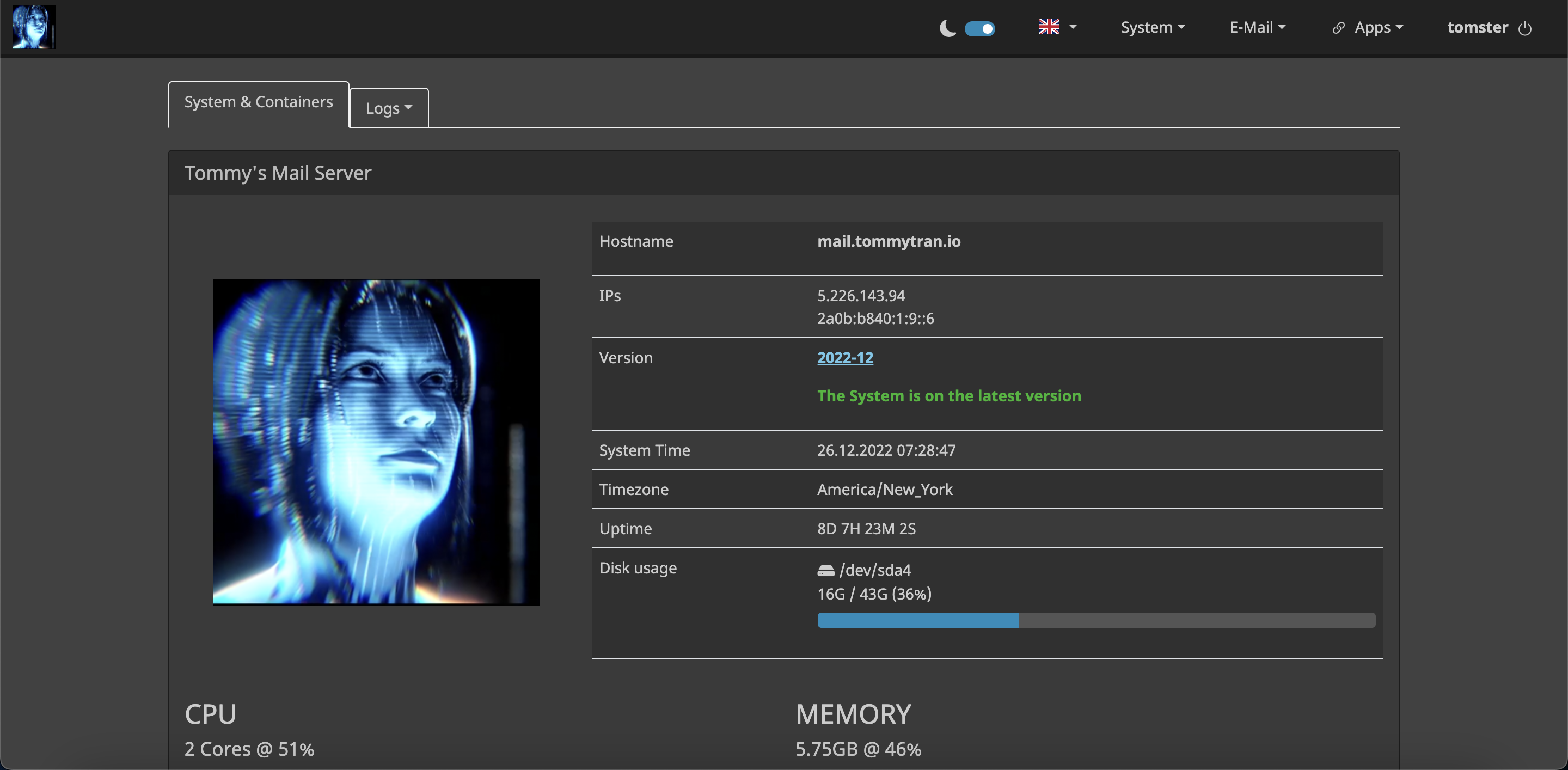
Mailcow is a fairly popular self-hosted mail server. If you use it, there are a few ways you can improve its security by following these steps.
Consider disabling weak ciphers and TLS versions below 1.2 in data/conf/postfix/extra.cf:
tls_high_cipherlist = ECDHE-ECDSA-AES256-GCM-SHA384:ECDHE-RSA-AES256-GCM-SHA384:ECDHE-ECDSA-CHACHA20-POLY1305:ECDHE-RSA-CHACHA20-POLY1305:ECDHE-ECDSA-AES128-GCM-SHA256:ECDHE-RSA-AES128-GCM-SHA256
tls_preempt_cipherlist = yes

smtp_tls_protocols = !SSLv2, !SSLv3, !TLSv1, !TLSv1.1
smtp_tls_ciphers = high
smtp_tls_mandatory_ciphers = high

smtpd_tls_protocols = !SSLv2, !SSLv3, !TLSv1, !TLSv1.1
smtpd_tls_ciphers = high
smtpd_tls_mandatory_ciphers = high
These security configurations can be added/modified in data/conf/nginx/includes/site-defaults.conf.
Consider only supporting strong ciphers:
ssl_ciphers ECDHE-ECDSA-AES128-GCM-SHA256:ECDHE-RSA-AES128-GCM-SHA256:ECDHE-ECDSA-AES256-GCM-SHA384:ECDHE-RSA-AES256-GCM-SHA384:ECDHE-ECDSA-CHACHA20-POLY1305:ECDHE-RSA-CHACHA20-POLY1305:DHE-RSA-AES128-GCM-SHA256:DHE-RSA-AES256-GCM-SHA384;
And prioritize ChaCha ciphers:
ssl_conf_command Options PrioritizeChaCha;
Consider adding includeSubDomains; and preload; to the HSTS configuration if all of your services are using HTTPS:
add_header Strict-Transport-Security "max-age=63072000; includeSubDomains; preload";
We will setup Content Security, so this header is no longer needed. In fact, it may do more harm than good. Change the setting to 0:
add_header X-XSS-Protection "0";
Mailcow does not need any special permissions to operate, except for USB which is needed to access your FIDO2 keys if you use them.
Add this header to deny other permissions:
add_header Permissions-Policy "accelerometer=(), ambient-light-sensor=(), autoplay=(), battery=(), browsing-topics=(), camera=(), clipboard-read=(), display-capture=(), document-domain=(), encrypted-media=(), fullscreen=(), geolocation=(), gyroscope=(), hid=(), idle-detection=(), interest-cohort=(), magnetometer=(), microphone=(), midi=(), payment=(), picture-in-picture=(), screen-wake-lock=(), serial=(), usb=(), sync-xhr=(), xr-spatial-tracking=()";
Use the following as your Content Security Policy:
add_header Content-Security-Policy "default-src 'none'; connect-src 'self' https://api.github.com https://www.gravatar.com; font-src 'self' https://fonts.gstatic.com; img-src 'self' data: https://www.gravatar.com; script-src 'self' 'unsafe-inline'; style-src 'self' 'unsafe-inline' https://fonts.googleapis.com; frame-ancestors 'none'; upgrade-insecure-requests; block-all-mixed-content; base-uri 'none'";
add_header Content-Security-Policy "default-src 'none'; connect-src 'self' https://api.github.com; font-src 'self' https://fonts.gstatic.com; img-src 'self' data:; script-src 'self' 'unsafe-inline'; style-src 'self' 'unsafe-inline' https://fonts.googleapis.com; frame-ancestors 'none'; upgrade-insecure-requests; block-all-mixed-content; base-uri 'none'";
Mailcow does not use any cross site scripts, or documents. Thus, you should set CORP and COOP headers to their strictest configuration:
add_header Cross-Origin-Resource-Policy same-origin;
add_header Cross-Origin-Opener-Policy same-origin;
If you do not use Gravatar with SOGo, you can also set COEP to require-corp since image embedding will not be used either:
add_header Cross-Origin-Embedder-Policy require-corp;
Disable gzip compression to avoid the BREACH attack. Change gzip on; to gzip off;.
此内容由惯性聚合(RSS阅读器)自动聚合整理,仅供阅读参考。 原文来自 — 版权归原作者所有。