



惯性聚合 高效追踪和阅读你感兴趣的博客、新闻、科技资讯
阅读原文 在惯性聚合中打开

推荐订阅源

L
LangChain Blog
博客园 - 司徒正美
美团技术团队
WordPress大学
WordPress大学
奇客Solidot–传递最新科技情报
奇客Solidot–传递最新科技情报
人人都是产品经理
人人都是产品经理
让小产品的独立变现更简单 - ezindie.com
T
Troy Hunt's Blog
S
Schneier on Security
T
The Exploit Database - CXSecurity.com
P
Proofpoint News Feed
云风的 BLOG
云风的 BLOG
Engineering at Meta
Engineering at Meta
Cisco Talos Blog
Cisco Talos Blog
T
Tor Project blog
B
Blog
NISL@THU
NISL@THU
月光博客
月光博客
博客园 - 【当耐特】
AWS News Blog
AWS News Blog
cs.CL updates on arXiv.org
腾讯CDC
L
Lohrmann on Cybersecurity
The Cloudflare Blog
L
LINUX DO - 最新话题
S
Security @ Cisco Blogs
S
Secure Thoughts
Spread Privacy
Spread Privacy
有赞技术团队
有赞技术团队
The Last Watchdog
The Last Watchdog
Project Zero
Project Zero
cs.AI updates on arXiv.org
Vercel News
Vercel News
H
Hacker News: Front Page
S
SegmentFault 最新的问题
Schneier on Security
aimingoo的专栏
aimingoo的专栏
P
Privacy & Cybersecurity Law Blog
博客园 - 三生石上(FineUI控件)
Forbes - Security
Forbes - Security
C
CXSECURITY Database RSS Feed - CXSecurity.com
I
InfoQ
T
Tailwind CSS Blog
Application and Cybersecurity Blog
G
GRAHAM CLULEY
W
WeLiveSecurity
小众软件
小众软件
Recorded Future
Recorded Future
Cyberwarzone
Cyberwarzone
cs.CV updates on arXiv.org

Amazon News

20 best books of 2026 so far, according to Amazon editors Claude Fable 5 from Anthropic now available on Amazon Bedrock Amazon's impact in Seattle, Bellevue, and the Puget Sound: Amazon employees volunteer for spring cleanups across the Puget Sound Amazon in the community: Service, community, and commitment at HQ2 Amazon Leo's largest Arianespace launch yet will feature upgraded boosters to deploy more satellites 'Vought Rising': How to watch on Prime Video Amazon disaster relief technology: 2,000 free systems that restore power, Wi-Fi, and water in minutes Pinterest signs $4 billion AWS deal to scale AI for 600 million users Amazon announces new robots, faster delivery, and 25,000 jobs in Europe Amazon unveils new Proteus robot in €10 billion European investment in its fulfillment centers Amazon customers in the UK can now add fresh groceries to Same-Day Delivery orders in parts of London Prime Video's most-watched original films and series last week worldwide NBA Finals 2026: How to watch Knicks vs. Spurs live on Prime Video What does an Amazon fulfillment center GM do every day? Amazon launches Prime in South Africa Spider-Man: Brand New Day early screenings in theaters through Prime How AWS transformed IT by making cloud computing accessible to everyone The best early Prime Day 2026 deals to shop now Amazon Prime Day 2026: Ofertas exclusivas para miembros Prime del 23-26 de junio When is Amazon Prime Day 2026? Shop deals June 23-26 What’s new on Prime Video in June 2026, including ‘The Legend of Vox Machina,’ NWSL Challenge Cup, and more Sustainability at Amazon: Water conservation efforts, supports California watershed restoration through innovative Forest Resilience Bond How Amazon fights freight fraud and protects products How Amazon is investing in Indiana's economy What is agentic AI? Amazon's approach to reliable AI agents How AWS used random graph theory to build more efficient data centers Amazon Japan launches Shinkansen bullet train deliveries Amazon Health Services welcomes Dr. Roy Schoenberg as new SVP AWS Agentic Shopping Assistant: Amazon's AI shopping tech, now for any retailer Andy Jassy on Prime Video’s growth: ‘It’s profitable and still early’ How Amazon is investing in Virginia's economy Amazon employee benefits: 3 stories of support through grief, a cancer diagnosis, and career reinvention Alexa Podcasts: AI-generated audio episodes on any topic, on demand What is Audible? Pricing, plans, and how to listen Alexa for Shopping: Amazon's AI assistant for personalized shopping Amazon brings full visual shopping experience to Echo Show with Alexa+ 10 AI chip terms to know: GPUs, accelerators, inference, and more How to order groceries on Amazon Amazon Now delivers fresh groceries and essentials in 30 minutes or less 'Fourth Wing' TV series: What to know about the Prime Video show 'Jury Duty' renewed for Season 3 on Prime Video: What to know New on Prime Video: Fourth Wing, Reacher Season 5, Rings of Power Season 3 date, Terminal List Season 2, Jury Duty Season 3 Prime Video renews 'Reacher' for Season 5: What to know Amazon Pet Days 2026: Top 65 deals Amazon CEO Andy Jassy explains how Amazon keeps prices low Amazon CEO Andy Jassy on investing $4 billion in rural delivery Why Amazon is spending big on AI infrastructure, according to CEO Andy Jassy What is Amazon Supply Chain Services? CEO Andy Jassy explains Blink launches first 2K video doorbells Amazon plans to invest more than €15 billion in France AWS Trainium and Graviton chips: How Amazon powers AI and cloud computing Amazon Business launches fresh grocery Same-Day Delivery in 2,300+ cities Alexa+ Now Available on Bose Speakers as a Prime Benefit Amazon launches Supply Chain Services for businesses of all sizes What’s new on Prime Video in May, including “Spider-Noir,” NASCAR, and live music events How Amazon is investing in Mississippi's economy and workforce How Amazon team members volunteer to support communities year-round How to check Amazon's price history Amazon's CEO Doug Herrington explains why telling your team to 'move faster' doesn't work Amazon sellers hit record growth: 75,000 surpassed $1 million in sales in 2025 Amazon CEO Andy Jassy on why customers are choosing AWS for AI Andy Jassy on Amazon Ads growth, AI tools in Q1 2026 earnings CEO Andy Jassy on Amazon Stores growth, delivery speed in Q1 2026 Amazon CEO Andy Jassy on the growth of Amazon’s chips business Amazon announces Prime Day 2026 in June How Amazon is investing in California's economy How Amazon is investing in Oregon's economy OpenAI Models on Amazon Bedrock: AWS expands partnership with Codex and Managed Agents Amazon’s Hear the highlights now lets you ask questions while you shop Amazon Quick desktop app: AI that learns how you work Amazon Connect expands into four new agentic AI solutions Amazon ranks No. 4 on LinkedIn's 2026 Top Companies list How Amazon CPUs like AWS Graviton enable agentic AI How Amazon uses AI to stop counterfeit products and fake reviews How Amazon is investing in Illinois's economy Citadel Season 2: Trailer, Prime Video release date, cast, how to watch Amazon One Medical GLP-1 management program with upfront medication costs Amazon announces $5B Anthropic investment, up to $20B more 'Clarkson’s Farm' Season 5: Release date, trailer, how to watch on Prime Video, and more Amazon Summer Beauty Event 2026: Up to 30% off Medicube, Dyson & more Watch Jack Ryan Ghost War: Complete series and film on Prime Video Amazon Q1 2026 earnings report: Read the release Amazon data centers: Amazon Richmond County Community Fund helps fund community programs in North Carolina Amazon Ember Artline: Preorder the Lifestyle TV with 2,000+ Free Art Pieces Fire TV Stick HD: Amazon's most portable streaming device Alexa+: Amazon’s next-gen AI assistant now available in Italy Prime Video now offers Apple TV and Peacock Premium Plus streaming bundle for $19.99 per month AWS launches AI tool to speed drug discovery research ‘Your Fault: London' coming to Prime Video June 17: Trailer, cast, how to watch, and more Amazon to acquire Globalstar; partners with Apple Amazon Leo brings gigabit Wi-Fi to commercial airlines What is AWS Graviton? How Amazon's custom chip powers the cloud Andy Jassy explains how starting over drives Amazon's reinvention Andy Jassy on pursuing multiple parallel paths when inventing and experimenting Andy Jassy shares the biggest lessons from 28 years at Amazon Amazon CEO Andy Jassy on innovating via robotics, faster rural delivery, broadband connectivity Amazon CEO Andy Jassy on AWS and the rise of AI Amazon to invest $25 billion in Mississippi data centers Amazon CEO Andy Jassy’s 2025 Letter to Shareholders ‘No Place to be Single’: Trailer, release date, cast, how to watch
How Amazon is making its data centers more water-efficient
Alex Davies · 2026-06-11 · via Amazon News

Amazon's data centers are 7x more water-efficient than the industry average. Here’s how we do it.

Amazon is constantly innovating to reduce the amount of water we use in our data centers, resulting in a 52% improvement in water efficiency since 2021.

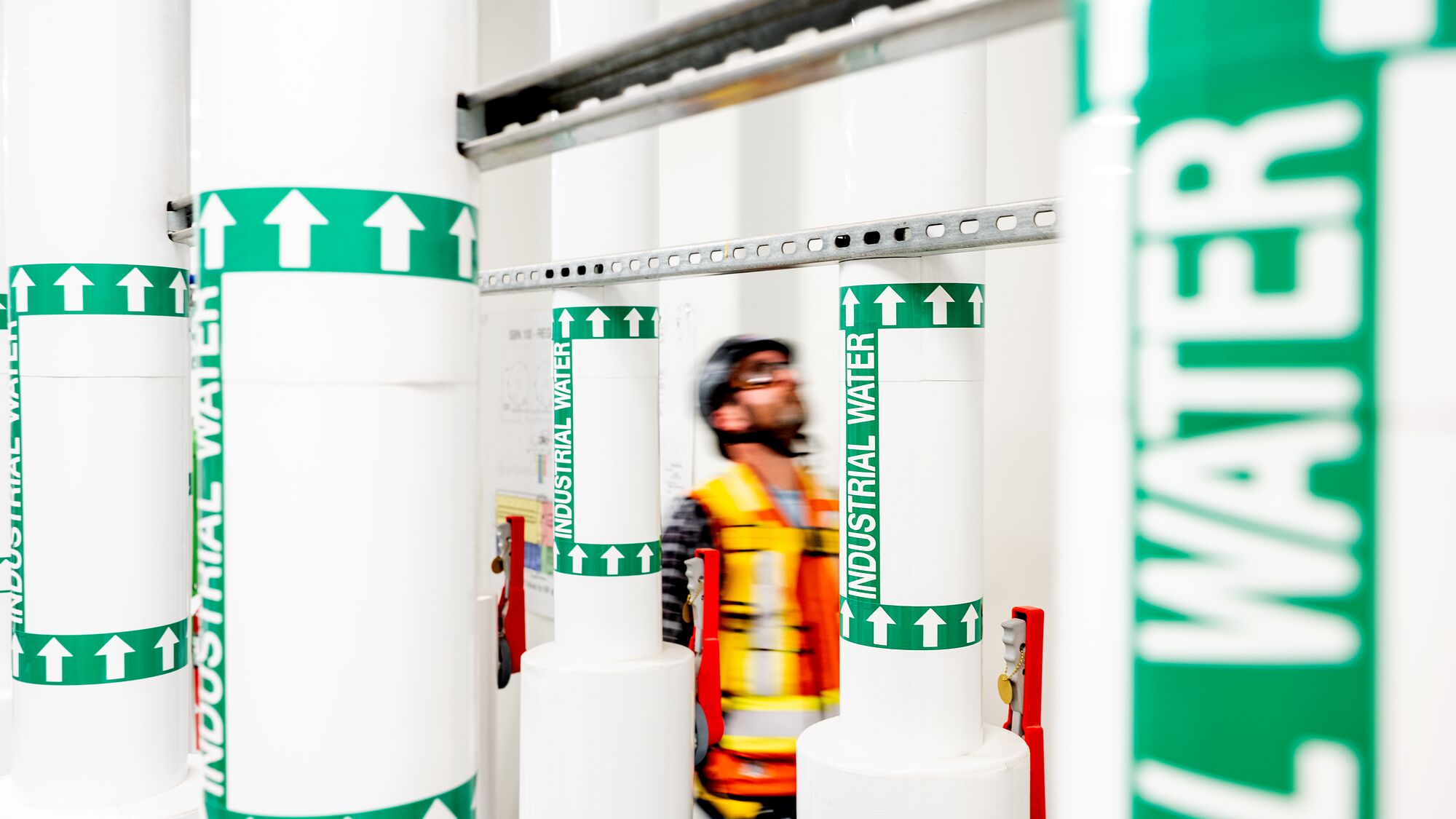
Worker in safety vest amid industrial water pipe labels

Key takeaways

  • Amazon's data centers are over 7x more water-efficient than the industry average, using air cooling for most of the year and water only during the hottest days.
  • We’re 75% of the way to our goal of being water positive by 2030, meaning that for every gallon of water we use in our data center operations, we will return more than a gallon back to the communities where we operate. In 2025, we returned 3 gallons for every 4 we used—and we’ve announced over 50 water projects that are expected to return more than 5.8 billion gallons annually once fully implemented.
  • We use reclaimed water (water that would have otherwise been wasted or unusable) across more data centers than any other company, and we’re helping communities develop reclaimed water programs from the ground up.

When data centers use water for cooling, one of the most important metrics is how efficiently they use that water—meaning how little water they use for each unit of compute. Amazon announced that its global data center operations used just 0.12 liters of water per kilowatt-hour (L/kWh) in 2025, a rate that’s over 7x more efficient than the industry average of 0.84 L/kWh.

In other words, we use far less water per unit of compute than others in the global data center industry, which as a whole accounts for less than 0.5% of all industrial water use globally.

And we’re continuing to get even more efficient year over year. These efficiency gains are the result of years of investment in custom cooling technology, smarter systems, and a commitment to minimize water use wherever possible.

Blue industrial pipelines with valves in factory warehouseAlong with limiting water usage, we’re pioneering the use of reclaimed water, which comes from wastewater treatment plants, not drinking water supplies.

"Data centers enable everything from video calls to virtual medical visits and education to online banking," says Joern Tinnemeyer, a data center engineering leader at Amazon. "To deliver that computing reliably, we need to maintain optimal temperatures. My team focuses on thermal management—taking the heat generated as a byproduct of computing operations and removing it as effectively and as efficiently as possible."

About 90% of the time, our data centers use “free air cooling," pulling in outside air, running it past servers to absorb the heat, then pumping it back outside—no water involved. "It's kind of like in your house," Tinnemeyer says. "It's a nice summer morning. It's not that hot out. I'm gonna open up my windows rather than turn the air conditioner on, and just let the breeze pull through."
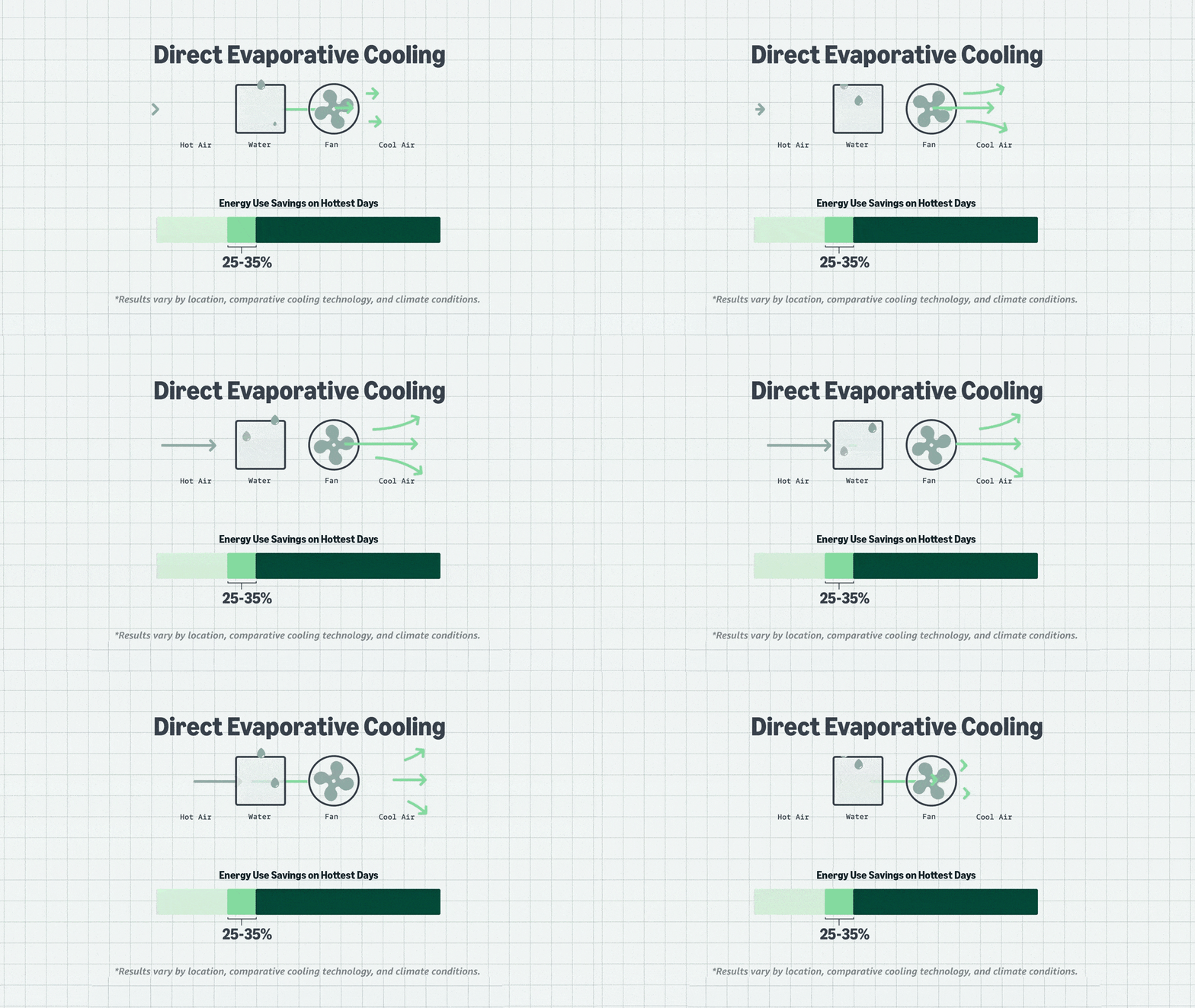
This is a gif showing direct evaportive cooling and that the energy savings Amazon receives is between 25-35%

But when the hottest hours of the hottest days arrive, especially in warmer parts of the world, the air gets too hot and humid to cool the servers effectively. This is when we use evaporative cooling, in which water is sprayed onto an absorbent medium that Amazon water specialist Beau Schilz describes as "a sophisticated, giant sponge." Hot air flows through this water-soaked material, and as the water evaporates, it pulls heat from the air, cooling it by five to 10 degrees.

"It's like sweating," Schilz explains. "The evaporative process pulls the heat off of your body so you don't overheat."

Some companies instead use chillers that work like giant air conditioners. But with currently available technology, using water during hot hours actually reduces overall environmental and community impact. That’s because chillers typically require 25% to 35% more electricity, and that extra demand often comes precisely when everyone else needs power for their fans and air conditioners. We determined it's better overall to use some water during the hottest days of the year than to overconsume electricity during the very moments when the grid is most stressed.

top down view of AWS liquid cooling system with technician hand/screwdriver in frame, diagonal view

Running hotter to use less water

For the past few years, we’ve been steadily raising the temperature thresholds at which our data centers operate, designing servers to tolerate more heat. If servers can tolerate more heat, they can reduce the number of hours they need water to cool things down. After a few years of iteration, learning, and adjusting, we now use water to cool incoming air only when ambient temperatures exceed roughly 85° F, making the system efficient in most climates.

"This is how we innovate at Amazon," Tinnemeyer says. "We set an ambitious target that benefits our customers, iterate relentlessly, and validate with data—in this case, proving we could cut water use in half without any impact on performance."

To validate the approach, we analyzed thousands of hours of data across data center campuses, checking failure rates at higher temperatures. "The failure rate didn't increase," Schilz says.
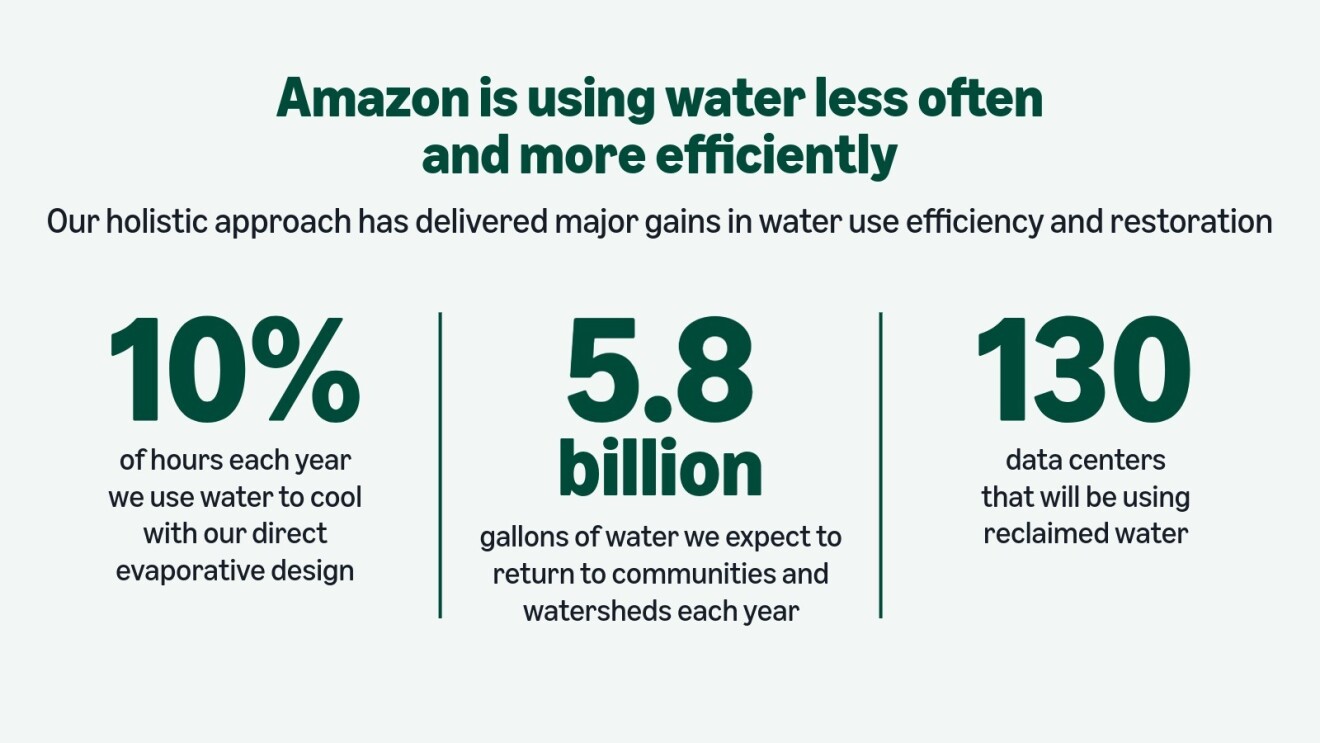
Amazon water efficiency statistics: 10% cooling hours with evaporative design, 5.8 billion gallons returned annually, 130 data centers using reclaimed water

The results have been significant: "Our engineers looked at two identical data centers on the same campus and were able to use about 50% less water in one of them that was running with higher temperatures," Schilz says.

For example, in Northern Virginia, our largest region by IT load, we dropped water use by 42% year-over-year, even as demand for computing continued to grow.
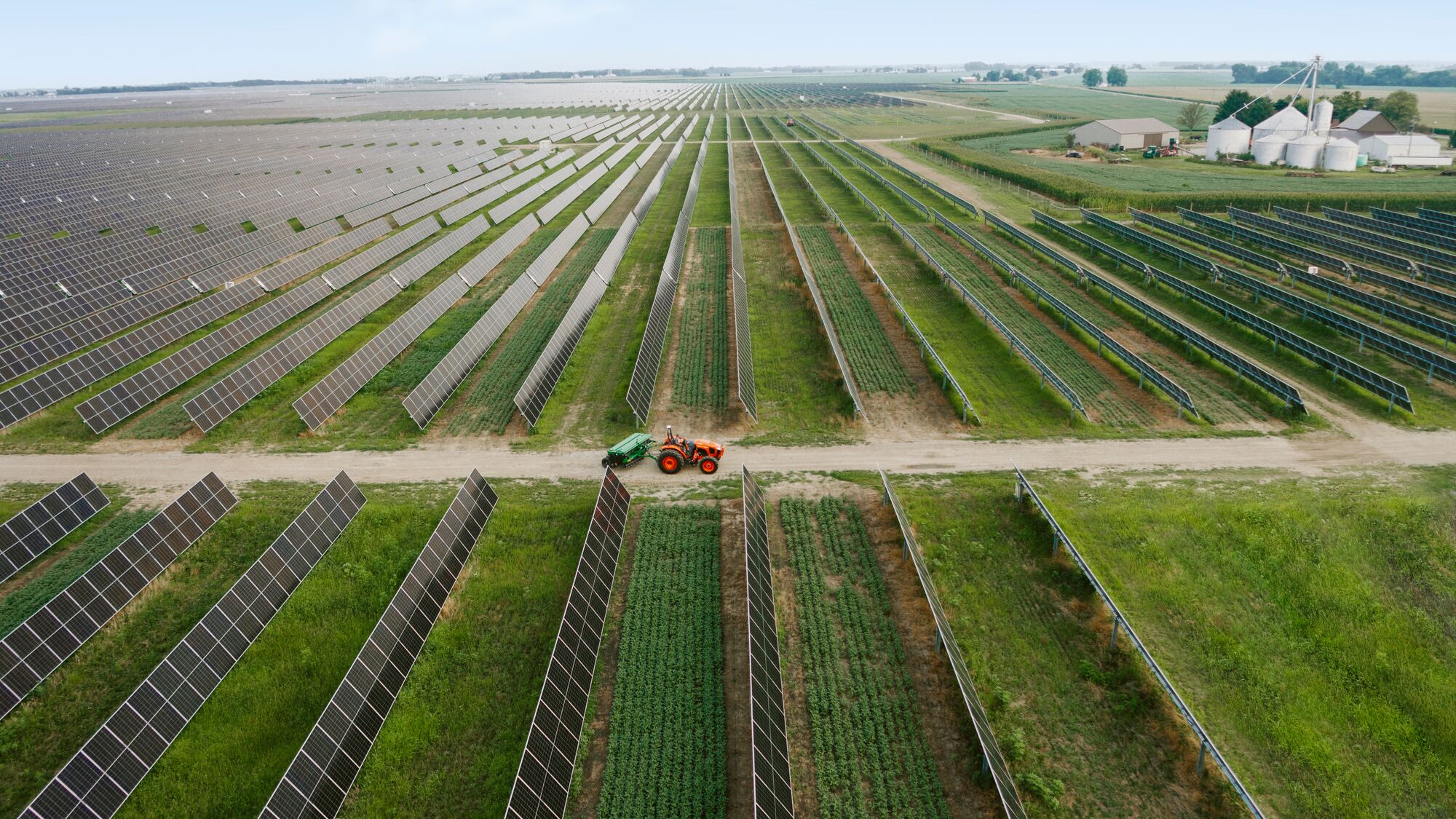
carbon-free energy at Amazon, a photo of a solar farm with rows of panels alongside agricultural fields and a tractor

75% of the way to water positive

While we’re constantly getting more efficient and we’re using less water per kWh of server use every year, we want to go well beyond that and actually create more usable water around the world than we consume. So we've committed to being water positive by 2030 and we’re already about 75% of the way there.

How do we do that? First, we track how much water we use so we understand how much water we’ll need to return to reach our goal. In 2025, we withdrew about 2.5 billion gallons across our entire global data center footprint during the whole year. To put that in perspective, Americans use roughly 3.3 trillion gallons a year to water their lawns and gardens, according to the EPA—meaning every year landscape irrigation uses over 1,300 times more water than our data centers. And, at the sites we own and operate directly, the total amount of water we withdrew decreased 2% from 2024 to 2025, even as the number of buildings we have around the world continued to grow.

Next, we invest in and invent ways to capture water that would be otherwise wasted and "return" it to communities that need it.

A technician pushing a cart that holds their laptop through servers inside a data center.Data centers overall use less than 0.5% of all global industrial water use, and Amazon is a small fraction of that.

For example, in Hermiston, Oregon, we’re funding a project to pull water from the Columbia River during peak winter flows, storing it in an aquifer for use during drier parts of the year. In northeastern Spain we worked with environmental consultancy Mediodes on a pipeline that moves runoff water from upstream fields to a poplar grove in the town of Pina del Ebro, reducing the need to pull irrigation water from the Ebro River. Near Guadalajara, Mexico, we’re supporting a watershed restoration project to help the ground absorb more rainwater and stop pollution from flowing into the Santiago River basin.

Together, we’ve announced over 50  water projects expected to return more than 5.8  billion gallons of water annually for use by local communities. That's enough to fill 8,800 Olympic swimming pools.
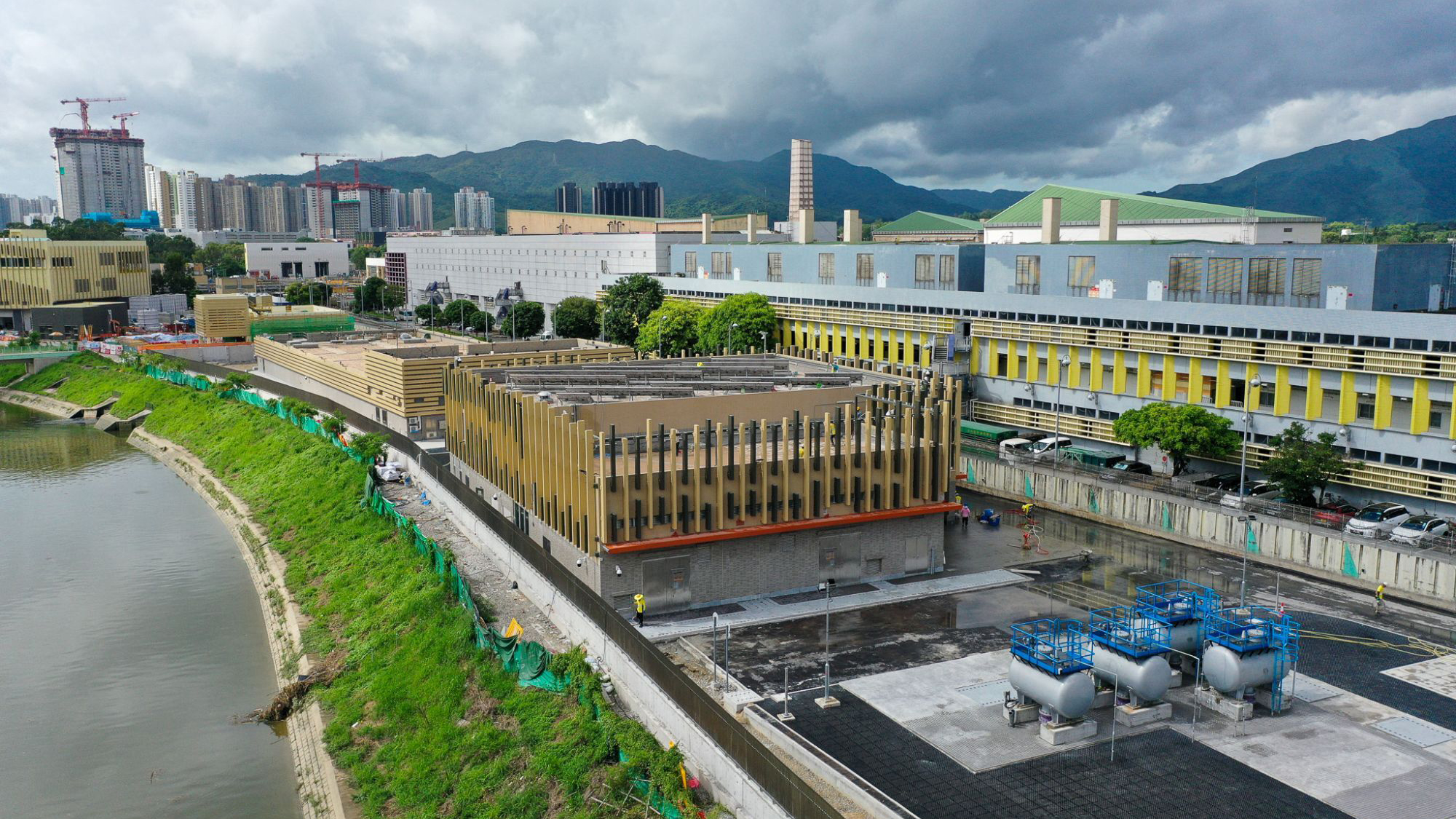
Hong Kong: Urban development along riverbank with industrial facility and mountains in background

We’re also working to benefit the communities where we operate by using water in our own operations that would otherwise be unusable. We’re pioneering the use of this "reclaimed" water, sourcing from wastewater treatment plants instead of using drinkable water. We already operate 26 facilities using 100% reclaimed water, more than any other cloud provider, with 130 more contracted globally. In Mississippi, Hong Kong, and Indonesia, we’ve created reclaimed water programs by funding infrastructure and assisting with permitting.

"We're not just using reclaimed water," says Usman Khan, a water specialist at Amazon for over seven years. "We're helping communities develop these programs from the ground up."

For water specialist Beau Schilz, who spent years in water utilities before joining Amazon, it comes back to being a responsible neighbor. "We're particularly focused on areas where there's water scarcity," he says. "Amazon wants to partner with communities to ensure our water stewardship creates local benefits that they want to see."

As demand for cloud computing continues to grow, so does our commitment to doing more with less—and to leave communities better than we found them.