



AI systems today can write essays, generate code, summarize complex ideas, and carry on conversations with remarkable fluency. Yet those same systems still struggle with tasks humans find intuitive: reliably tracking objects through change, reasoning compositionally in unfamiliar situations, or distinguishing truth from plausible fiction. These contradictions have fueled polarized debates about AI. Some see current systems as early forms of human-like intelligence; others dismiss them as sophisticated autocomplete.
In recent interdisciplinary work – including Adam Frank, Marcelo Gleiser, and Evan Thompson’s The Blind Spot (opens in new tab) and DeepMind researcher Alexander Lerchner’s The Abstraction Fallacy (opens in new tab) – a different picture is emerging. Rather than asking whether AI systems are becoming intelligent in the human sense, these approaches ask a more basic question: What if AI systems work because they rely on structures that are rooted in human cognition? This shift in perspective, which draws on the phenomenology of Edmund Husserl, helps make sense of both the capabilities and the limits of modern AI.
In our recent paper, The Origins of Artificial Intelligence in Natural Intelligence, we argue that modern AI systems are best understood neither as human minds nor as trivial statistical tricks. Instead, they extend structures that originate in human cognition itself. Further drawing on the phenomenology of Husserl, the paper proposes that language already contains sedimented structures of human understanding —structures that AI systems learn to model and extend. This perspective helps explain both the capabilities and the boundaries of contemporary AI.
Human perception is not simply passive reception of sensory data. We experience the world as stable things unfolding through change: a cup remains the same cup as we move around it; a melody remains recognizable even as individual notes pass away. Language emerges by expressing these stable structures in conceptual form. Words like “red,” “round,” or “larger than” articulate relationships that originate in lived experience.
Large language models learn statistical relationships within this linguistic world. They capture how concepts tend to relate across enormous bodies of human writing. This explains why AI systems can produce coherent responses across many domains. But it also explains why they hallucinate. Humans remain answerable to the world: experience continually corrects our expectations and beliefs. AI systems, by contrast, extend patterns within text itself. They can continue a line of reasoning with remarkable fluency, but they lack the lived engagement with the world that anchors meaning and truth.
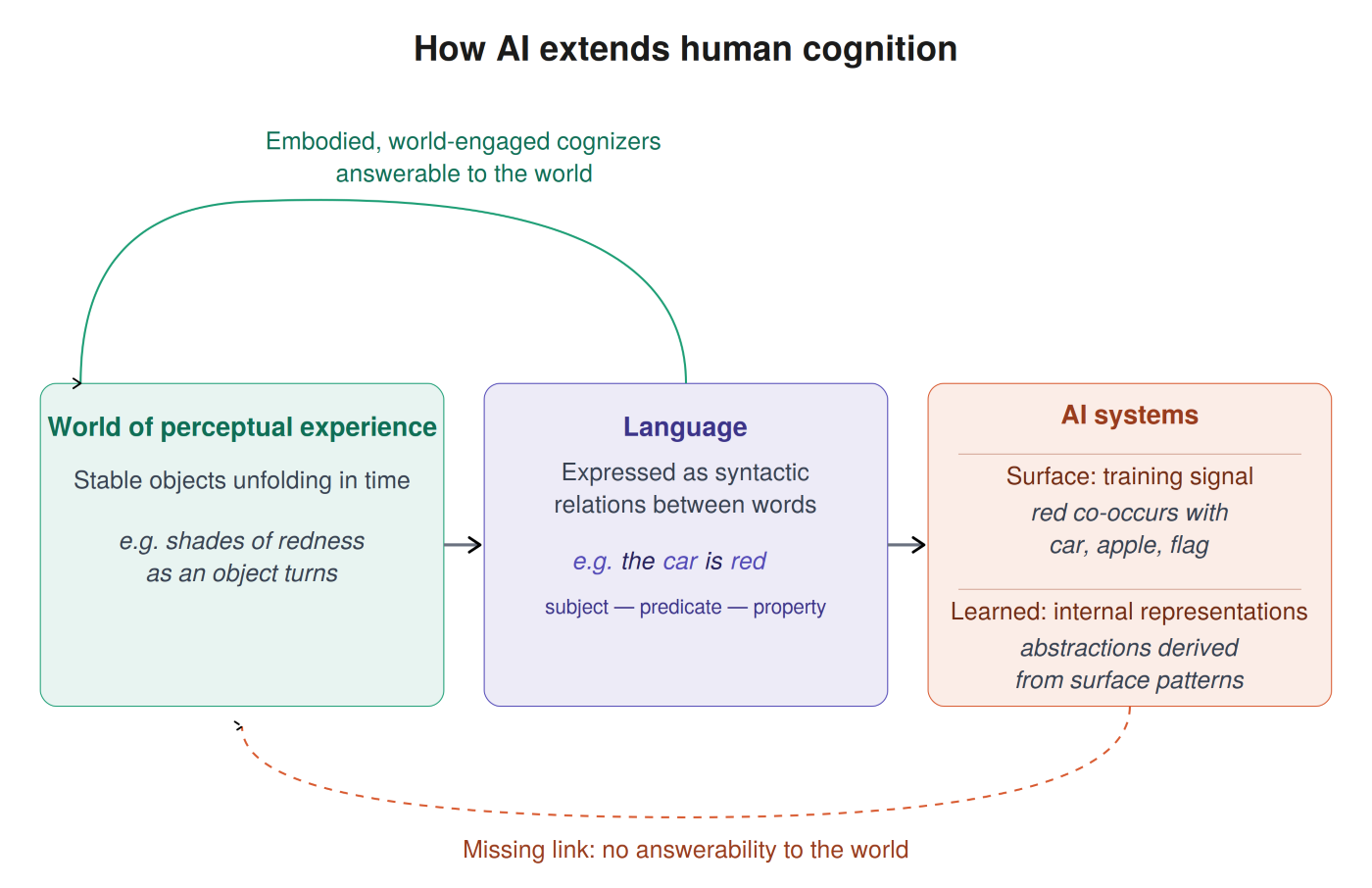
This framework helps explain several recurring challenges in AI research. One is the “compositionality gap”—the tendency for language models to perform well on familiar reasoning patterns while failing when asked to combine concepts in genuinely novel ways. Research increasingly shows that larger models improve fluency and factual recall much faster than they improve true compositional reasoning. From our perspective, this is not simply an engineering limitation but a structural boundary: AI systems can extend patterns already sedimented in language, but they do not possess the world-directed understanding that allows humans to generate genuinely new conceptual relations.
A similar pattern appears in multimodal systems that combine language and vision. These systems can often label images correctly while still failing at robust reasoning about objects and their parts. They learn correlations between visual patterns and language rather than perceiving stable objects unfolding through time in the way humans do. The result is systems that can appear impressively fluent while remaining surprisingly brittle outside familiar patterns.
This perspective also reframes debates about AI safety. Public discussion often swings between fears of “rogue superintelligence” and claims that AI poses little meaningful risk. Our research suggests that both extremes misunderstand the nature of current systems. The most immediate risks arise not because AI possesses human-like intentions, but because it can extend patterns of reasoning without reflective responsibility to the world. Systems can generate persuasive but ungrounded outputs, automate flawed decisions at scale, or execute harmful actions if embedded in poorly governed environments.
This helps explain why AI safety is increasingly shifting from model safety to system safety. In practice, organizations already rely on layered safeguards—what the industry increasingly calls “harnesses”—to constrain, validate, and monitor AI behavior. Rather than temporary patches, our paper argues that these mechanisms reflect something fundamental about AI architecture itself: trustworthy behavior emerges from the work of builders of AI systems responsible for their behavior, a responsibility that cannot be delegated to or shared with models.
This interpretation aligns closely with how enterprises increasingly approach trustworthy AI deployment. Organizations need systems that can extend human intelligence while remaining governable, auditable, and aligned with human oversight. Understanding AI as a derived form of intelligence clarifies why layered governance, evaluation, and operational controls matter so deeply.
Spotlight: Event Series

Join us for a continuous exchange of ideas about research in the era of general AI. Watch the latest episodes on demand.
Looking ahead, we believe phenomenology offers more than a critique of AI—it offers a framework for understanding its promise. AI systems reveal something profound about human cognition itself: that meaning can be formalized, extended, and scaled in powerful new ways. The central societal risk of AI thus turns out to be kicking away the ladder of its origins in human experience and cognition – misinterpreting AI as a rival intelligence that diminishes our humanity and thus, in turn, diminishes the true promise of AI itself.
The question, then, is not whether AI will replace human intelligence. It is how we can responsibly build systems that extend human understanding while remaining grounded in the world from which that understanding arises. If we mistake AI systems for autonomous minds, we risk over-trusting them. If we dismiss them as trivial tricks, we risk overlooking one of the most important technological developments of our time. A more grounded interpretation recognizes both truths at once: AI is a genuine extension of human intelligence—and precisely because of that, humans remain responsible for how it is understood, governed, and used.
此内容由惯性聚合(RSS阅读器)自动聚合整理,仅供阅读参考。 原文来自 — 版权归原作者所有。