

惯性聚合 高效追踪和阅读你感兴趣的博客、新闻、科技资讯
阅读原文 在惯性聚合中打开

推荐订阅源

B
Blog RSS Feed
Threat Intelligence Blog | Flashpoint
G
GRAHAM CLULEY
Hacker News - Newest:
Hacker News - Newest: "LLM"
C
Cybersecurity and Infrastructure Security Agency CISA
Simon Willison's Weblog
Latest news
Latest news
C
CERT Recently Published Vulnerability Notes
T
Threatpost
V
Vulnerabilities – Threatpost
AWS News Blog
AWS News Blog
Blog — PlanetScale
Blog — PlanetScale
C
Cisco Blogs
cs.AI updates on arXiv.org
U
Unit 42
The Register - Security
T
The Blog of Author Tim Ferriss
Stack Overflow Blog
Stack Overflow Blog
The Hacker News
The Hacker News
AI
AI
Project Zero
Project Zero
Scott Helme
Scott Helme
S
Securelist
Vercel News
Vercel News
GbyAI
GbyAI
S
Security @ Cisco Blogs
I
InfoQ
aimingoo的专栏
aimingoo的专栏
Cyber Security Advisories - MS-ISAC
C
Check Point Blog
Forbes - Security
Forbes - Security
Google Online Security Blog
W
WeLiveSecurity
CTFtime.org: upcoming CTF events
H
Heimdal Security Blog
G
Google Developers Blog
D
DataBreaches.Net
The Last Watchdog
The Last Watchdog
D
Docker
MyScale Blog
MyScale Blog
T
Tor Project blog
Cyberwarzone
Cyberwarzone
Recent Announcements
Microsoft Security Blog
T
Tenable Blog
T
Threat Research - Cisco Blogs
Cisco Talos Blog
Cisco Talos Blog
H
Hackread – Cybersecurity News, Data Breaches, AI and More
博客园 - 聂微东
月光博客
月光博客

Microsoft Research Blog - Microsoft Research

Scaling cryptographic verification to boost computer security Aurora 1.5: Extending open foundation models for weather and Earth-system applications - Microsoft Research AI can generate Charts. Flint helps generate better ones. SkillOpt turns AI agent skills into trainable assets Memora scales agent memory to boost long-horizon productivity Talos brings continuous genomic reanalysis to nearly 5,000 unsolved cases Ire identifies another LOTUSLITE specimen Data Formulator 0.7: AI-powered data analytics for enterprise data Extending Human Intelligence Through AI MagenticLite, MagenticBrain, Fara1.5: An agentic experience optimized for small models Vega: Zero-knowledge proofs for digital identity in the age of AI Further Notes on Our Recent Research on AI Delegation and Long-Horizon Reliability mimalloc: A new, high-performance, scalable memory allocator for the modern era GridSFM: A new, small foundation model for the electric grid Advancing AI for materials with MatterSim: experimental synthesis, faster simulation, and multi-task models SocialReasoning-Bench: Measuring whether AI agents act in users’ best interests Building realistic electric transmission grid dataset at scale: a pipeline from open dataset - Microsoft Research Microsoft at NSDI 2026: Advances in large-scale networked systems Red-teaming a network of agents: Understanding what breaks when AI agents interact at scale AutoAdapt: Automated domain adaptation for large language models New Future of Work: AI is driving rapid change, uneven benefits ADeLe: Predicting and explaining AI performance across tasks AsgardBench: A benchmark for visually grounded interactive planning GroundedPlanBench: Spatially grounded long-horizon task planning for robot manipulation Systematic debugging for AI agents: Introducing the AgentRx framework PlugMem: Transforming raw agent interactions into reusable knowledge Phi-4-reasoning-vision and the lessons of training a multimodal reasoning model CORPGEN advances AI agents for real work Media Authenticity Methods in Practice: Capabilities, Limitations, and Directions Project Silica’s advances in glass storage technology
Turning brain prediction models into testable explanations
Brenda Potts · 2026-06-26 · via Microsoft Research Blog - Microsoft Research
Understanding the brain | four white line icons on an abstract purple background: brain icon, chat bubble icon, circle with a checkmark icon, search icon

At a glance

  • LLM-based models can predict the human brain’s responses to language with high accuracy. But what drives that performance is essentially unreadable: a vast collection of learned parameters, not scientific theories anyone can read.
  • Generative causal testing (GCT), developed in a collaboration between Microsoft Research, the University of California, Berkeley, the University of California, San Francisco, and Columbia University, distills these brain-prediction models into short verbal explanations of what each patch of cortex responds to: phrases like “food preparation” or “location names.”
  • GCT then closes the loop: an LLM writes new stories designed to activate a targeted brain area, subjects hear them in the scanner, and the region lights up only if the explanation is right.
  • In experiments, GCT confirmed known selectivity, teased apart neighboring place-processing regions long thought interchangeable, and revealed tiny prefrontal “micro-regions” tuned to specific concepts like dialogue, clock times, and measurements.

The explainability problem in language neuroscience

Over the past decade, LLMs have become the most accurate tools we have for predicting how the human brain responds to language. Feed an LLM the same story a person hears in an fMRI scanner, and the model’s internal representations can predict the activity of individual patches of cortex with remarkable fidelity. But this success comes with a catch: nobody can read these models. They are millions of inscrutable parameters that can’t be directly translated into interpretations. A model that predicts brain activity tells us that a region responds to language, but not what it is actually picking up on, whether it’s food, places, numbers, or something else entirely. As black-box models spread, the gap between prediction and understanding has become one of the central problems in computational neuroscience.

Turning black boxes into testable theories

In a new paper accepted in Nature Neuroscience, Microsoft Research scientists, in collaboration with scientists at the University of California, Berkeley, University of California, San Francisco, and Columbia University, introduce a framework to overcome this explainability crisis: generative causal testing (GCT). GCT distills brain-prediction models into short, readable accounts of what each patch of cortex responds to, then tests those claims. An LLM writes new stories engineered to activate a specific brain area, subjects hear them in the scanner, and if the explanation is correct, the targeted region lights up. The result is a method that translates uninterpretable predictive models back into the currency of science: concise hypotheses that can be confirmed or refuted in a follow-up experiment. An LLM writes new stories engineered to activate a specific brain area, subjects hear them in the scanner, and if the explanation is correct, the targeted region lights up. The result is a method that translates uninterpretable predictive models back into the currency of science: concise hypotheses that can be confirmed or refuted in a follow-up experiment.
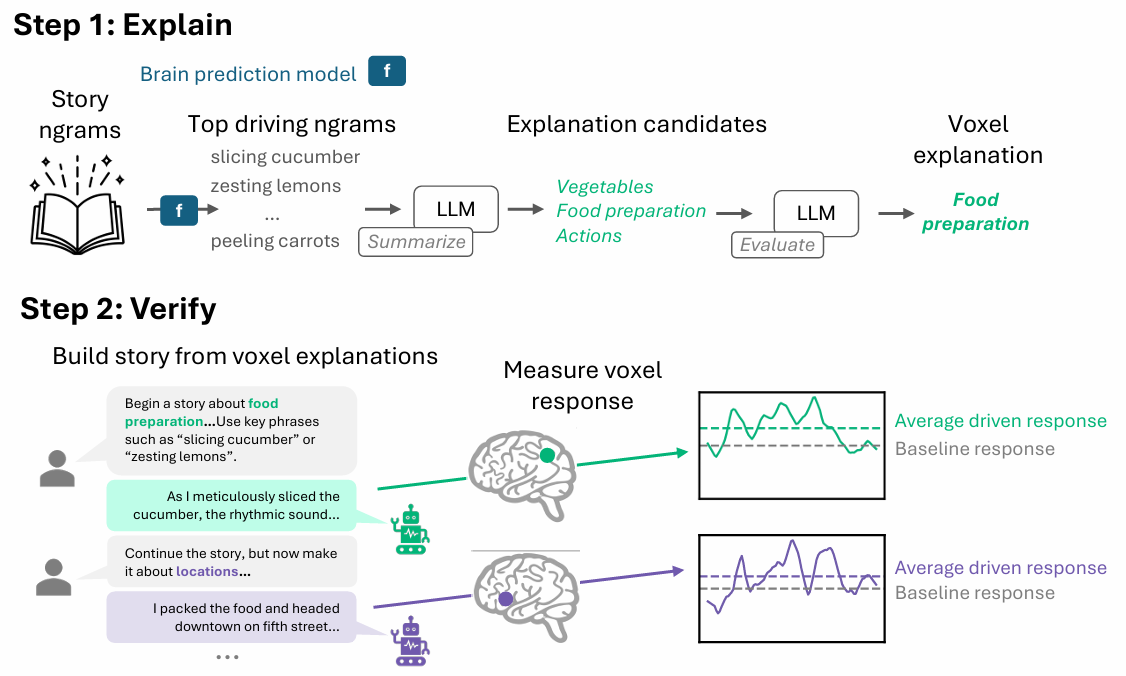
Figure 1: Diagram showing a 2-step process. At the top, in the first step a pipeline of arrows shows the progression from story ngrams to a voxel explanation that reads “Food preparation”. The bottom shows the second step with an AI chat and images of brain regions and line plots of their responses.
Figure 1. The two steps of generative causal testing (GCT). In Step 1, the phrases that most strongly drive a brain region’s predictive model are summarized by an LLM into a short candidate explanation, such as “food preparation.” In Step 2, an LLM writes new stories designed to match that explanation, and the region’s response to these “driving” stories is measured in the scanner and compared against baseline. 

How GCT works

GCT has two steps: explanation, then verification. To generate an explanation, the method starts from a predictive model for a single voxel or region and identifies the short phrases that most strongly drive its predicted response. An LLM then summarizes those words into a concise verbal explanation, often a single phrase such as “food preparation” or “location names.”

The crucial second stage closes the loop. To build trust in the explanation, GCT uses an LLM to write new stories in which each paragraph is carefully constructed to drive a brain region according to its explanation. Three subjects returned to the scanner to read these synthetic stories. If a region’s activity to its “driving” paragraphs was significantly greater than to baseline text, the explanation passed a genuine causal test, not just a correlational one.

Across all three subjects, the core approach held up: the synthetic stories reliably drove their target regions above baseline, confirming that GCT’s short explanations capture something the cortex genuinely responds to. The explanations were also most trustworthy where the underlying brain-prediction models were strongest (the more stable the model, the more reliably its explanation could be confirmed in the scanner). With the method validated on regions whose selectivity was already known, the researchers turned GCT on harder questions.

Figure 2: Six visualizations of brain surfaces show the normalized bold response for different categories including Locations and Food Preparation.
Figure 2. Brain response maps to GCT stories for different topics. Some maps recover well-established findings: the explanation “Locations” produces strong responses in the place areas RSC, OPA, and PPA. Others independently confirm newer hypotheses: “Food Preparation” activates a region in ventral occipital cortex near the fusiform face area (FFA). Some like (“Birthdays”) do not map cleanly onto any known result, pointing toward directions for future research.

GCT also proved sharp enough to settle long-standing ambiguities. Three neighboring regions involved in processing places have often been treated as functionally similar: the retrosplenial cortex (RSC), the parahippocampal place area (PPA), and the occipital place area (OPA). At first, stories written for one region also activated the others. But by generating differential stimuli (stories designed to switch one region on while keeping its neighbors quiet), GCT teased the three apart. For example, RSC responds more strongly to proper noun location names, like Tokyo or Connecticut, rather than general location. This is the kind of nuanced, region-specific theory that a raw predictive model cannot provide on its own.

Beyond known regions, the authors discovered new prefrontal “micro-regions.” By scanning a grid of candidate locations and keeping only the most stable ones, GCT surfaced these previously unmapped regions tuned to remarkably specific concepts: one selective for dialogue between people (words like “said” or “told”), one for mentions of clock times (“one o’clock”), and one for numeric measurements (“50 feet”). These are distinctions no one had gone looking for; they emerged because the method could propose a hypothesis and immediately test it.

Spotlight: Event Series

Research Forum | abstract background with colorful hexagons

Microsoft Research Forum

Join us for a continuous exchange of ideas about research in the era of general AI. Watch the latest episodes on demand.

Implications and looking forward

The significance of GCT reaches well beyond neuroscience. Researchers increasingly face the same dilemma: a model that predicts beautifully but explains nothing. GCT shows that a data-driven model need not be the end of inquiry; it can be distilled into a readable, experimentally testable theory, and that theory can be checked against reality by generating new experiments on demand.

For neuroscience specifically, GCT points toward a faster, more hypothesis-rich way of mapping the cortex—one where an AI system proposes what a brain region might encode and a closed-loop experiment confirms or rejects it within a single study. The same generate-and-verify philosophy could extend to other domains where powerful predictive models have outrun our ability to understand them. The broader lesson is hopeful: the rise of black-box models in science does not necessarily mean the retreat of human-readable theory. With the right framework, the two can advance together.

Acknowledgements

This work was a collaboration across Microsoft Research, UC Berkeley (Alex Huth, Bin Yu, Sihang Guo, and Aliyah Hsu), Columbia University (RJ Antonello, co-lead), and UCSF (Shailee Jain). We also thank the study participants and the broader language-neuroscience community whose tools and datasets made this research possible.

Read the paper (opens in new tab): “Generative causal testing to bridge data-driven models and scientific theories in language neuroscience,” accepted in Nature Neuroscience and the code on Github (opens in new tab).