


UC Berkeley chip with 16 carbon-nanotube sensors detects walnut allergens at 0.05g and chicken spoilage within 24 hours
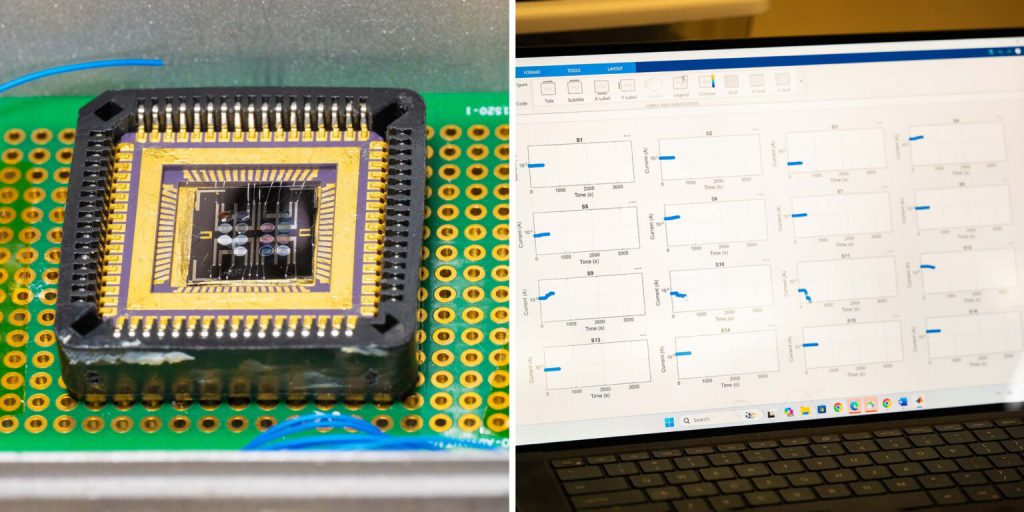
The late-night leftover sniff test — chicken container at arm’s length, cautious inhale, no clear verdict — is a near-universal kitchen ritual. That guessing game might have an expiration date of its own. UC Berkeley Ph.D. student Carla Bassil has built an electronic nose: a chip packed with 16 carbon-nanotube gas sensors and machine-learning software that reads the volatile compounds food releases and identifies what’s safe and what’s not. The most striking result so far: it detected 0.05 grams of walnut — roughly one hundredth of a single shelled walnut. A portable prototype already connects to an iPhone app. If you’re curious about the broader world of kitchen gadgets that are quietly reshaping how we cook and eat, this research fits a larger trend.
Sixteen sensors, each coated differently, create a gas fingerprint that AI reads the way Shazam identifies a song.
Each of the 16 sensors wears a different chemical coating, so each one reacts uniquely to the volatile organic compounds drifting off your groceries. Bassil calls them “digital taste buds.” The combined response across all channels forms a signature pattern — a gas fingerprint — that machine-learning models learn to classify. This isn’t sniffing for one telltale chemical. It’s reading the whole aromatic profile at once, an approach that mirrors how AI chips are increasingly being purpose-built to handle complex pattern recognition at the hardware level.
In testing, the chip:
All results were achieved at room temperature, with no heating element required. Carbon nanotube films run cooler and draw less power than traditional metal-oxide sensors, and they accept a wider range of sensing materials. The research is published in peer-reviewed journal Science Advances; this is not a product announcement.
Bassil describes the approach as using “the relative selectivity of the gas sensors, paired with the pattern recognition abilities of machine learning, to sort out which gas fingerprint is associated with each food” — producing a tool “far more sensitive and far more objective than any human nose,” according to UC Berkeley’s news release. Independent food-safety engineers have not yet publicly evaluated the system outside the Berkeley lab setting.
A portable prototype paired with an iPhone app already exists, but real kitchens are messier than controlled labs.
Bassil has already demonstrated a handheld version paired with a phone app — the clearest signal yet that this research points toward consumer hardware, not just journal papers. Separate engineering teams have prototyped fridge-mounted e-noses that alert users to gas buildup from spoiling items. The Berkeley approach stands apart through its nanotube architecture: smaller, lower power, and manufactured in a single fabrication step, which matters enormously if this ever needs to scale beyond a university lab. For a sense of where practical kitchen gadgets stand today, the contrast with this emerging technology is striking.
For families managing food allergies, a portable scanner catching trace nut contamination sits in a different category than reading ingredient labels and hoping for the best. That said, honesty matters here: the system hasn’t been tested with mixed foods or overlapping kitchen odors. Your fridge smells like last night’s curry, this morning’s coffee, and whatever that thing in the back used to be. Controlled labs don’t replicate that chaos.
Sensor drift, calibration, and real-world interference still stand between this chip and a consumer product.
The “best before” date on your milk is an educated guess. This chip measures actual chemical reality. Calibration challenges, sensor drift over time, and interference from household odors all need solving before anything ships. The direction, though, is unmistakable — your fridge’s next meaningful upgrade might not be a touchscreen or a camera. It might be a nose.
此内容由惯性聚合(RSS阅读器)自动聚合整理,仅供阅读参考。 原文来自 — 版权归原作者所有。