

惯性聚合 高效追踪和阅读你感兴趣的博客、新闻、科技资讯
阅读原文 在惯性聚合中打开

推荐订阅源

GbyAI
GbyAI
阮一峰的网络日志
阮一峰的网络日志
G
Google Developers Blog
J
Java Code Geeks
Blog — PlanetScale
Blog — PlanetScale
大猫的无限游戏
大猫的无限游戏
云风的 BLOG
云风的 BLOG
Vercel News
Vercel News
L
LangChain Blog
Hugging Face - Blog
Hugging Face - Blog
T
The Blog of Author Tim Ferriss
让小产品的独立变现更简单 - ezindie.com
Stack Overflow Blog
Stack Overflow Blog
P
Proofpoint News Feed
腾讯CDC
博客园_首页
博客园 - 聂微东
奇客Solidot–传递最新科技情报
奇客Solidot–传递最新科技情报
M
MIT News - Artificial intelligence
WordPress大学
WordPress大学
D
DataBreaches.Net
Microsoft Security Blog
有赞技术团队
有赞技术团队
博客园 - 叶小钗

Cerbos - All Posts

Authentik vs Keycloak: Self-hosted IdP comparison Mapping business requirements to authorization policy for automotive Fine-grained authorization for AI gateways EIC 2026: Stop counting agents, protect what they can touch Agent skill for writing authorization policies in Claude Desktop Identity security in 2026 EIC 2026 takeaways: the identity stack built for humans will not hold up for AI agents Already have authentication? Here's the authorization layer you still need. Tokens are authorization decisions: a guide to policy-driven token issuance What is a Runtime Authorization Platform It's a dimmer switch, not a kill switch. How CISOs are rethinking AI agent governance From maps to bitmaps (and from bitmaps to bitmaps) AuthZEN, Shared Signals, SCIM Events, IPSIE: Notes from the OpenID Enterprise Panel How do you update authorization policies without redeploying your application? IIW42 recap: Where agent authorization got real Cerbos PDP v0.52.0/v0.53.0: Engine performance, security hardening, and CEL path functions Authorization Management Platforms: what they do, how they work, and where they fit PocketOS AI coding agent deleted a production database in 9 seconds Non-Human Identity management still has a blind spot Supabase alternative in 2026: Best open source auth options Benefits of on-premise authorization: Why enterprises are moving toward self-hosted Authorization policies: How to write, test, and validate them (faster with AI) Agent skill for writing authorization policies How much does it cost to build authorization in-house? Why centralized authorization governance reduces incident response time OPA alternative Why AI agents make authorization a right now problem Modernizing legacy application authorization: why it’s your biggest security blind spot How to add authorization to legacy applications without code changes 5 authorization blind spots auditors find, and how to fix them
Announcing ePDP Rules: Fine-grained control for embedded ...
Alex Olivier · 2026-02-04 · via Cerbos - All Posts

Since launching embedded PDPs, we've heard consistent feedback from teams using client-side authorization at scale. You wanted more control over bundle contents. You asked for tenant isolation in multi-tenant applications. You needed security controls for sensitive authorization logic.

Today, we're delivering on that feedback with ePDP Rules - a new way to configure exactly what policies are served to which clients, with enterprise-grade security built in.

What you asked for

Conversations with customers building browser applications, edge deployments, and multi-tenant SaaS platforms shaped this release. Three themes emerged:

  • "We need smaller bundles for browsers." Teams building SPAs and document editors wanted to serve only the policies relevant to end-user interactions, not the full policy set used by backend services.

  • "We need tenant isolation." Multi-tenant providers wanted each customer to receive only their scoped policies, improving both security posture and bundle performance.

  • "We need access controls." Security-conscious organizations wanted authentication and network restrictions before adopting embedded PDPs for sensitive authorization logic.

ePDP Rules address all three.

Introducing ePDP Rules

An ePDP rule is a named configuration that defines exactly how a policy bundle is built and served for a specific use case. Each deployment can have multiple rules - a minimal bundle for browsers, a full bundle for edge workers, a tenant-specific bundle for each customer. All from the same policy store.
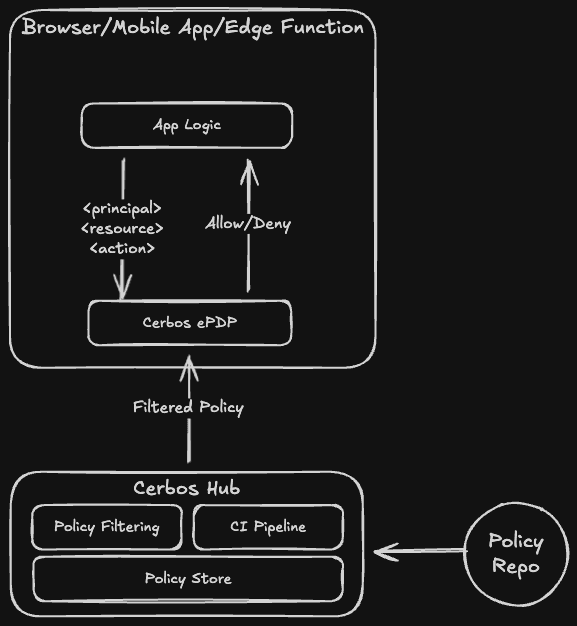
ePDP Rules diagram.png

Policy filtering

Filter bundles to include only what each client needs:

  • Resources and actions. Serve only document:view and document:edit to your browser app, keeping document:delete and admin resources server-side.
  • Scopes. Isolate tenant policies with static scopes (defined in the rule) or dynamic scopes (specified at fetch time).
  • Roles. Exclude admin-only rules from end-user bundles.
  • Versions. Support gradual rollouts or legacy client compatibility.

Security controls

Protect authorization logic with defense-in-depth:

  • Client credential authentication. Require the same credentials used by service PDPs to download bundles.
  • IP allowlists. Restrict downloads to corporate networks, CDN IPs, or known edge provider ranges.

Dynamic scopes for multi-tenant applications

For SaaS providers, dynamic scopes solve the tenant isolation challenge. Clients specify which tenant scope they need when fetching a bundle, and Cerbos Hub serves only the relevant policies. Requesting tenant-a.prod automatically includes ancestor scopes (tenant-a, root) while excluding everything else.

One deployment, multiple bundle profiles

Configure once, serve everywhere. A single deployment can define:

  • A browser rule with minimal resources and actions, filtered to end-user roles
  • An edge rule with full policies and IP restrictions for your CDN
  • Per-tenant rules with dynamic scope filtering for customer-specific bundles

Each rule gets a stable identifier that client SDKs use to fetch the right bundle.

Unified platform, feature parity

With the upgrade, we have reached parity between the PDP and ePDP. Features like Query Plans now work in embedded environments. New PDP capabilities automatically benefit embedded deployments. One platform, your choice of deployment model.

Getting started

Sign up to Cerbos Hub to create your first ePDP rule. New deployments using Policy Stores automatically support ePDP Rules.

Full documentation is available at docs.cerbos.dev/cerbos-hub/deployments-epdp-rules.

What's next

This release establishes the foundation for embedded authorization at scale. Native mobile SDK support for iOS and Android is on the roadmap, with timelines driven by your feedback.

Log in to your Cerbos Hub workspace to create your first ePDP rule today. We'd love to hear how you're using client-side authorization, and what capabilities would make it even more powerful.

If you're new to Cerbos, try out Cerbos Hub or book a call with a Cerbos engineer to see how externalized authorization can streamline access control in your applications.