





惯性聚合 高效追踪和阅读你感兴趣的博客、新闻、科技资讯
阅读原文 在惯性聚合中打开

推荐订阅源

Hugging Face - Blog
Hugging Face - Blog
宝玉的分享
宝玉的分享
G
Google Developers Blog
T
Tailwind CSS Blog
奇客Solidot–传递最新科技情报
奇客Solidot–传递最新科技情报
V
V2EX
V
Visual Studio Blog
博客园 - Franky
S
SegmentFault 最新的问题
Jina AI
Jina AI
爱范儿
爱范儿
The Cloudflare Blog
酷 壳 – CoolShell
酷 壳 – CoolShell
D
DataBreaches.Net
C
Check Point Blog
月光博客
月光博客
P
Proofpoint News Feed
T
The Blog of Author Tim Ferriss
罗磊的独立博客
H
Hackread – Cybersecurity News, Data Breaches, AI and More
MongoDB | Blog
MongoDB | Blog
The GitHub Blog
The GitHub Blog
Y
Y Combinator Blog
Martin Fowler
Martin Fowler

Cerbos - All Posts

Authentik vs Keycloak: Self-hosted IdP comparison Mapping business requirements to authorization policy for automotive Fine-grained authorization for AI gateways EIC 2026: Stop counting agents, protect what they can touch Agent skill for writing authorization policies in Claude Desktop Identity security in 2026 EIC 2026 takeaways: the identity stack built for humans will not hold up for AI agents Already have authentication? Here's the authorization layer you still need. Tokens are authorization decisions: a guide to policy-driven token issuance What is a Runtime Authorization Platform It's a dimmer switch, not a kill switch. How CISOs are rethinking AI agent governance From maps to bitmaps (and from bitmaps to bitmaps) AuthZEN, Shared Signals, SCIM Events, IPSIE: Notes from the OpenID Enterprise Panel How do you update authorization policies without redeploying your application? IIW42 recap: Where agent authorization got real Cerbos PDP v0.52.0/v0.53.0: Engine performance, security hardening, and CEL path functions Authorization Management Platforms: what they do, how they work, and where they fit PocketOS AI coding agent deleted a production database in 9 seconds Non-Human Identity management still has a blind spot Supabase alternative in 2026: Best open source auth options Benefits of on-premise authorization: Why enterprises are moving toward self-hosted Authorization policies: How to write, test, and validate them (faster with AI) Agent skill for writing authorization policies How much does it cost to build authorization in-house? Why centralized authorization governance reduces incident response time OPA alternative Why AI agents make authorization a right now problem Modernizing legacy application authorization: why it’s your biggest security blind spot How to add authorization to legacy applications without code changes 5 authorization blind spots auditors find, and how to fix them
REPL, IDE Support, Testing and more - Cerbos v0.15 Release
Alex Olivier · 2022-04-04 · via Cerbos - All Posts

The latest release of Cerbos includes a new REPL for developing conditions for policies, rich IDE support for a better authoring experience and improvements to the testing framework.

REPL

Cerbos now ships with a REPL (read-evaluate-print-loop) for developing conditions for policies. It provides an interactive environment where all the Cerbos special variables like request can be set and referenced in CEL expressions to get immediate feedback about the effects of executing those expressions. When developing complex logic, the REPL should help policy authors save a lot of time in the prototyping stage. It’s available as a sub command of the Cerbos executable and can be run from the binary or the container by invoking cerbos repl. See the REPL documentation for more information.

IDE Support

Schemas describing the structure of the Cerbos policies are now publicly available and can be used with editors (VSCode, Jetbrains and more) that support schemas to make the policy editing experience better. Most editors, when configured with the schema URL, can provide context-sensitive hints, validation and other rich editing features for policies. See Policy authoring for more information about how to configure your editor.
Testing

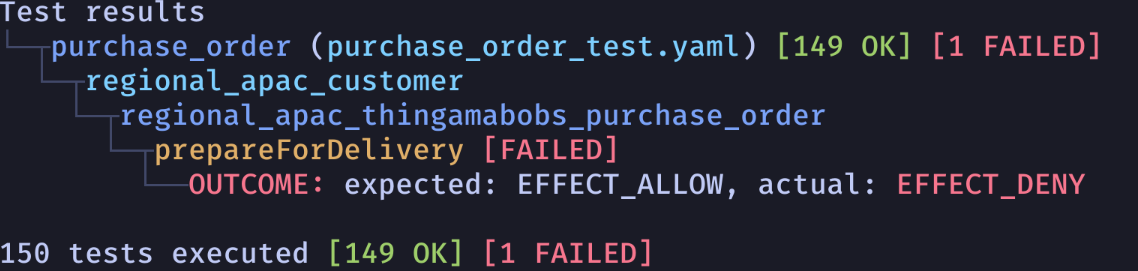
One of the core features of Cerbos is the policy testing framework. This release includes many improvements to the test runner to make the test output easy to consume by both humans and automated tools. The default output produces a summarised view of the test run which is much more compact and easy to read. Failures and other details are rendered in a natural tree structure and the output can be customised in many ways. Engine traces for failed tests are now properly rendered as JSON for consumption by automated tools as well.


Additional updates include a new method in the Admin API and cerbosctl to reload policies on demand, an improved test server with all configuration options available and anonymous telemetry to to help Cerbos developers prioritise new features and improve existing ones

You can find the full release notes here and if you have any questions join our Slack community.