


惯性聚合 高效追踪和阅读你感兴趣的博客、新闻、科技资讯
阅读原文 在惯性聚合中打开

推荐订阅源

L
LangChain Blog
阮一峰的网络日志
阮一峰的网络日志
WordPress大学
WordPress大学
博客园 - 司徒正美
罗磊的独立博客
D
Docker
Last Week in AI
Last Week in AI
爱范儿
爱范儿
M
MIT News - Artificial intelligence
V
V2EX
Google DeepMind News
小众软件
小众软件
Apple Machine Learning Research
Microsoft Security Blog
T
Tailwind CSS Blog
MyScale Blog
MyScale Blog
V
Visual Studio Blog
博客园 - 叶小钗
B
Blog RSS Feed
A
About on SuperTechFans
F
Fortinet All Blogs
T
The Blog of Author Tim Ferriss
Martin Fowler
Martin Fowler
P
Proofpoint News Feed

Cerbos - All Posts

Authentik vs Keycloak: Self-hosted IdP comparison Mapping business requirements to authorization policy for automotive Fine-grained authorization for AI gateways EIC 2026: Stop counting agents, protect what they can touch Agent skill for writing authorization policies in Claude Desktop Identity security in 2026 EIC 2026 takeaways: the identity stack built for humans will not hold up for AI agents Already have authentication? Here's the authorization layer you still need. Tokens are authorization decisions: a guide to policy-driven token issuance What is a Runtime Authorization Platform It's a dimmer switch, not a kill switch. How CISOs are rethinking AI agent governance From maps to bitmaps (and from bitmaps to bitmaps) AuthZEN, Shared Signals, SCIM Events, IPSIE: Notes from the OpenID Enterprise Panel How do you update authorization policies without redeploying your application? IIW42 recap: Where agent authorization got real Cerbos PDP v0.52.0/v0.53.0: Engine performance, security hardening, and CEL path functions Authorization Management Platforms: what they do, how they work, and where they fit PocketOS AI coding agent deleted a production database in 9 seconds Non-Human Identity management still has a blind spot Supabase alternative in 2026: Best open source auth options Benefits of on-premise authorization: Why enterprises are moving toward self-hosted Authorization policies: How to write, test, and validate them (faster with AI) Agent skill for writing authorization policies How much does it cost to build authorization in-house? Why centralized authorization governance reduces incident response time OPA alternative Why AI agents make authorization a right now problem Modernizing legacy application authorization: why it’s your biggest security blind spot How to add authorization to legacy applications without code changes 5 authorization blind spots auditors find, and how to fix them
Broken Access Control is the #1 issue in OWASP 2021 Top 10
Alex Olivier · 2021-10-07 · via Cerbos - All Posts

The Open Web Application Security Project (OWASP) is a nonprofit foundation that works to improve the security of software. Many will be familiar with the OWASP Top 10 which is published every few years and is used as the standard for evaluating the security of web applications.

The 2021 Top 10 has just been released and the top issue facing the industry is Broken Access Control. Having climbed from #5 in 2017.
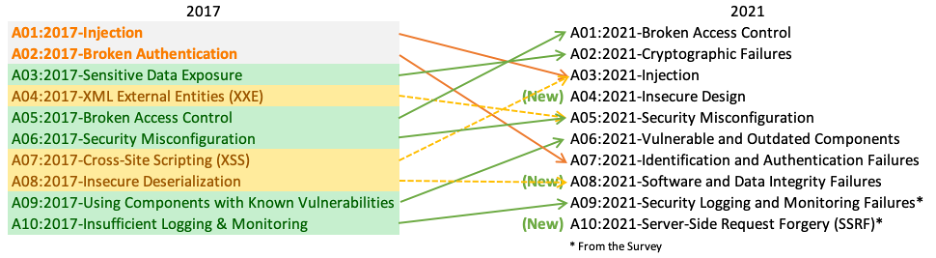
match

As a team we have worked in numerous businesses and had to ensure our products could stand up against the OWASP list when going through a pentest or compliance audit and access control was always an area of concern so we are not surprised to see it in the top spot.

Our mission with Cerbos is to ensure no one ever has to spend valuable time building access control and give the community a plug and play solution so that when it comes to the next audit or quarterly pentest it is no longer a concern.

Digging more into what OWASP has classed as “Broken Access Control” reveals all the areas that teams designing authorization need to consider - the majority of which Cerbos’ policies based ABAC controls can support:

Access control enforces policy such that users cannot act outside of their intended permissions. Failures typically lead to unauthorized information disclosure, modification, or destruction of all data or performing a business function outside the user's limits. Common access control vulnerabilities include:

  • Violation of the principle of least privilege or deny by default, where access should only be granted for particular capabilities, roles, or users, but is available to anyone.
  • Bypassing access control checks by modifying the URL (parameter tampering or force browsing), internal application state, or the HTML page, or by using an attack tool modifying API requests.
  • Permitting viewing or editing someone else's account, by providing its unique identifier (insecure direct object references)
  • Accessing API with missing access controls for POST, PUT and DELETE.
  • Elevation of privilege. Acting as a user without being logged in or acting as an admin when logged in as a user.
  • Metadata manipulation, such as replaying or tampering with a JSON Web Token (JWT) access control token, or a cookie or hidden field manipulated to elevate privileges or abusing JWT invalidation.
  • CORS misconfiguration allows API access from unauthorized/untrusted origins.
  • Force browsing to authenticated pages as an unauthenticated user or to privileged pages as a standard user.

You can read the full OWASP 2021 Top 10 here and if you want to learn more about how Cerbos can mitigate these issues in your application check out our documentation and join our Slack Community.