
惯性聚合 高效追踪和阅读你感兴趣的博客、新闻、科技资讯
阅读原文 在惯性聚合中打开

推荐订阅源

钛媒体:引领未来商业与生活新知
钛媒体:引领未来商业与生活新知
MongoDB | Blog
MongoDB | Blog
博客园_首页
博客园 - 三生石上(FineUI控件)
博客园 - 聂微东
B
Blog RSS Feed
D
Docker
IT之家
IT之家
大猫的无限游戏
大猫的无限游戏
OSCHINA 社区最新新闻
OSCHINA 社区最新新闻
阮一峰的网络日志
阮一峰的网络日志
罗磊的独立博客
Recent Announcements
freeCodeCamp Programming Tutorials: Python, JavaScript, Git & More
A
About on SuperTechFans
The GitHub Blog
The GitHub Blog
G
Google Developers Blog
V
V2EX
量子位
雷峰网
雷峰网
月光博客
月光博客
云风的 BLOG
云风的 BLOG
奇客Solidot–传递最新科技情报
奇客Solidot–传递最新科技情报
T
Tailwind CSS Blog

Cerbos - All Posts

Authentik vs Keycloak: Self-hosted IdP comparison Mapping business requirements to authorization policy for automotive Fine-grained authorization for AI gateways EIC 2026: Stop counting agents, protect what they can touch Agent skill for writing authorization policies in Claude Desktop Identity security in 2026 EIC 2026 takeaways: the identity stack built for humans will not hold up for AI agents Already have authentication? Here's the authorization layer you still need. Tokens are authorization decisions: a guide to policy-driven token issuance What is a Runtime Authorization Platform It's a dimmer switch, not a kill switch. How CISOs are rethinking AI agent governance From maps to bitmaps (and from bitmaps to bitmaps) AuthZEN, Shared Signals, SCIM Events, IPSIE: Notes from the OpenID Enterprise Panel How do you update authorization policies without redeploying your application? IIW42 recap: Where agent authorization got real Cerbos PDP v0.52.0/v0.53.0: Engine performance, security hardening, and CEL path functions Authorization Management Platforms: what they do, how they work, and where they fit PocketOS AI coding agent deleted a production database in 9 seconds Non-Human Identity management still has a blind spot Supabase alternative in 2026: Best open source auth options Benefits of on-premise authorization: Why enterprises are moving toward self-hosted Authorization policies: How to write, test, and validate them (faster with AI) Agent skill for writing authorization policies How much does it cost to build authorization in-house? Why centralized authorization governance reduces incident response time OPA alternative Why AI agents make authorization a right now problem Modernizing legacy application authorization: why it’s your biggest security blind spot How to add authorization to legacy applications without code changes 5 authorization blind spots auditors find, and how to fix them
Announcing the new Cerbos Hub usage dashboard
Alex Olivier · 2025-08-05 · via Cerbos - All Posts

In any production system, observability is key. For an authorization layer that is central to your application's security and functionality, understanding usage patterns, performance, and decision outcomes is critical. Hardcoding this logic or relying on scattered logs is not a scalable or manageable solution. Modern applications require a centralized, insightful view of their authorization metrics.

To address this, we are excited to launch the new Usage Dashboard in Cerbos Hub. This new feature provides a comprehensive, real-time view of your authorization service, allowing you to monitor key metrics, analyze trends, and gain valuable insights into your policies and their consumers.

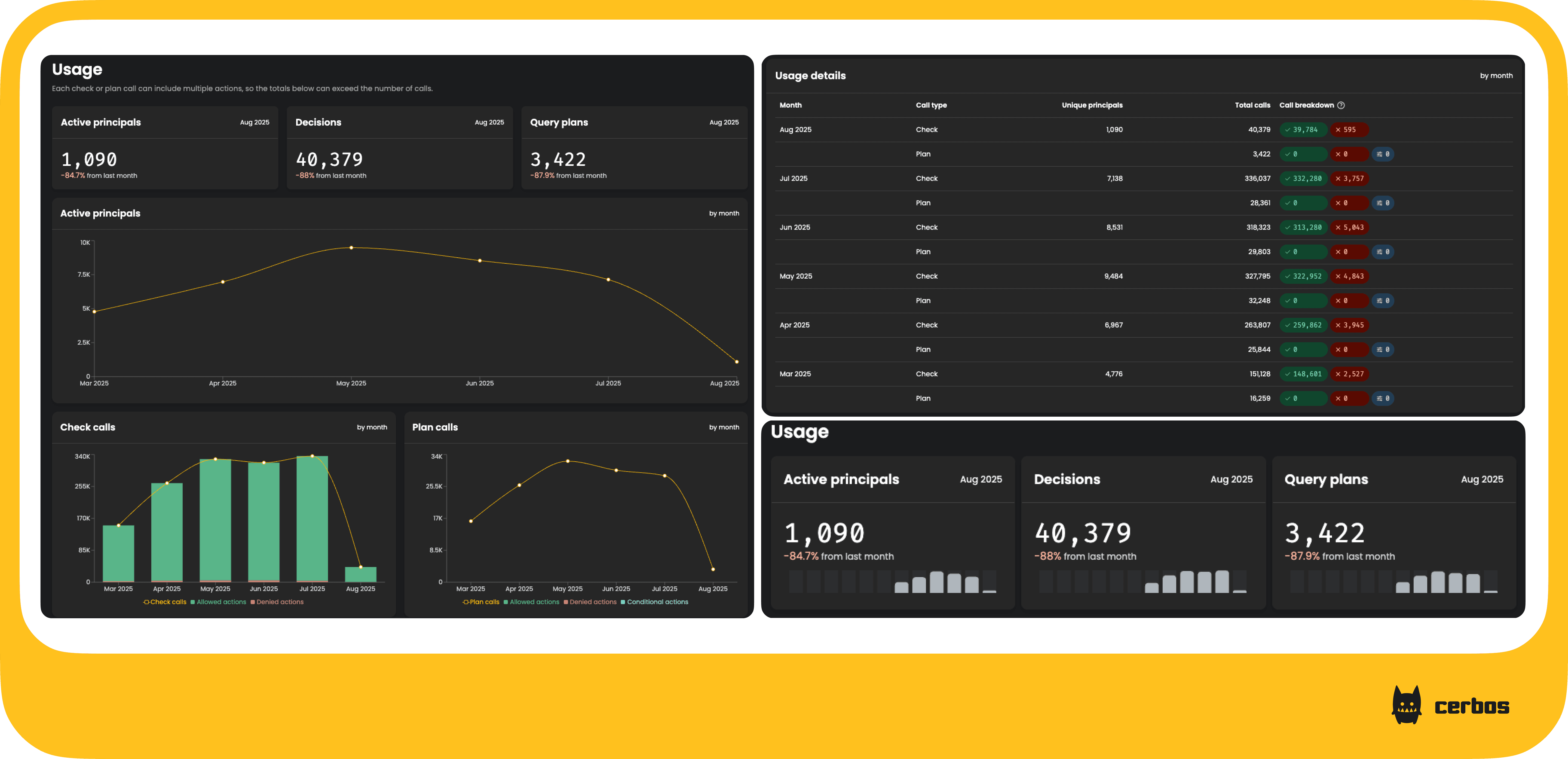
The new usage insights, available on both the workspace homepage and its own dedicated "Usage" section, surface these key metrics into a quick reference dashboard. It provides a detailed breakdown of your Monthly Active Principals (MAPs), decisions, query plans, and more, allowing you to see exactly how your authorization policies are being used.
Announcing the new Cerbos Hub usage dashboard.png

Key metrics

The dashboard provides several key widgets, each designed to give you a specific insight into your authorization layer:

  • Active principals. This tracks the number of unique principals that trigger policy evaluations. Monitoring this helps you understand user activity and capacity planning for your Cerbos PDP instances.
  • Decisions. See the total volume of authorization decisions being made over time. This is a direct measure of your authorization workload and can help you spot trends and anomalies.
  • Query plans. For users of Cerbos' advanced query planning features, this metric provides insights into the number of query plans being compiled, helping you understand the complexity and usage of your data-aware policies.
  • Check calls. Analyze the volume of Check API calls, with a clear breakdown of Allowed vs. Denied outcomes. A sudden spike in denied calls could indicate misconfigured policies, application bugs, or even security probes.
  • Plan calls. For those using query plans, this chart shows the usage of Plan API calls, breaking down the responses into Allowed, Denied, and Conditional outcomes. This is crucial for understanding the behavior of policies that dynamically generate database queries.

Granular details for deeper analysis

Below the high-level charts, the "Usage details" table provides a granular, month-by-month breakdown of your authorization calls. You can see the exact number of Check and Plan calls, the number of unique principals involved, and the total calls, giving you a comprehensive historical view of your usage.

This is just the beginning

This initial release of the Usage Dashboard is the first step towards providing comprehensive observability into your authorization layer. We are committed to expanding our capabilities and would love to hear from you. What other metrics would you find valuable? How can we make this dashboard an even more powerful tool for managing your authorization policies?

Log in to your Cerbos Hub workspace to explore the new Usage dashboard today. Your feedback is invaluable as we continue to evolve Cerbos to meet the needs of developers building modern, secure applications.

If you’re interested in implementing externalized authorization - try out Cerbos Hub or book a call with a Cerbos engineer to see how our solution can help streamline access control in your applications.