


Photo: Shahram Saadat
This article is part of the Future of AI, a collection of articles that investigates how artificial intelligence will impact the fashion and beauty industries in the years to come.
In 1950, computer scientist Alan Turing proposed the “imitation game”, questioning whether a machine should be considered “intelligent” if its users couldn’t tell they were communicating with a computer. Decades later, the idea became known as the Turing Test, and remains one of the most enduring ways of thinking about AI. But the test has always been about imitation, not understanding. Today, most researchers believe AI can generate, predict, and persuade without genuinely thinking or understanding. Models are becoming increasingly good at recognizing patterns and producing fluent responses, but they still struggle with inference: understanding unspoken context, causal relationships, and the deeper meaning behind what is being said.
These limitations really matter for fashion, which sits in a profoundly unique position when it comes to AI. High fashion is an industry built on all the inferred meaning, emotion, and unspoken context that shapes human desire. Aspiration, identity, and the promise of buying into a certain life form the basis of luxury. Taste, curation, and superior craftsmanship are all notions rooted in human storytelling and the accumulation of references through time.
According to our Vogue Business AI survey, consumers value the accumulation of those references through lived experiences over any efficiency the tech creates. “I’m largely informed by the history of fashion, or that feeling of being drawn to a particular item — both vintage and new — and working out how it plays into what I already own,” says one respondent when describing what draws them to brands. “Any people in real life or online who I deem to be stylish. Personal sense of style is the most interesting and inspiring thing,” says another, of where they go for style ideas.
Only a quarter of consumers (24%) say that AI-generated fashion images and videos are as valuable as those made by humans. Most seek out fashion advice and inspiration from real humans — magazines (57%), street style (47%), fashion blogs/Substacks/Pinterest (36%), and influencers (35%) — over AI chatbots, which just 3% say they use as a source of style inspiration. Two thirds (66%) say their shopping experience would be hindered if an AI robot — instead of a human sales advisor — were to assist them in-store.
Forecasting what will happen in AI tomorrow is impossible, let alone 10 years from now. But our consumer survey — and months of conversations with technologists, analysts, and creatives — make it slightly easier to predict what consumers will want. A decade from now, AI may well have improved enough to generate runway concepts, trend reports, and shopping recommendations that are indistinguishable from those created by a human. But will consumers stop caring if there was a human behind a fashion output? The answer is likely no. What’s more likely, however, is that in 10 years time:
- AI will be ubiquitous in luxury fashion — but only in the background
- The physical in-store experience will become the apex of luxury
- Consumers won’t use mainstream AI agents for luxury fashion purchases. Luxury retailers and brands may design their own as a way to signal taste
- In a world where ‘thinking’ machines are everywhere and anywhere, humanity will become luxury’s new scarcity
Fashion futurists believe that, after all, the AI technology that gets adopted by the industry will only be what consumers fundamentally crave. “Futurism is not about what technologies can do. Futurism is about what humanity wants,” says Dmytro Kornilov, CEO of fashion innovation studio Ffface. “We only create and adopt things that we as a society and individuals want, and are ready to accept.”
AI will be ubiquitous — but only in the background
In 10 years time, experts predict that AI will underpin the entire luxury industry. It will sit in the background, driving efficiency and enabling a better customer experience, in a way that the customer does not see. “What will continue to be true for luxury is that AI will not be a visible solution to the end customer,” says Andrea Steiner, associate partner at Bain with a focus on luxury retail and fashion. “It will be something that enables brands to deliver a more personalized, more engaging experience through all the different consumer touchpoints, but still keeping, at least in the foreseeable future, the human at the center of the connection.”
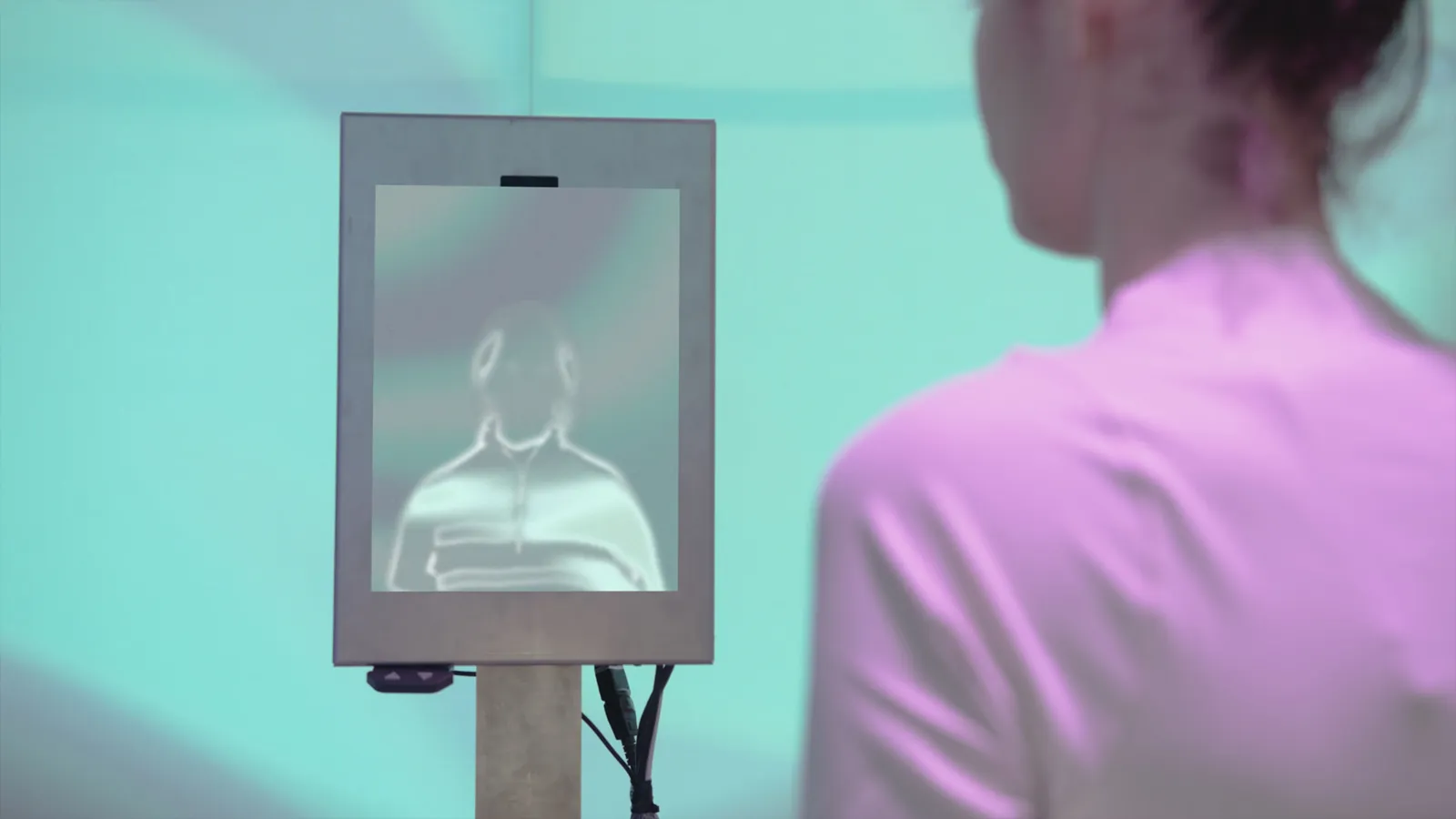
A customer experiences an AI-powered sensory experience at Nike House of Innovation, Paris.
Much of these applications of AI will be focused on backend operations, like supply chain optimization and inventory planning, which Steiner says will open up more resource for other teams like marketing and HR that handle consumer-facing touchpoints. “AI will enable brands to optimize the marketing spending on each single consumer, so they can use less marketing money for the same number of consumers, or reach more consumers within the same spend,” Steiner says, highlighting the development of what he calls “digital twins” of customers on brand CRMs that enable them to better segment marketing communications as well as pre-empt what customers want from their in-store experiences.
“The expectation of customers will increase, they’ll expect brands to know about them, what they’ve bought, and what they might like,” says Richard Overboom, experience director at Random Studio. “But in the physical environments, I believe there will be less and less visible AI.”
The in-store experience becomes the apex of luxury
These freed-up resources will allow brands to invest more in hyper-personalized clienteling and advanced experiential design for in-store — maxxing out the luxury feeling IRL, via new capabilities mostly powered by AI. “AI is turning our real life into the fourth dimension of the internet,” says Kornilov, who believes we are just “months away” from some larger groups beginning to test certain AI capabilities in-store.
Imagine walking down New York’s Fifth Avenue, glancing at a luxury brand’s storefront with your smart glasses, and seeing whether they have the size and style of jeans you want in stock across your right lens. Upon entering the store five minutes later, the shelving display has adapted to place the brand’s denim collection at the fore. A sales advisor approaches you, asks for your name, and instantaneously knows your size, travel schedule, lifestyle, and aesthetic preferences, before ushering you into the fitting room, where the jeans are ready for you to try on. You step inside, and music that reflects the mood your pace of breathing denotes starts playing over the speakers. As you try the jeans on, the mirror in front of you suggests other products from around the store in what it knows to be your size and preferred colorways, which you can style virtually with the new jeans.
Once you leave the fitting room, the sales advisor presents a range of made-to-order products on another smart screen that can be designed to fit the taste profile the brand has built from your preferences and purchase history. A week after purchasing the jeans, you receive a Whatsapp message from the sales advisor asking if you’d like to try on mock-ups of those products in-store.
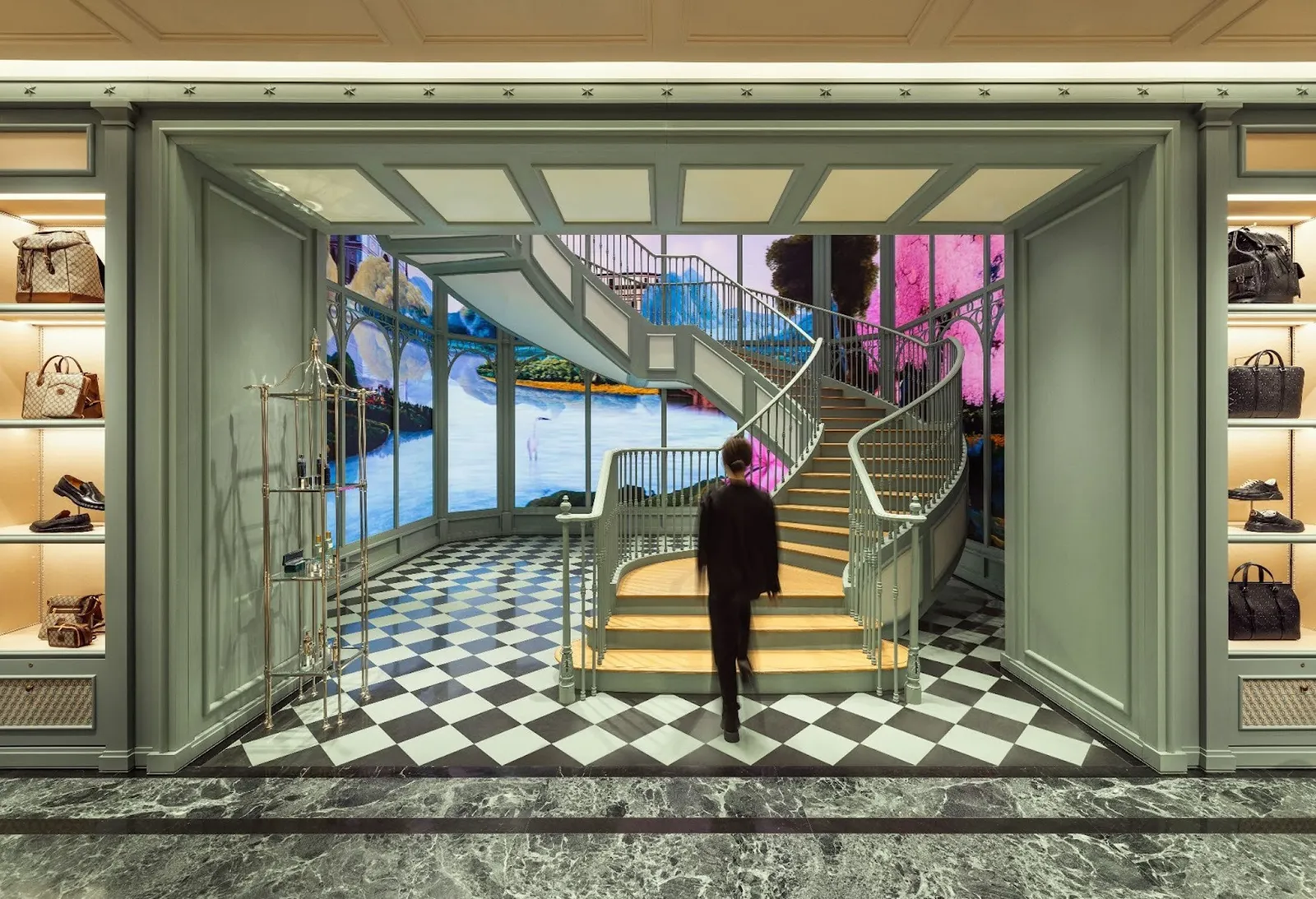
Gucci’s store in Chengdu, where Random Studio created an immersive digital fresco composed of layers of AI-generated imagery morphing together to create an ever-evolving fantasy landscape.
Experts say brands are beginning to invest in an AI-enhanced retail future where hyper-personalization and immersive experiences for pre and post-purchase like this will soon become the on and offline luxury norm. Flagship stores will function almost like theme parks for fashion devotees, as AI opens up new frontiers of experiential retail design — from lighting that responds to the customers’ breathing, to personalized soundscapes for every visitor on the shop floor. In-store clienteling will all be enabled by behind-the-scenes AI agents that deliver sales advisors with live customer segmentation, product recommendation, and store availability. But while the boundary between what is a digital purchase and a physical purchase is becoming increasingly blurred, crucially, the consumer will never feel like they’re interacting with AI.
“The beautiful thing about a lot of what AI does is to actually hide a lot of visible technology and have the human as the interface,” Overboom says.
The internet becomes “agentic”
Technologists say we’re already living in a “new era of commerce”, thanks to the emergence of AI agents that can autonomously handle end-to-end tasks they’re programmed to carry out with no human input. They predict that over the next decade, these agents will be able to carry out more and more tasks, acting increasingly like AI “personal assistants” that manage your email inbox, diary invites, flight bookings, and shopping. “We believe that agents are the next frontier and will play a critical role in ChatGPT becoming a superassistant — understanding your goals, anticipating your needs, and completing actions on your behalf, all of which could unlock new opportunities for shopping,” says Neel Ajjarapu, commerce product lead at OpenAI. “But foundational to that is trust — ensuring users stay in control, payment is secure, and data sharing is minimal.”
The biggest names in AI and commerce like OpenAI, Google, Perplexity, Anthropic, and Shopify are collaborating on open-source “protocols” to create a shared language for these agents so they can perform these tasks across every touchpoint of the internet — regardless of platform, website, or brand. Their hope is that these agents build a holistic understanding of the consumer, which could improve AI’s interpretation of personal taste.
“We’re witnessing the biggest shift in commerce since the internet,” says Harley Finkelstein, president of Shopify, who points out that the platform — which powers the majority of luxury brands’ e-commerce sites, from Victoria Beckham to Loewe — has seen orders coming to Shopify stores from AI search surge 15x since last January. “Instead of typing keywords into a search bar and sifting through hundreds of results, shoppers will simply tell an AI agent what they want, and it will find it for them. That’s a fundamentally new discovery model, and a completely bespoke shopping experience, at a scale we’ve never seen before.” Finkelstein argues that AI will act as a “trust multiplier”, drawing on all publicly available information about brands, something he believes is a “very good thing for luxury”.
Our survey of fashion-conscious consumers indicates that the performance of AI tools like ChatGPT for shopping is what’s currently holding uptake back, rather than a lack of demand. When asked to what extent they find AI chatbot recommendations for fashion and beauty products useful, 38% of respondents say they’re undecided, while 35% find them mostly useful. Just 1% of consumers think they’re “entirely useful”.
But advocates for AI’s potential in fashion believe that in the next 10 years, it will improve exponentially. “Over the next decade, AI will function much more like a personal stylist or a shopping companion — one that precisely understands your intent: your taste, your past behavior, what you linger on, what you almost bought, and how your style evolves over time,” says Elizabeth von der Goltz, chief revenue officer at Poshmark.
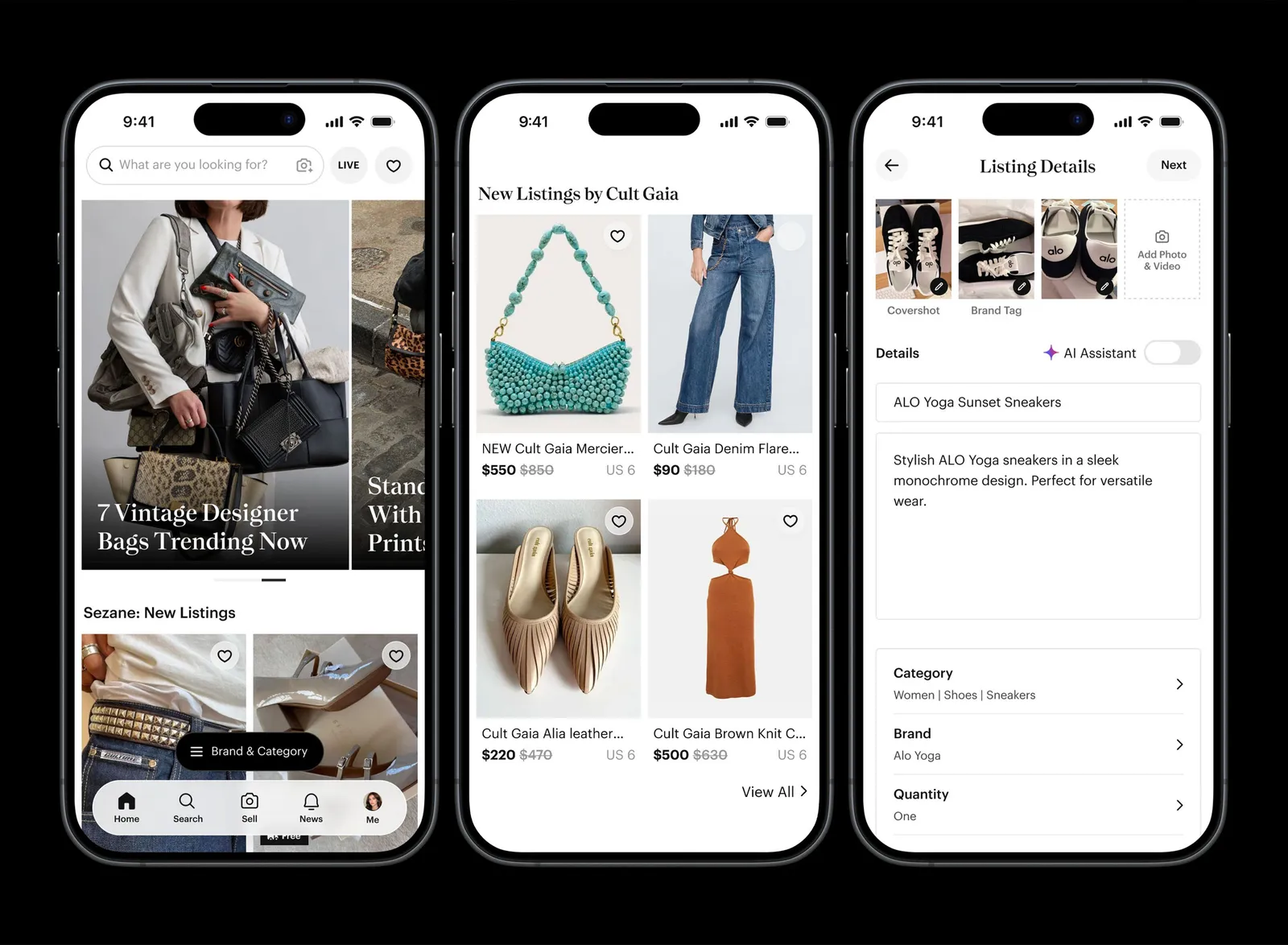
Poshmark’s AI-powered shopping app.
Since launching ChatGPT for shopping this time last year, OpenAI had released a string of features focused on hosting the entire shopper journey on ChatGPT — including an integrated checkout — which would have resulted in minimal consumer touchpoints for brands. But it then rolled back these plans to refocus on shopping discovery. Two weeks later, Walmart debuted Sparky, its own AI-powered shopping assistant that sits within ChatGPT and Google Gemini, opening up experiments with features like account linking, personalization, and native payment flows in a Walmart-branded “agent” experience on these platforms. It’s an early indication that the pendulum is shifting back to power in the hands of brands, with AI platforms serving as the infrastructure for branded AI agent experiences instead.
In response, experts say brands might develop their own AI bots that function more as branded personal styling agents — a step beyond early experiments like Ralph Lauren’s Ask Ralph AI styling assistant. This is good news for luxury brands, who could potentially editorialize these branded shopping experiences, so they feel more like their current e-commerce sites. And whoever controls the checkout stage always gains the most customer data. “I think this could all point to a world where OpenAI or Google Gemini enables you to interface with multiple branded agents,” says Max Sinclair, CEO of Azoma AI, which helps brands with their AI search strategies. Sinclair says this could take one of two forms: a world where we have one “super agent” that handles all our life admin, lives on our main device like our phone, and interacts with several branded shopping agents, or a world where we have several verticalized agents such as a “calendar agent” and a “fashion agent” that sit like apps on our device and we deploy for each task.
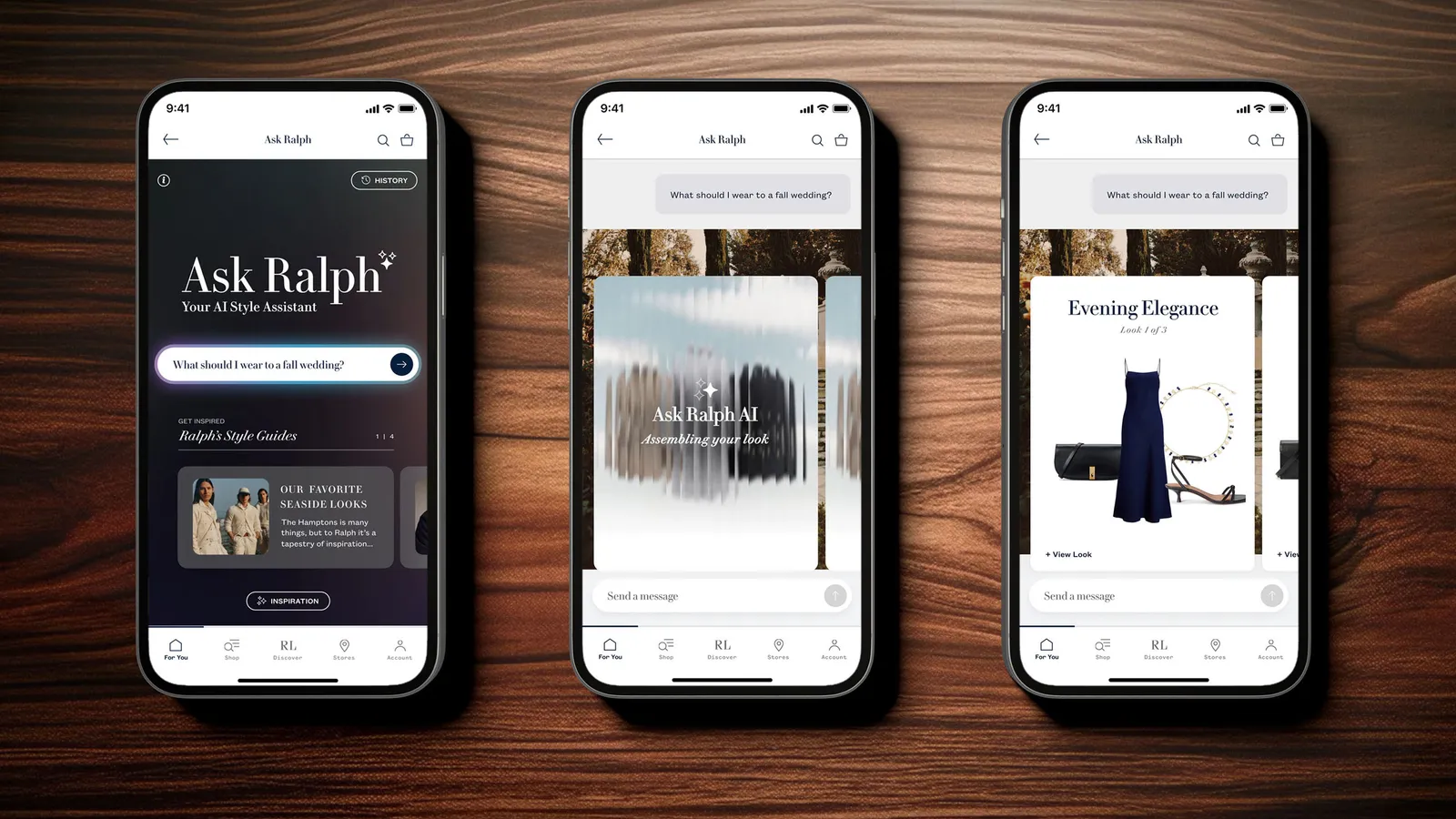
Ralph Lauren’s “Ask Ralph” AI styling tool.
But the consensus among most luxury experts — and the consumers Vogue Business surveyed — is that the use of AI agents will be limited within luxury. Only 31% of our survey respondents would outsource shopping to an AI agent, even if it knew their taste and purchase history. Alongside accuracy, transparency and security, the fear of missing out on the joys of shopping for a high fashion item is one of our respondents’ biggest concerns. “The emotional intent of purchase, the value of a purchase… For high-end luxury, agents are a no for me, that’s a luxury experience in-store,” says one respondent. “It’s less risky due to fraud, I can quality check, and it’s a ‘real-life’ experience’. But for non-emotional, commoditized purchases (e.g. work clothes) and cheaper value (with a budget), it’s a yes.”
Humanity will become luxury’s new scarcity
Luxury will, instead, become one of the very few domains that doesn’t become entirely agentic. “Agentic AI will most likely be about segmenting the brands and the market,” says Steiner, who predicts that consumers will likely never want to hand over their card details to an agent to purchase large-ticket items from high-end luxury brands. Yet he also predicts that luxury brands themselves will use AI agents extensively — but to deliver a more “human” touch. AI agents will equip sales advisors with live in-store clienteling information, like customer segmentation, product recommendation, store availability, and background information on the present collection, so they can better focus on storytelling around the brand and conversing with the customer.
In a world where this hyper-personalization becomes a given, and the customer is cognisant of just how much brands know about them, data privacy and human touchpoints will become a luxury USP. “Being transparent with the customer about how this personalization is delivered is of the utmost importance for luxury, and is still one of the biggest reasons why delivery will be handled through humans, so you feel it’s not a machine or a robot, but a tangible entity shaping that personalization for you,” Steiner says.
The efficiency of AI will enable luxury brands to double down on elements that feel distinctively human, deliberately preserving some friction and imperfection, in a world where AI has made mass retail frictionless. Waiting lists, atelier visits, hand-finishes, archival content in marketing, founding stories, artisanal narratives — all of these will become even more important, as AI makes “humanity” more valuable, not less.
AI companies’ fashion ambitions are focused on hyper-personalization for the customer — from Daydream and Poshmark’s fashion-coded algorithms, to ChatGPT and Google Gemini’s interpretations of your data. But these promises present a paradox: the more perfectly AI understands everyone, the less special “perfect” personalization may feel. If more consumers get a completely custom experience for every brand, then exclusivity may shift from “this was made for me” to “this was made by a particular human” or “this object has a real heritage and history”.
When seamless personalization becomes cheap and abundant, people may pay a premium for signs of genuine human judgement, limitation, and craftsmanship. “Those are what define true luxury,” says Matt Maher, founder of M7 Innovations. “AI won’t replace emotional connection. It will just make it more valuable.”
