


This article is part of the Future of AI, a collection of articles that investigates how artificial intelligence will impact the fashion and beauty industries in the years to come.
In Hangzhou, a shopper can ask an AI agent to assemble an entire wardrobe, try it on their virtual avatar, and purchase it all within the same super-app. Meanwhile, in Silicon Valley, startups are racing to build even more powerful large language models (LLMs) to compete with China. And in Brussels, lawmakers are debating how that same technology should be governed.
The AI race is a high-stakes geopolitical battle between governments competing to create the most powerful technology in order to increase their economic competitiveness and safeguard national security. But different countries have fundamentally different ideas about how AI should shape business and society. The gap between those ideas is where luxury brands now have to operate.
“We’re seeing multi-locality emerging, where because of deep AI and data use, there become more local specificities,” says Holger Harreis, senior partner at McKinsey. “These specificities differ by income segment and age around the globe, but they’re always present.”
Luxury executives are preparing to tackle this growing fragmentation. Rather than scaling a single AI strategy globally, experts say that brands will need to localize how they use AI and data market by market, applying AI selectively to enhance customer experience where it matters, while protecting the elements of luxury that must remain distinctly human. The result is not one AI-driven future for the luxury market, but several.
Numerous governments — the US, China, France, the UK, Japan, the UAE, Saudi Arabia, Singapore, and more — have formally identified AI as central to their national, economic, and security strategies.
The most prominent players in the AI race are the US and China, bolstered by access to capital and driven by the growing geopolitical tensions between them. The US’s AI development is fast and startup-led. The key players — Nvidia, OpenAI, Google, Meta, Anthropic, Microsoft, and Amazon — are building models or tools, each with distinct strengths. “Maybe one is better at visualization, one is better at processing and coding, and one is better conversationally,” says Raakhi Agrawal, managing director and partner at Boston Consulting Group. “It’s more varied and containerized in the US.” This means brands must compete across multiple AI entry points simultaneously — from search to agents to platforms — potentially with no single dominant channel.
In China, companies including Deepseek, Moonshot, and Zhipu are building capable LLMs, but the AI landscape is largely being shaped by tech giants such as Alibaba and Tencent, who have access to vast amounts of consumer data from an ecosystem of integrated super-app platforms. “One platform can end up with a lot of customer data and know a lot about their preferences. But the more data and context that AI agents have, the better the recommendations are going to be and the more useful they are to a consumer,” Agrawal says.
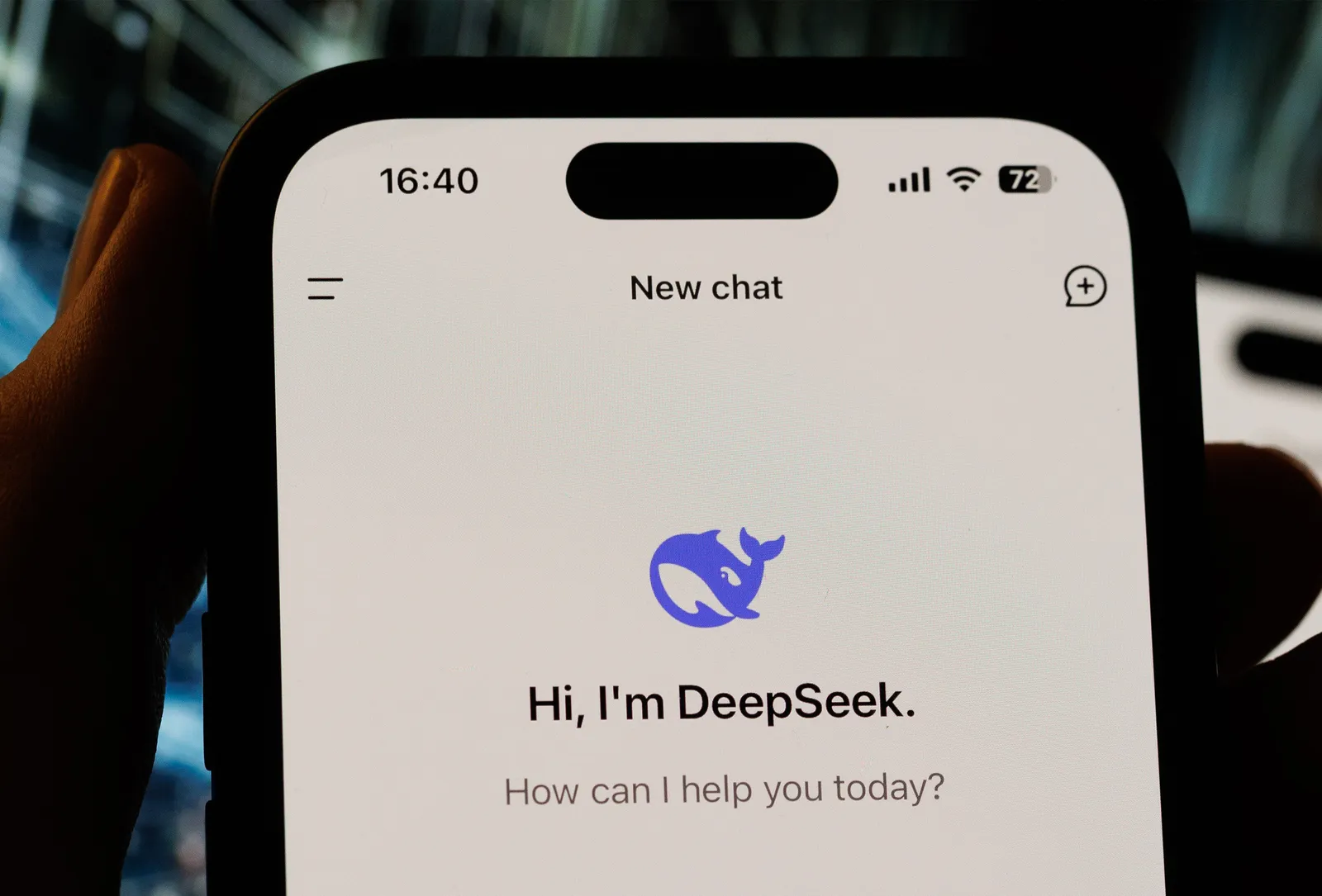
A user interface message on the DeepSeek artificial intelligence app.
A representative for Alibaba’s Tmall and Taobao describes AI as now embedded into every step of the shopping experience — from discovery and personalized search, to virtual try-on, AI-powered live streaming and intelligent customer service. “China’s AI integration in commerce is accelerating, backed by consumer openness to AI-powered experiences, digital infrastructure, and the density of mobile-first shopping behaviors,” the spokesperson said.
Europe’s two key LLM players have data privacy at the center of their offerings: Paris-based Mistral AI is Europe’s flagship AI company and has become known as “Europe’s answer to OpenAI”, aiming to offer a GDPR-compliant foundation model, while German AI startup Aleph Alpha was founded with a focus of providing European companies with control over their data.
But for the most part, Europe’s AI landscape is less oriented toward building LLMs and more toward deploying them within a regulated framework. “One of the strengths in Europe is not building these foundation models, which are being built in the US and China, but taking those models and putting them together and building these businesses around that,” says Alexandru Voica, head of corporate affairs and policy at London-based AI-powered enterprise software company Synthesia.
Beyond these three, emerging markets including India, some of the Gulf states such as the UAE and Saudi Arabia, Brazil, and Southeast Asia are also worth watching. In India, adoption and optimism around AI is high, aided by a strong base of technical talent, though the challenge for the region is access to capital. Conglomerates such as Reliance Industries and Adani have pledged hundreds of thousands of dollars with the goal of building a sovereign AI infrastructure in India. Brazil, though not a frontier AI builder, has similarly fast local adoption, while Southeast Asia is emerging as a hybrid market with mobile-fist consumers and strong e-commerce systems (including platforms such as Sea Group and Grab) rapidly adopting AI in a multi-market environment.
In contrast, the UAE and Saudi Arabia are leveraging state investment and infrastructure to position themselves as emerging AI hubs. Key players include the UAE’s sovereign investor Mubadala and Saudi’s sovereign investor the Public Investment Fund; Abu Dhabi-based Hub71, which provides tech startups with access to capital, mentorship, and networking; Riyadh-based STV, the largest tech-focused venture capital firm in the Middle East; and Abu Dhabi’s AI solutions company G42, which is backed by Mudabala.

Guests look at a model of the largest data center in the UAE under construction in Abu Dhabi as the Stargate initiative, a joint venture between G42, Microsoft, and OpenAI, during the Abu Dhabi International Petroleum Exhibition & Conference, 2025.
What connects these emerging markets is their large Gen Z and Alpha populations. “[These generations] are embracing AI technology and using it in their everyday life, including shopping recommendations,” says Agrawal. “If the [younger generations] are using it in how they shop or discover brands, that’s a signal companies need to be aware of to be ready for a shift that’s coming in the next five to 10 years.” Harreis expects these markets to drive localization as they adapt global technology to specific cultural contexts. Given the high rate of AI adoption among these populations, brands equally have an opportunity to localize AI tools in emerging markets.
Beyond which region has the most sophisticated AI, local regulatory approaches will also dictate how brands can operate across markets. The same AI-powered service — from personalized recommendations to virtual assistants — may be feasible in one market but restricted or redesigned in another. Unlike technical differences, regulatory constraints directly determine what data brands can collect, how they reach their customers, and what kinds of experiences they can legally create.
The resulting AI regulation landscape is likely to be fragmented, but not without precedent. “There’s temptation to think all of this is so new and that there’s no history to help us, but actually, there are plenty of areas where countries have had [different] regulations throughout history,” says Alexander Evans, a policy expert and former diplomat who teaches at the LSE School of Public Policy.
The obvious precedent is privacy laws. “The reality is brands already have to adapt to different regional playbooks for CRM given the data privacy and storage regulations are so different across regions,” says Andrea Steiner, associate partner at Bain. Because customer data must comply with local laws, brands cannot easily transfer customer data to track them when they travel globally. This means brands have needed to rely on local reidentification processes or more sophisticated consent frameworks to reconnect customer profiles across regions.
Whether AI regulation proves similarly navigable remains to be seen, but the operational muscle exists. The critical question is whether different regulatory systems can interoperate at all — and whether countries will consider each other’s AI policies adequate enough to allow data to flow freely — or whether it becomes siloed entirely.
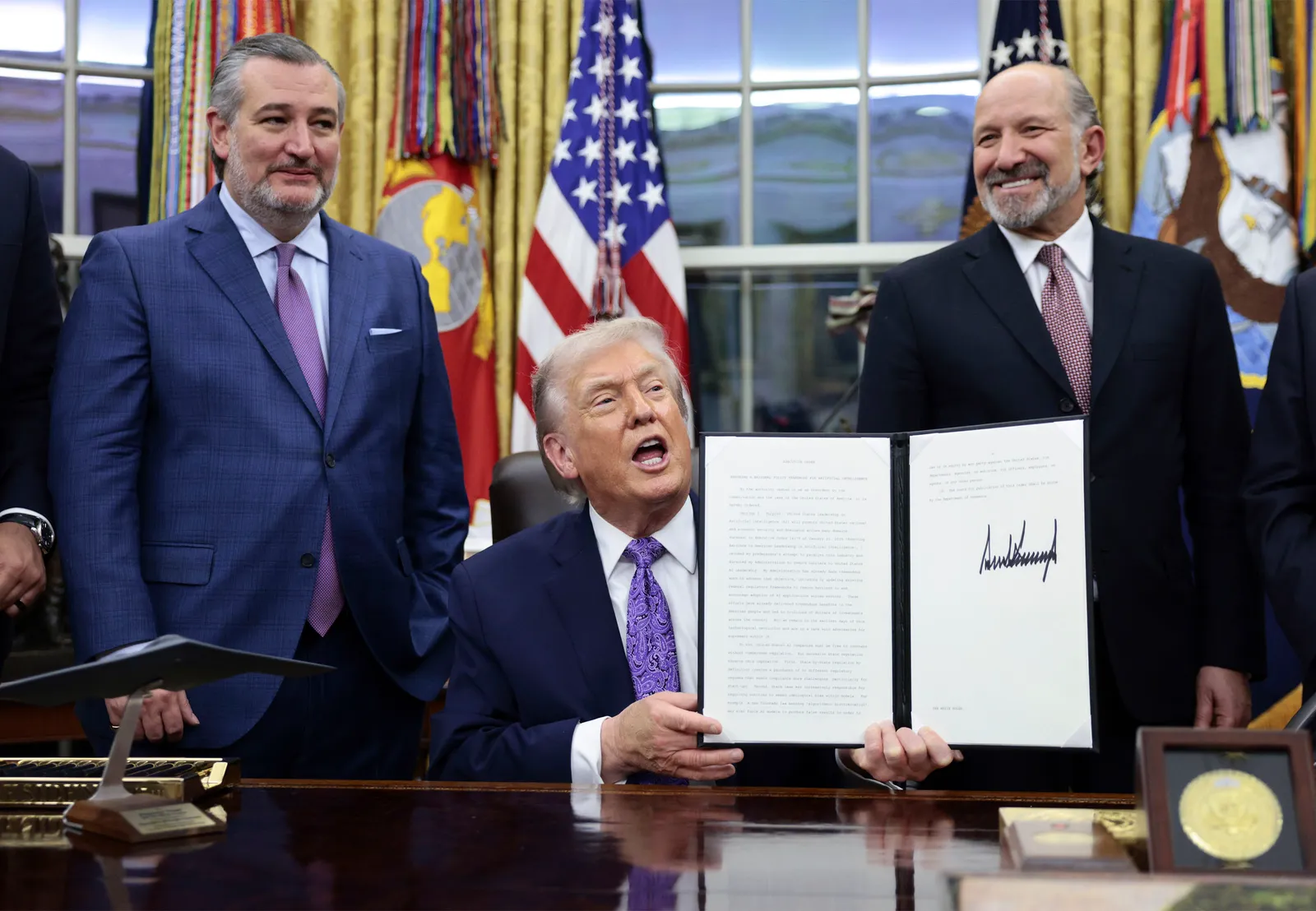
US President Donald Trump in the Oval Office of the White House after signing an executive order to stop state-level regulation of AI.
The US sits on one end of the spectrum, allowing companies to experiment and scale quickly before regulation catches up. Harreis points to the recent lawsuits filed against Meta and Google for allegedly building intentionally addictive social media platforms as indicative of the US’s regulatory pattern: light-touch at first, with legal frameworks established through consumer-driven rulings rather than proactive legislation.
Europe sits at the other end of the spectrum, seeking to set rules early before the technology has been fully embedded, for instance with the AI Act. That creates its own complications. “The EU is passing these rules that are essentially designed to have more control over American and Chinese technology companies, but the rules have been set for those building large AI foundation models,” says Voica. In practice, this creates bureaucracy for companies creating AI tools that have nothing to do with foundation models. Voica also flags unclear definitions in the AI Act — terms like “high-risk AI systems”, which lack the technical specificity needed to actually comply with. “Ideally, if there are going to be these measures in place, they need to be a lot more specific.”
The result is a “chilling effect”, Voica continues: European companies are keen to adopt AI but hesitant to commit to tools that may be regulated differently in a few years time. Steiner notes that the regulations around customer data mean European companies are more likely to “be cautious in how they develop AI solutions to remain compliant, so maybe they are piloting internally but not scaling to the customer”.
Exclusive Vogue Business research confirms that this caution carries through to the consumer, too. In a survey of 251 Vogue, Vogue Business, and GQ readers about AI in shopping, respondents in the UK and Europe were more likely to share data and security concerns, as well as calls for more regulation and legislation around data use in AI, while those in the US were more concerned with their personal data being used to upsell them, or around the quality of recommendations. Of the 141 respondents that flagged data safety and security concerns, 19.9% were from the US, compared to 75.1% from the UK and Europe. (Respondents from the US made up 24% of total survey respondents, the UK accounted for 55%, while Spain, France, Germany, and Italy combined accounted for 11%.)
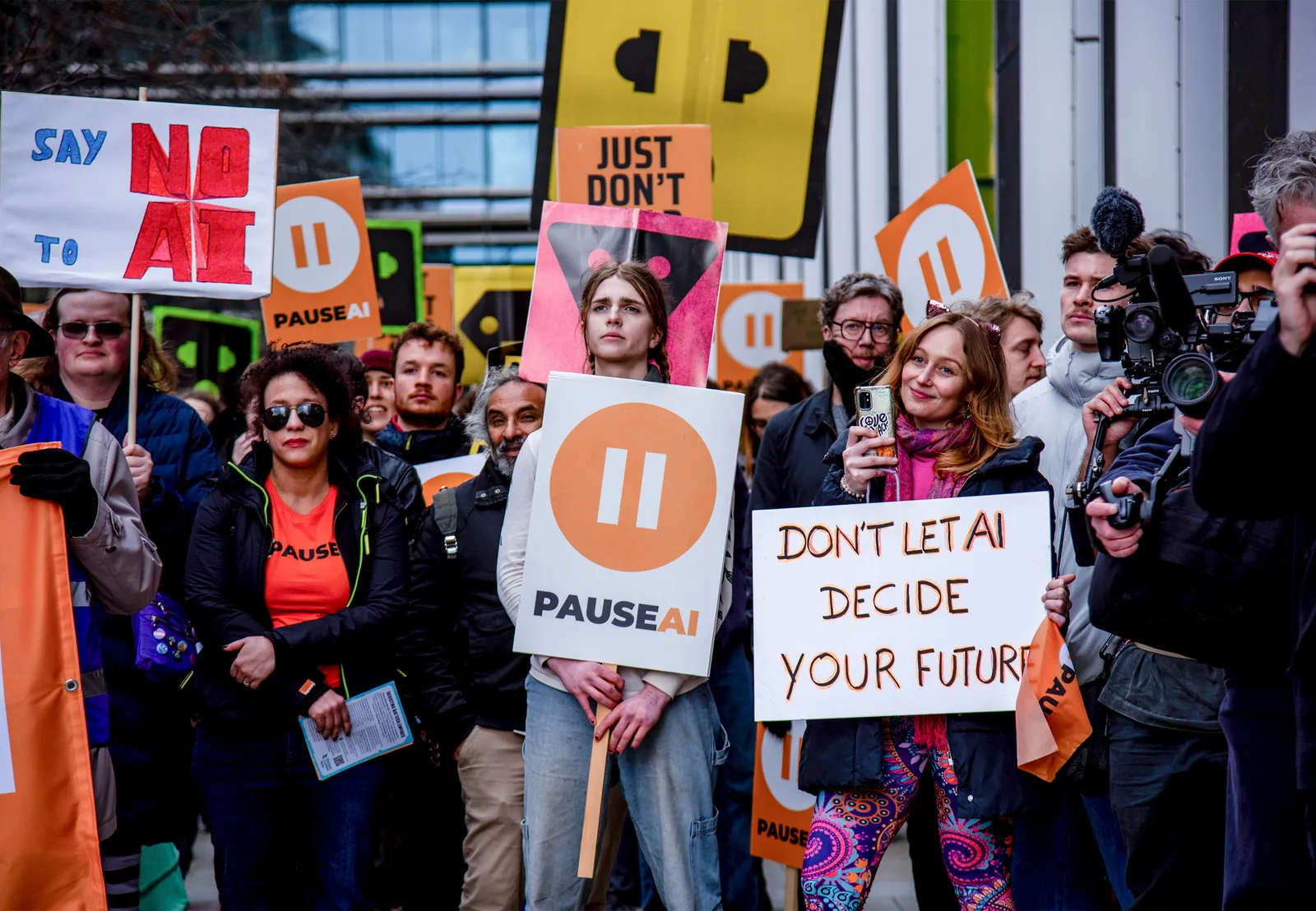
The March Against the Machines protest took place in February. Protestors marched outside OpenAI’s London offices and called for a pause on advanced AI development with greater public oversight of how the technology is regulated.
In China and parts of the Middle East, the dynamic is inverted. AI is advancing through more state-aligned models that are more closely linked to government priorities. Deep integration between technology companies and the state has enabled rapid, seamless deployment across consumer platforms. For brands, this opens up opportunities to deliver data-rich, joined-up experiences, but requires operating comfortably within a centralized system on that government’s terms.
The biggest shift luxury needs to prepare for is the move from globalized strategies back to localized ones, as they navigate differences in AI regulation and consumer acceptance across the world. Complying with regulations, while not simple, will become table stakes; the real opportunity for competitive advantage will depend on how attuned a luxury brand is with its consumers across different markets. “If a market is AI-first and people are accustomed to AI, it will push luxury houses to think about how to meet those consumers, because they’re going to want to see the level of enhanced experience that AI can offer,” says Agrawal. The definition of a luxury experience may become less consistent globally, instead shaped by the technological and regulatory norms of each market.
AI is unlikely to transform luxury uniformly. Its biggest impact will be felt not at the very top — where VVICs and VIPs will continue to expect human relationships — but in the tier below, where brands have historically struggled to deliver personalization at scale. “The big opportunity is to leverage AI to enhance the human experience that customers expect from luxury and make it more effective for those non-VIC customers,” says Agrawal.
How a brand approaches this will also depend on its positioning within the market. Ultra-luxury houses don’t need to put their entire catalogs online to be discoverable via AI search, but they are finding opportunities to better connect the digital experience with what happens before or after a store visit — improving service, streamlining operations, and enhancing clienteling without eroding exclusivity.
Wherever a brand lands, the customer will ultimately judge the outcome over the tool. “The customer will ask, is this a better experience for me?” says Agrawal. “You’ll still see a human sales associate welcoming you into the store, but maybe on the device they’re using, they’re getting AI-informed suggestions on your historical purchase pattern and who you are in terms of consumer profile, behavioral segments and how they should approach you,” adds Steiner.
As regulation remains difficult to predict, the most important thing for brands to understand is what their own customers expect from them — not just in terms of experience, but also trust. “This is a strategic decision that affects customer perception and links to the cohesiveness of the brand image and reputation,” Harreis says. “Ultimately, the question is, how far do you want to go?”
此内容由惯性聚合(RSS阅读器)自动聚合整理,仅供阅读参考。 原文来自 — 版权归原作者所有。