








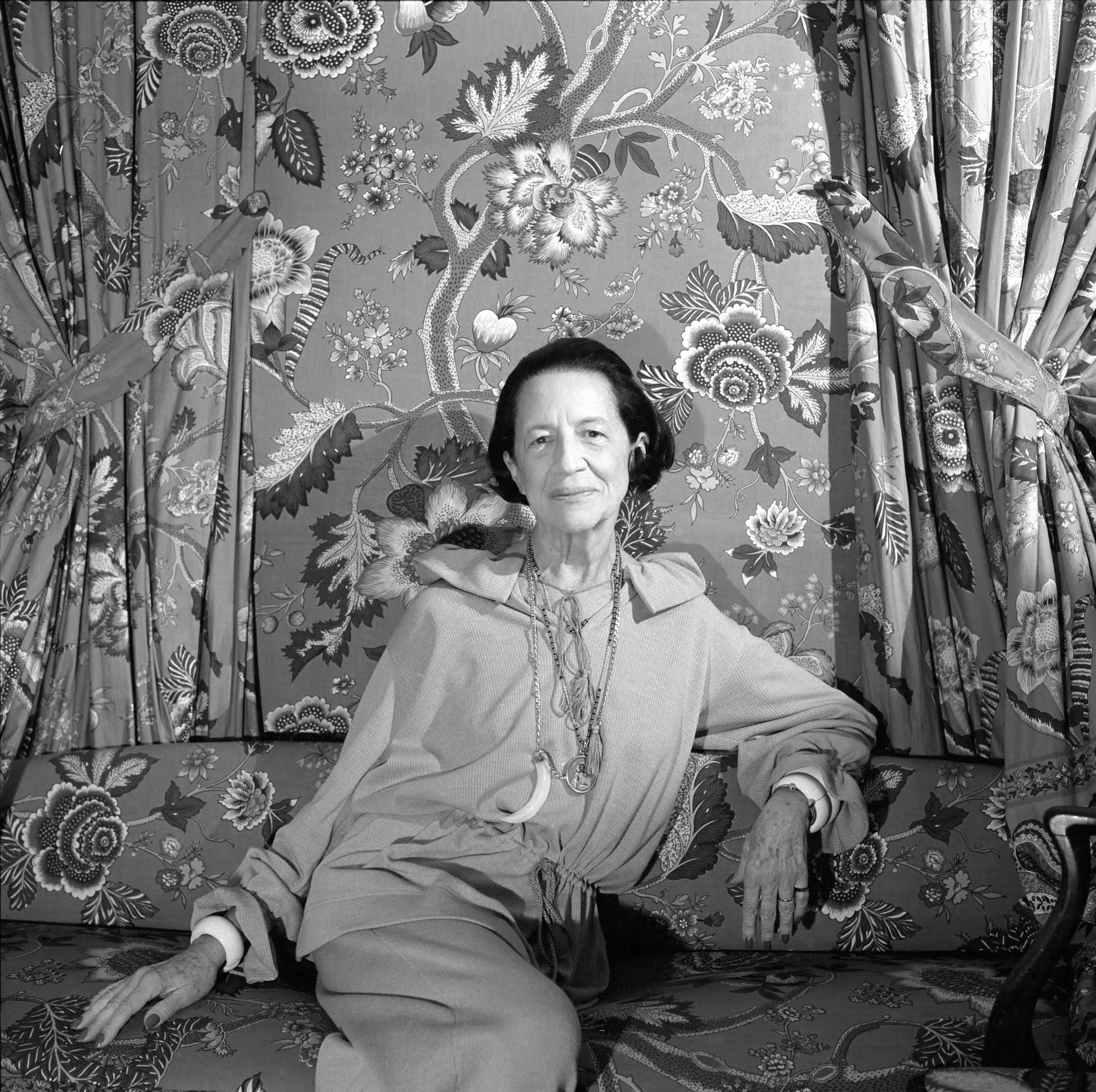
Photographed by Cecil Beaton, 1978
“Diana Vreeland” was originally published in the December 1989 issue of Vogue.
For more of the best from Vogue’s archive, sign up for our Nostalgia newsletter here.
Alexander Liberman, Editorial Director of Condé Nast
From the moment she came to Vogue, she created a revolution. Diana Vreeland shook up years of tradition that needed to be reexamined. She brought iconoclastic daring. She encouraged the breaking of rules and taboos.
She was able to do it because she was so brilliantly disciplined. She was not wild; she was a disciplined savage. She was the first editor to say to me, “You know, this is entertainment.” In many ways, she acted as a brilliant theatrical producer. She visualized Vogue as theater. She pushed a certain excess because she understood that you have to pass the stage lights and reach out beyond to your audience. She was the most talented editor of her period because she was able to stamp an era in the reader’s mind.
She admired and felt instinctively that the excitement of America was in its youth. She made Vogue move forward, to become a more dynamic, younger, with-it magazine. She was the first editor to truly sense the change in the street. And she was more obsessed with fashion than anybody I’ve ever known. She worked fantastically hard. She was a perfectionist and was very, very thorough. She was concerned as much with the practical technique of retouching and engraving as with the exactness of the combing of hair. She cared a great deal about the conveying of an image on the page. And she was very fast in her decisions. She involved instinct and chance, her way of working in the imponderable realm of fashion, beauty, and style.
She didn’t like her authority to be questioned. She refused interference as a means of protecting her creative thought process. There was an excessiveness that was special. When she arrived at work, everything suddenly became very mannered, like a form of court etiquette. She surrounded herself with charming young secretaries and assistants who served as a minor court to guard the queen. Things were slid under the door, then returned mysteriously. She would not be ready for discussion until a certain hour. There was a regality about her. She had a very special manner of placing her feet when she walked through the corridors of Vogue, which always struck me. Her studied equilibrium was such, one imagined her walking through a palace. Yet with all this sense of court rigor and regimental style, she believed in a daily uniform of a black sweater, a beige skirt, and always, comfortable shoes. She changed the concept of office life by bringing seduction to the workplace. She combined seduction with intense encouragement. Every planning of a sitting with photographers was a moment of seduction. Manners and behavior were paramount, which created an attractiveness about work. She never seemed to be involved in drudgery. A friend said, “Proust would have liked Diana.” Diana Vreeland was the ultimate in refinement.
I remember Diana coming to one of my exhibitions in the sixties. As she left, she said, “Alex, what wonderful sweaters these paintings would make.” In her mind, the show became a new graphic concept for sweaters, perhaps her greatest compliment. Art, literature, ballet, and music were her cult, the source of inspiration, an impetus. She had extraordinary antennae. One of her secrets was a creative generosity through encouragement. She thought big. There was nothing, as the French say, mesquine, about Diana Vreeland. Nothing small or petty. If she was enthusiastic about a story, we must give it sixteen pages, thirty pages! In those days, everything was possible as Vogue published two issues a month. More extravagant adventures could be achieved. Before her, Vogue had been edited to a certain severe, social register concept of the proper life. She shocked a puritanical America. Greater impact was something she dared to the hilt.
Those two stars of modern fashion, Chanel and Diana Vreeland, were comparable, although they didn’t like each other. Both were marvelous potentates, sensing in the other an important rival. Diana, with her sense of drama, flash, and flamboyance, projected more than Chanel. Chanel was the couturiere in her salon, inventing. Diana Vreeland occupied the world stage of fashion. She always loved Russia and the extravagance of the Russian character. Somewhere in her heart she was connected to the Ballets Russes. There was a Bakst, Diaghilev quality to her: the abundance of jewels, the exaggeration, the Russian color, the savagery, the opulence, the lavishness. But like Chanel, she was also very modern. She was very Anglo-Saxon and comfortable with all things English: the titles, the precise tailoring, the uniform, the regimental rigor of English life, the correctness, the meticulousness of note writing. She had an admiration for the thoroughbred, be it an extraordinary beauty or a superb racehorse.
She was a dictator in many respects and could be severe. Yet with all the difficulties and idiosyncrasies of this eccentric human being, one forgave all. I knew she was aiming for the beyond, the extraordinary, the best of everything for Vogue. I respected and admired her for this unending striving to go beyond excellence. I loved her, and we had a wonderful decade at Vogue. She was a great joy in my life.
André Leon Talley, Vogue Creative Director
Diana Vreeland went to work in the thirties and never looked back. She believed in the “get up and go, get cracking” individual. “What I am most proud of is that I’ve always gone to work,” she often said. She was a thoroughly modern woman, happily married for forty-two years, who raised a family and lived to enjoy four great-grandchildren before her death in August. Her career at Vogue, followed by her fifteen years as a consultant to the Metropolitan Museum of Art’s Costume Institute, was her exhilarating life tonic.
She knew that modern life was as rich on the streets as it was in the most sophisticated salons of Paris. Style had to come from every strata of society. She found the same kind of passion and authority in Tina Turner’s backstep in stilettos as in the writings of Isak Dinesen. She saw romance and spirit in everything from Voltaire to Jack Nicholson. I remember once we had a three-hour conversation about espadrilles. That kind of obsession with the perfect espadrille may seem neurotic to some people, but it stood for a certain sense of perfection that she always believed in. And when we had finished, around four in the morning, she decided we had to explore her apartment. So we went into the kitchen, a place she hadn’t set foot in for years. She always communicated with her cooks via the telephone, with detailed notes scrawled on large yellow legal pads in Chinese green ink, or in person, in her dressing room. We were hungry and needed a snack of peanut butter, one of her favorite foods, which she loved served to her on K’ang Hsi porcelain plates, with spoon. She didn’t have a clue as to where was in her pantry, where the cutlery was kept. It was truly a nightcrawler’s adventure. Her feet were on foreign soil in her own kitchen. Another time she had a craving for English clotted cream. For weeks, she was obsessed with clotted cream from the English countryside. She would ask for anything and, if it were humanly possible, one had to accomplish it. Finally, I asked Manolo Blahnik if he could bring some clotted cream from England for the Red Empress. Blahnik made a special trip to Bath, two hours from London, organized the clotted cream, had it packed in a special container of dry ice, and brought it with him when he came on the Concorde to New York for a working trip. The first thing we did was deliver the clotted cream to Diana Vreeland’s doorstep. And the notes that came from her the next morning were framed by both Blahnik and myself.
From the age of fourteen I knew who Diana Vreeland was, from reading Vogue. I never thought I’d get to meet her. She became not only my mentor, but my best friend. I’ve had dinners alone with her that were for me as important as attending a state dinner. I read to her on weekends. She liked my big booming voice. I sacrificed holidays and weekend evenings and read until sometimes I lost my voice. I would sit erect in a chair that she chose. We would read everything from articles on Prince to Flaubert to Truman Capote. Every Christmas Eve, I would read her A Christmas Memory by Truman Capote, who was a great friend. One day I decided to read from D.V., and she just thought it was fabulous that I would read to her from her own book.
She wasn’t a selfish person. She gave a great deal of time to you. She always cared and she’d call at the oddest hour just to say how are you, what have you I eaten today, what have you done. As The Reverend John Andrew, rector of Saint Thomas Church, the same church where she was married in 1924, so aptly said in his eulogy, “Diana appreciated the human contribution to excellence.’’ As Isak Dinesen wrote of a character in Anecdotes of Destiny, “Ah, how she will enchant the angels.”
Polly Allen Mellen, Vogue Fashion Director
I remember when Mrs. Vreeland went to see Millicent Rogers, who at that time was wearing an enormous black cotton skirt with layers of petticoats. She had every kind of ring on her fingers. She was designing her own jewelry, and every finger was covered in a bigger-then-big turquoise, her own rough jewelry. And Mrs. Vreeland said to Millicent, “Not that ring, Millicent, that looks like somebody’s misplaced tooth filling.” When Mrs. Vreeland came back from that trip we went into the market and she had this enormous black cotton sateen skirt made. That year we all wore a black sateen skirt with ten petticoats underneath with a pink Brooks Brothers oxford button-down shirt. Mrs. Vreeland started that. And she revived black ballet slippers, which we all wore.
People think of her only for fantasy. But she was the gray flannel suit lady, the gray flannel pants lady. Tailoring was very important to her. To sit and watch her be fitted was painful. She had a mirror she held to her face so she could see that everything being fitted was perfect in the back. In the fifties it was all Mainbocher; everything was made for her by Main. She had the most incredible gray flannel coachman’s coat made for her by him. Then Mainbocher did denim. She thought it was the greatest thing that ever happened to him.
She always made an entrance, but always. She was flamboyant and she was never alone. She entered a party with a man, or two men. Before her husband died, she went to parties with him. They were the most attractive couple. Her jewelry at night, her accessories, everything was extravagant, extreme, flamboyant. If it was black, it was jet black to the extreme. It didn’t matter what party you went to, she was surrounded by the most attractive people there. She was so entertaining. If you didn’t join her, you felt as if you were out in Siberia.
In Paris in the sixties, she had her hair cut by Alexandre. Before that it had been combed back into this snood, her impeccable snood, with maybe a point d’esprit bow. Then, snap. She wanted all her hair off, a new, clipped pageboy she wore for the rest of her life. I will never forget it. A decade had gone by and she wanted to get on with the newness of the sixties. She had her hair cut during the couture collections. She then went out and bought an emerald green tweed suit. All the gray Mainbochers disappeared. She started wearing brilliant colors. She changed, she got wilder. Then you saw things in Vogue like Marisa Berenson in a pink wig.
But even in those days, it was the American market she believed in and pushed: Claire McCardell, Tina Leser, Charles James, Norman Norell, James Galanos, B. H. Wragge. She went wild over Stephen Burrows. She thought him and Giorgio di Sant’ Angelo brilliant. She was always in the fabric department at Vogue. She went into the market and inspired people. She always loved working in the back. She was a backstage person, working with the tailor. She instinctively knew everything about cut, drape, the shoulder line.
Before she sent me to Japan, she made me read all of The Tale of Genji. She said to me, you will enmesh yourself, feel it, so that you get it all, so that you understand the demands I’m making on you. I couldn’t believe she was making me read this enormous book. I mean, it was erotic. So when I had finished I said, “Mrs. V., I finished. Goodness, the part when they were together, and their love affair and the whole thing. . .”and she replied, “I wouldn’t know, darling. I couldn’t read it. I couldn’t possibly read it, but I knew it would be good for you.” And when we were doing a sitting based on Scheherazade, she talked about the seraglio, and she said, “It must have at least one hundred fifty more beads! After all, if you’re going into a seraglio, you might as well take something with you.’’
She never thought about anything negative. Never. There wasn’t time for that kind of negative thinking. Turn everything into a plus, was her motto. “There’s no such thing as a failure, Polly, if you learn from it the first time.”
Horst P. Horst, Vogue photographer
She would say, “Come into my office, I want to show you something.” On the floor in front of her desk was this tiny little thing, a two-piece bikini. She said, “Don’t you think it is the most exciting thing since the atom bomb? Now find me the right girl to wear it.” Of course, she had to have the right girl. “I don’t want any of those girls that do underwear photographs.” A girl called Veruschka came to my studio. I told Vreeland about her. She called Veruschka and asked her if she would pose for Vogue. Because Veruschka was a German countess she said, “I’ll do it, but under the condition that you mention my name.” So Veruschka was launched on her career as a symbol of the sixties in Vogue.
The first thing I ever did for her at Vogue was the house of Consuelo, the Duchess of Marlborough. I said to Diana, “Listen, I have never photographed a house. I wouldn’t know how to begin.’’ But you couldn’t say no to Diana. So that’s how I began to photograph houses, with a little Roloflex, like a Brownie, with no assistant, no lights. Valentine Lawford wrote the accompanying texts. When Diana saw the photographs, of course she said, “We need more.”
I would say that Chanel and Diana Vreeland made incredible contributions to the world of style and elegance in this century. They both could fabricate anything. It always had to be new with Diana. Like Chanel, Vreeland was a very strong girl, very definite. She was a loyal friend. A week before she died, I suddenly thought, I’ve got to send her some wonderful flowers. She called up and thanked me. “I can’t wait to come and see you, Diana,” I told her. She said, “No, no. Don’t come and see me. Just call me and give me the news.”
Snowdon, Vogue photographer
When I actually met her properly, I went into her office, which was quite frightening at first. And she said, “I want you to do a story on these amazing white whales. They are so aristocratic you wouldn’t believe it.”
I said, “Mrs. Vreeland, where are they?”
She said, “I don’t know where they are. But you will find them. Or I shall get someone to find them for you.”
Well, these whales were beautiful, seventeen feet long. They were in a tank on Coney Island. I had to put on a scuba diver’s suit and dive into the tank to photograph them. I had an assistant on the outside of the tank, writing the exposures on the side of the tank. And there was some guy at the top of the tank yelling down to me, saying not to get between the whales as they would flip me with a flick of their tails and that would be the end of me. I had thought they were harmless until that moment. But I got the photograph. By chance, they intertwined for the picture. Then Diana asked me to do white horses. I worked for about two months doing white horses, terrible photographs of white horses with daffodils. And they were rejected. In the end I went to Maryland and surrounded a whole paddock of white horses with smoke bombs. I created an entire fog, so when the horses galloped into it, there were just the most extraordinary heads. She liked that.
She had great depth. You see, I don’t think she thought frocks were that important. I think she felt elegance, style, and great individuality were important. She was the most unsnobby person I’ve ever known. Like most grand people, she was mentally humble. As Kenneth Clark said of Leonardo da Vinci, Mrs. Vreeland was great because she was inquisitive. She remained young because she was inquisitive. She was loved because she was inquisitive. She enthused people because of her inquisitiveness. That was her greatest quality.
Susan Train, Paris Bureau Chief
Her whole way of working was quite different. In Paris, when she was there, we took a suite at the Hôtel Crillon and moved the office right into the salon of her suite. She had her bedroom and bathroom. Two secretaries and my assistant, the four of us, would sit in this big room. We ran extra telephone lines into the suite, had our own typewriters. We moved out the furniture we didn’t like and had big working tables moved in. She was an early riser. She woke up, had her routine breakfast of tea and porridge, and took calls. One former editor said that Diana Vreeland got more work done from her bed in the morning than anybody else did sitting in an office all day. She always spoke to every photographer who was doing anything that day. She had everybody on the move. Then she would go into her bathroom, where she would spend more time than anybody could possibly conceive. I never knew what she was doing in there. There must have been yoga and meditation and exercises and creams. I could never figure it out because when she came out of the bathroom, she would then sit down and do her makeup at her dressing table. Everywhere we would put little notepads. There had to be at least three in the bathroom and several on her desk, on every available surface. When she had a thought she would write it down immediately. She was always on the job. Even from the bathroom she would keep the flow going. Everything she did and everything she saw, everyone she talked to, every color, every vibration she felt was eventually translated into fashion and into Vogue.
I spent hours with her being fitted for clothes. At that time her favorite house was Balenciaga. She loved Givenchy and she went big on Yves Saint Laurent when he came into his own, and, of course, Madame Grès. Mrs. Vreeland incited Madame Gres into creating wonderful clothes. Then these dramatic hemlines and brocades would end up in Vogue.
She was always on time. And she never failed to thank people for the smallest thing. When she viewed the collections, she would sit there in a sort of trance. You could see she was dreaming. She was imagining each thing as it came out and she was imagining it worn, where and how it would be worn.
Of course, she was very theatrical and very exceptional. People who did not know her well can’t imagine how human she was. The artificial creature she seemed to some was one of the most tolerant people I have ever known. She never criticized. She took people for what they were and never tried to make them into something else. She concentrated only on the good. If there was a bad part, she ignored it. She never put anybody down. She had humor, she had great courage, she had understanding, kindness, and she had depth. She was a good friend, always loyal. And she appreciated loyalty in others. You could be up, down, in or out—she was always there as a friend.