





The new David Geffen Galleries at the Los Angeles County Museum of Art do not so much sit on Wilshire Boulevard as hover above it, a long, blobby concrete structure stretching across the street, held aloft by gargantuan, widely spaced cores. At ground level, the building feels almost improbably large, much of its underside shaded.
More than 20 years in the making, the new David Geffen Galleries opened with a ribbon-cutting on Sunday, ahead of a two-week preview period for members. (It opens to the public on May 4.) Designed by Peter Zumthor, a Pritzker Prize–winning Swiss architect known for his deeply atmospheric buildings, the project replaces much of LACMA’s mid-century campus with a single, winding strucutre. It is the brainchild of longtime director Michael Govan, who joined LACMA in 2006 and immediately set out to create a museum without hierarchy—one that places objects and artworks from across geographies and time periods into direct dialogue with one another. (The museum’s education center, restaurant, and museum shop all sit beneath the main structure’s span.)
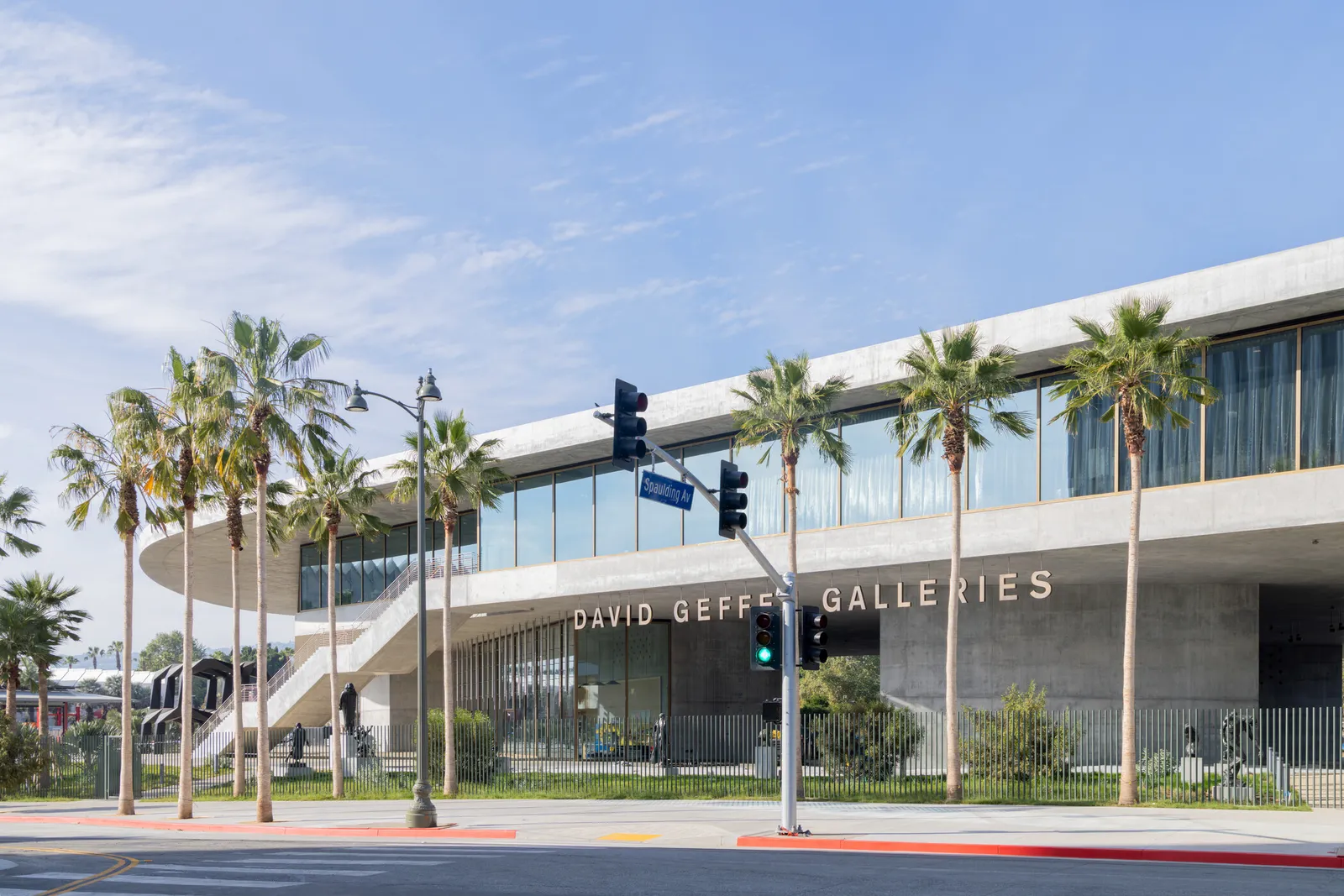
Photo: Iwan Baan
Artist Mariana Castillo Deball was commissioned to create a work that meets visitors before they even reach the galleries. Her plaza installation is etched into the ground and unfurls across the concrete in pale, sand-toned expanses marked with native animal tracks and bits of Quetzalcoatl, the Mesoamerican feathered serpent drawn from murals at Mexico’s Teotihuacan archaeological complex. Threaded through the surface are fine, raked lines that recall the sand of a Zen garden.
Castillo Deball, who was born in Mexico City, has built a practice around fragments—of objects, archives, and histories that have been scattered and displaced over time—often using archaeology and museum collections to trace how meaning is constructed and carried forward. The Quetzalcoatl figure has long been understood as a union of earth and sky, a form that bridges worlds, and here that feels almost literal. The building rises above the artwork, suspended and expansive, while the plaza remains grounded, in acknowledgment of the creatures that once roamed LA’s land.
“I thought it was a metaphor of what a museum is—that museums are made out of fragments,” says Castillo Deball. “And the first time I spoke with Michael, he explained to me that he saw this museum as an archipelago. You don’t have continents like you used to have in museums.”
In a border state where migration and cultural exchange are foundational—and immigration enforcement poses a constant threat—Castillo Deball’s work also makes that reality visible, embedding the labor of migrant workers directly into the surface of the museum.
“During the last two years, I’ve been working also with migrant workers to develop the plaza,” explains Castillo Deball. “So I also have very special contact with the current migration situation and the presence of ICE in Los Angeles. I think it’s important that I, for instance, as a Mexican artist, have a presence here in the building, and also that the hands and the traces of all these workers from Latin background [are present] on the surface of the concrete.”
After climbing one of the two external staircases or taking the elevator, you enter the galleries themselves. There is no grand, singular entrance or ceremonial procession directing your arrival. Instead, one level sprawls the length of three football fields, its perimeter ringed in glass, keeping the city in constant view: the Wilshire traffic humming below, the tar pits just beyond, and soft mountain ranges rising in the distance. From the street, glimpses of art flicker through the glass. The museum does not remove you from the city; instead, it insists that you engage with it.
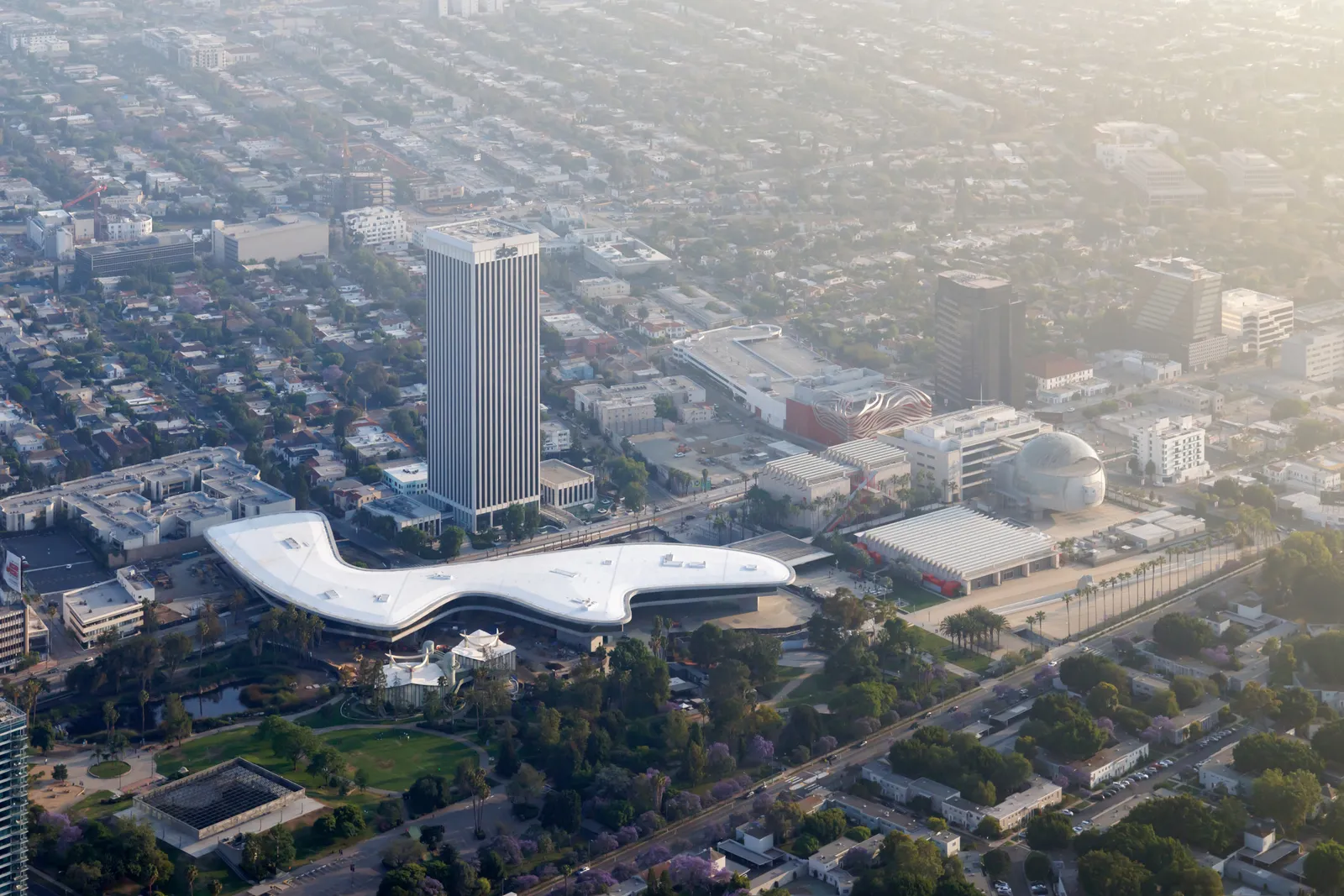
Photo: Iwan Baan
By the time Michael Govan arrived at LACMA in 2006, the museum’s mid-century campus had grown structurally inefficient and costly to maintain. Over the next decade, four buildings—the Ahmanson, Bing, Art of the Americas, and Hammer buildings—were demolished, a decision that drew sustained criticism from preservationists, architects, and critics who wondered how much gallery space would be lost when one new building went up in their place. The design itself has been equally debated—particularly its scale and heavy reliance on concrete, a material with a massive ecological footprint.
Govan has never sidestepped those concerns; instead, he reframes them in terms of time. “Everybody says concrete is not friendly,” he says. “But if the building lasts for 500 years, that’s very friendly, because in LA, usually you’d have 10 buildings built. So if this one can last and if you don’t tear down walls and rebuild them, then it’s wildly efficient.”
If the project is inseparable from institutional ambition, it is equally shaped by personal history. Its architect, Zumthor, lived and worked in Los Angeles in the 1980s, an experience that continues to inform his understanding of the city. “I have to know the emotions of a place,” he says. “I like to think of [the new LACMA building] as a Latin American project. We have to do something with the history of the place.” On the plaza level, a monumental stone head by Mexican sculptor Pedro Reyes echoes the building’s material palette, another nod to the city’s layered cultural influences.
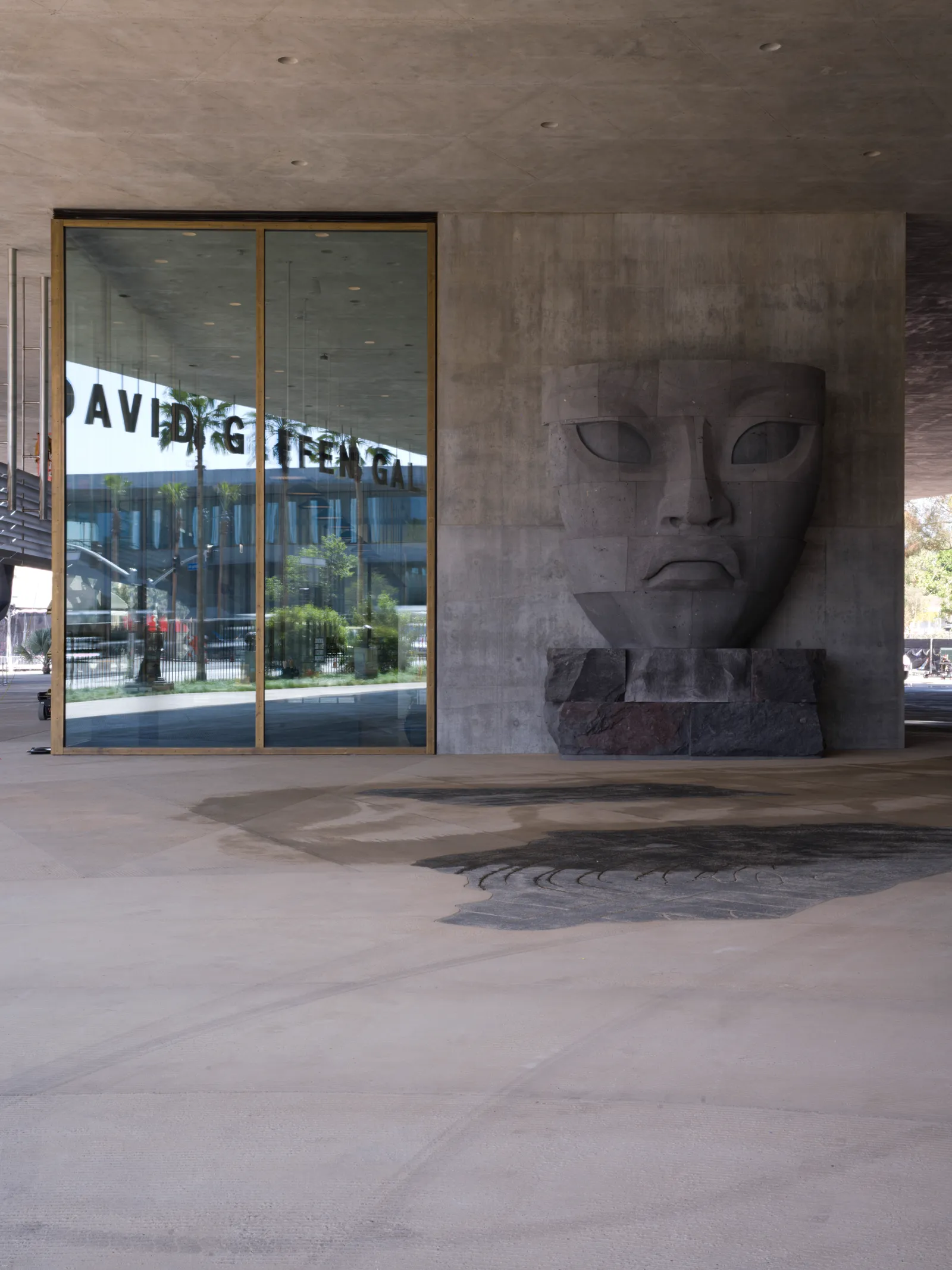
Photo: Museum Associates/LACMA
The new curatorial model is equally deliberate. For centuries, encyclopedic museums have organized their collections by geography, medium, and chronology, reinforcing a view of art history as linear and segmented. The Geffen Galleries reject that scheme entirely. Instead, the inaugural installation is organized around bodies of water: the Atlantic, the Mediterranean, the Indian Ocean, the Pacific. Oceans, in this framing, are not boundaries but conduits, linking people through trade and migration, carrying with them ideas, materials, and ways of making. (There is one crossroads in the museum that puts a fine point on this approach: multiple corridors converge in a space where large-scale photographs of each ocean hang on the walls.)
“In the 19th century, the idea [behind museums] was to categorize and separate,” Govan explains. “But we live in Los Angeles, where everybody’s integrated, and when you think about who we are as people, so much is about migration. So this installation is really about that.”
Local artists appear throughout the galleries. A new commission from Lauren Halsey—a sphinx-like sculpture that draws on both ancient Egyptian forms and the visual language of South Central Los Angeles, where she’s from—sits in dialogue with ancient Egyptian works and a Francis Bacon triptych, while a Matisse mosaic hangs opposite a bench that frames the setting sun.
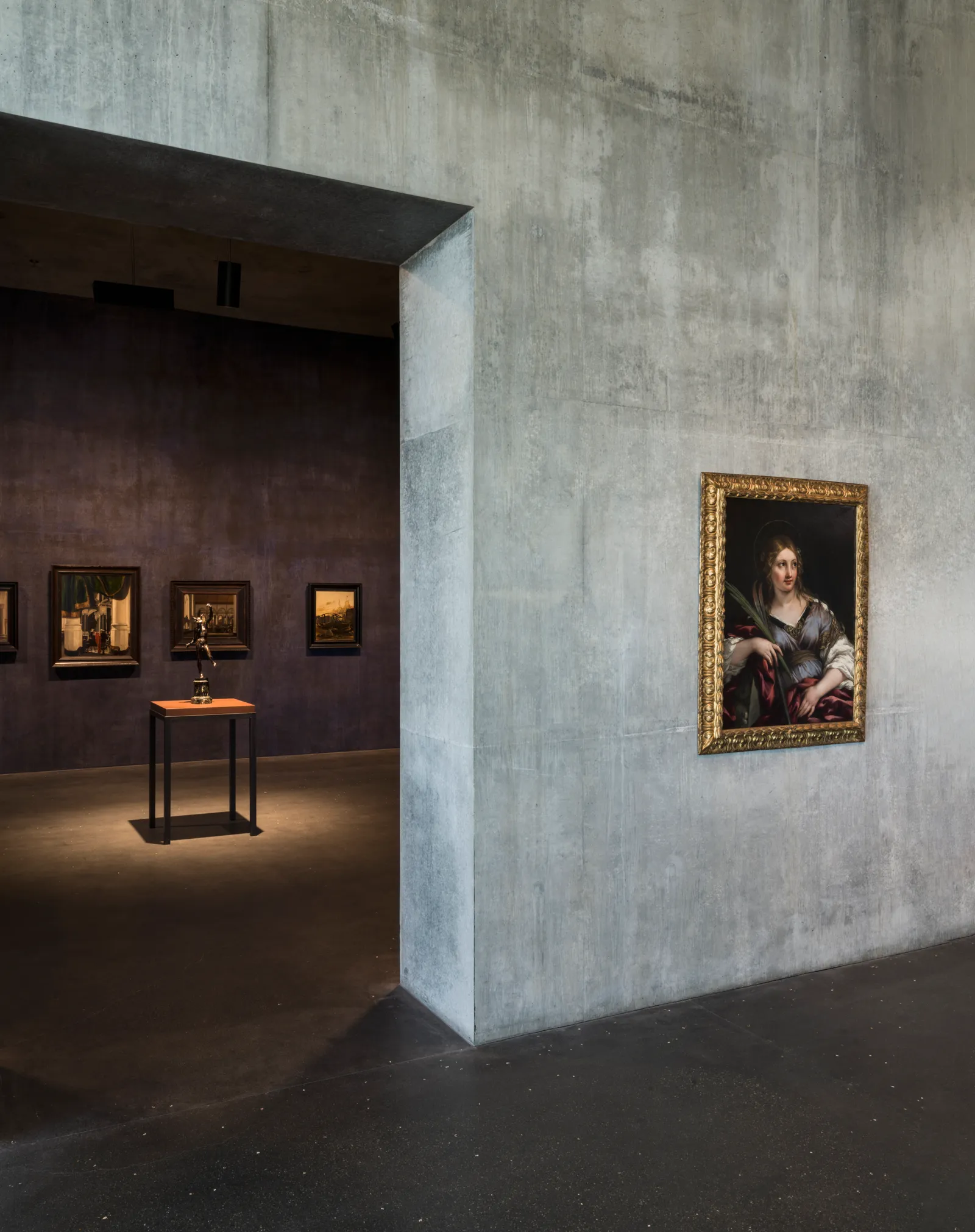
Photo: Museum Associates/LACMA
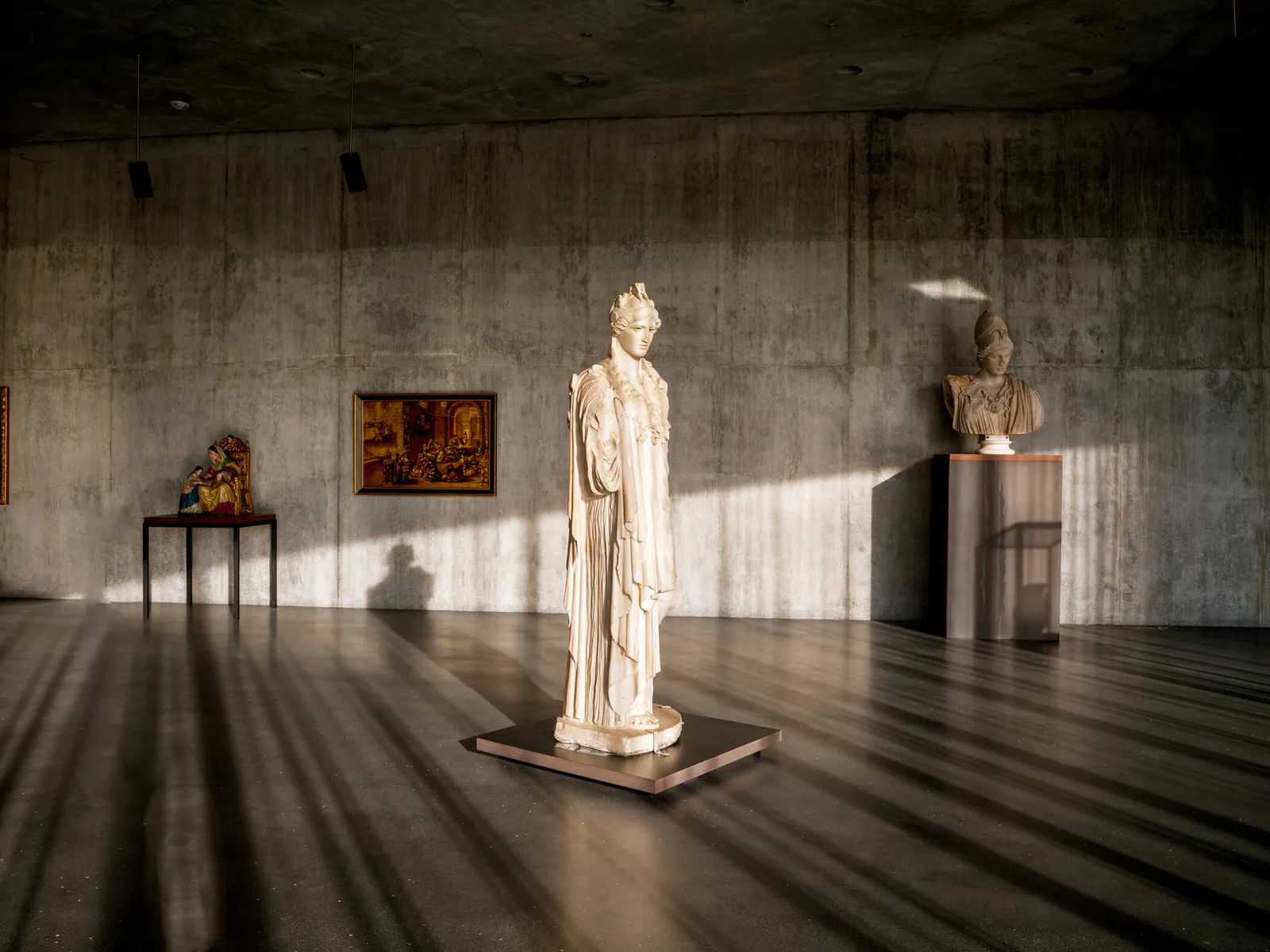
Throughout the building, the outer gallery walls are flooded with natural light, softened and refracted by custom curtains designed for the building by Reiko Sudo of NUNO Corporation. The woven textile shimmers almost imperceptibly as the sun shifts, altering the way objects register from one moment to the next. The interior galleries, meanwhile, are washed in deep mineral pigments: rich blues, burgundies, and near-black tones applied directly to the concrete.
“The natural light provides a different and super refreshing environment to display works,” says Britt Salvesen, curator and head of the Wallis Annenberg Photography Department at LACMA, who was one of 50 curators tapped to work on the museum’s installation. “You really appreciate the materials much more, whether it’s the texture of a ceramic or even a sheet of paper.”
And light, she adds, is “emotional.” “It’s changing and has different tonalities. That’s usually so controlled in a museum space and here, that emotion can really come through.”
LACMA - The Los Angeles County Museum of Art
The museum’s layout also allows for objects and traditions that have historically been sidelined in art spaces—photographs, textiles, works on paper, non-Western collections—to be encountered differently, folded into the same visual and conceptual field as more canonical works. “You don’t know what you love until you encounter it, right?” offers Salvesen. “And this definitely is intended to help people make discoveries and kind of find themselves in an area of culture where maybe it was either intimidating or unfamiliar, but suddenly you’re within it and experiencing it.”
At LACMA’s opening gala last week, guests moved through the plaza and into a tented room as performances unfolded across the spaces: a procession staged by the Seki Foundation, a Los Angeles–based arts nonprofit working across performance and ritual practices; a ceremonial welcome by Mamo Camilo, a spiritual leader of the Arhuaco community of Kutunsama, Colombia; a performance by the Mona Khan Company that drew from classical Indian dance traditions. The evening allowed different histories and cultural vocabularies to coexist within the same frame.
To round out the evening, record producer and guitarist T Bone Burnett took the stage and began to play Bob Dylan’s “The Times They Are A-Changin’.” It could have read as obvious. Instead, it felt hearteningly in step with a city that has always made a practice of remaking itself.
此内容由惯性聚合(RSS阅读器)自动聚合整理,仅供阅读参考。 原文来自 — 版权归原作者所有。