


Photos: Getty Images, Everett Collection ; Illustration: Dillen Phelps
Paramount Pictures made a lot of money in the first half of the 1990s by bringing TV characters to bigger screens: The Addams Family and Wayne’s World became massive surprise hits, spawning sequels, imitators, and ample tie-in merchandise. Other studios followed suit with TV-based smashes like The Fugitive and Maverick, and by 1996 Paramount was ready to play perhaps their biggest card yet: a big-budget adaptation of the old spy series Mission: Impossible, starring Tom Cruise, directed by Brian De Palma, and seemingly ready-made for sequels. For the first entry, at least, Mission: Impossible followed the game plan as rigorously as a trained IMF agent. It made a ton of money, in the U.S. and overseas. It became one of Cruise’s biggest hits yet. And it spawned seven sequels over the course of 30 years, before finally, maybe, possibly coming to rest with last year’s Final Reckoning. Mission accomplished.
But just before Paramount released what would become one of their signature franchises, alongside the similarly TV-based Star Trek movies (which had a big hit later in the year with First Contact), they had another show to usher onto multiplex screens in April 1996. Technically speaking, anyway; I can confirm that Kids in the Hall: Brain Candy did play at a six-screen multiplex in my hometown. More specifically, it played at the “old” mall, whose six-screen movie theater had become a second-run $2.99 joint, for exactly one week, at exactly once a day, at 12:05PM, two and a half months after its commercial premiere. They were really sweeping the corners, and it paid off handsomely with a total gross of $2.6 million. David Cronenberg’s Crash, in which people are sexually aroused by car crashes, proved slightly more appetizing to the moviegoing public at large. So did Feeling Minnesota, a long-forgotten indie quirkfest starring Keanu Reeves and Cameron Diaz, and Carpool, starring Tom Arnold. However, the Kids could take solace in the fact that they handily (by which I mean just barely) outgrossed Arnold’s other 1996 flop, The Stupids.
The Canadian sketch troupe also trounced their fellow basic-cable transplant Mystery Science Theater 3000: The Movie, which arrived in cinemas just one week after Brain Candy, and only mustered a million dollars by the end of its run, albeit on even fewer screens. That one never made it my old mall; I had to wait impatiently for VHS. Both releases could have been accurately described as past-peak versions of their respective shows, anyway: Brain Candy was made while the group’s five members were at odds, with Newsradio star Dave Foley not even on speaking terms with the rest of the group, and all five Kids suffering through individual personal tragedies, as detailed in this 25th anniversary retrospective that compares the Kids to an indie rock act like the Replacements.
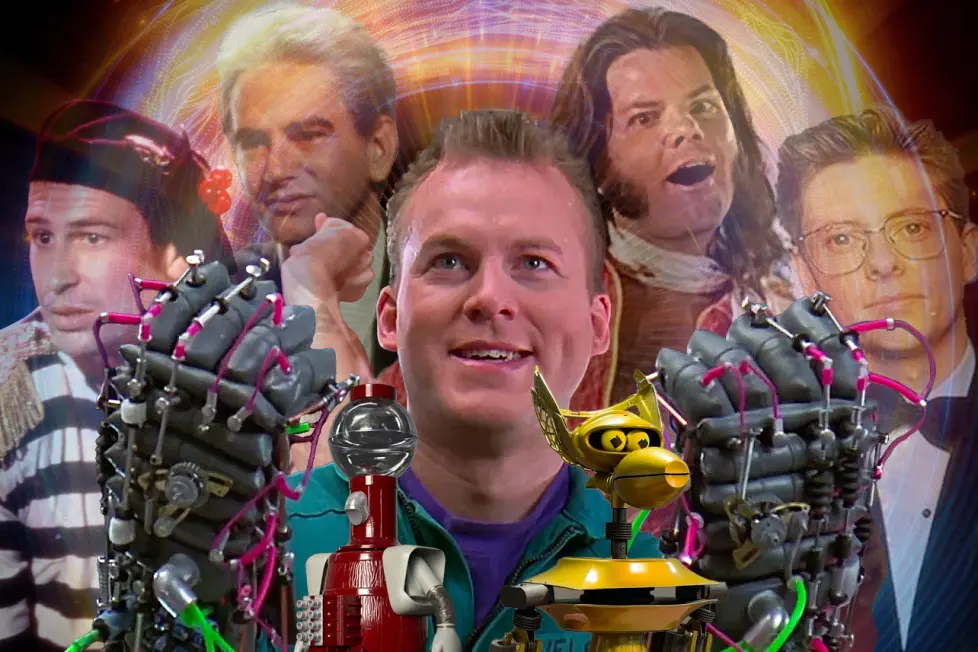
Mystery Science Theater 3000, meanwhile, somehow wound up shorter at the cinema than it was on TV. Episodes of the beloved series, in which a human and his robot companions heckle clunky low-budget genre movies, typically fit in a two-hour timeslot, meaning they’d feature around 90 minutes of material (the film, as well as some Muppet Show-like host segments involving the original characters). Cable real estate simply wasn’t as pricy as its network counterpart, and Comedy Central willingly gave over two hours at a time – or more, during their Thanksgiving marathons. The big-screen version of the show features This Island Earth, a sci-fi B-movie (which is to say, well above average for a MST3K subject) that runs 86 minutes, meaning some cuts would typically have to be made to fit the host segments. But in this case, a full half-hour of the movie was chopped out for pacing – along with one of those host breaks, leaving a 74-minute feature. Plus, heckling a decent-for-its-time sci-fi movie might seem like an upgrade, but MST3K is really at its best when its characters are faced with grade-Z trash. All of this made the movie more outlier than ultimate mega-episode.
And put together, these two cable refugees made a convincing argument that as hacky as adapting old ’60s TV shows could seem, maybe that process made more sense than attempting to translate a contemporary series to something that would inevitably disappoint longtime fans while baffling newcomers. Yet beyond their initially dire grosses (some more 1996 flops that made even more than these two films put together: Barb Wire! Joe’s Apartment! Ed, starring Matt LeBlanc!), both movies are actually pretty great introductions to their respective worlds. Mystery Science Theater 3000: The Movie does, in the end, have truncated time on its side; a 74-minute runtime is actually a great way to ease newbies into the admittedly bizarre and cult-y concept. And while no edition of Mystery Science Theater is truly all-killer, this installment is closer than many episodes.
Brain Candy is a different beast entirely. Adapting a sketch comedy series that’s essentially the Canadian equivalent of Monty Python, the Kids – Dave Foley, Scott Thompson, Bruce McCulloch, Kevin McDonald, and Mark McKinney – bypassed both the sketch-compilation feature (like Python’s And Now For Something Completely Different) and the loose-genre-parody (that’s actually more of a themed sketch compilation) of Monty Python and the Holy Grail. They went straight to Life of Brian: a more pointedly satirical story acted out by a sketch-comedy ensemble. This still allows for plenty of side characters, digressions, and eccentricity, but the Kids didn’t depend on many of their established characters for that, just as no one brandishes a dead parrot or visits an argument clinic in Life of Brian. Instead, Brain Candy is a movie about corporate drug culture, following a scientist (McDonald) who becomes rich and famous with his untested pill that cures depression. It is the funniest English-language film of 1996 and is competitive in the area of Funniest Movies of the 1990s. Among other things, it beat Mike Myers to the punch in terms of basing its megalomaniacal villain on a Lorne Michaels impression, here brought to life by Mark McKinney (who, hilariously, was on Saturday Night Live at the time of the film’s release; Michaels also produced Brain Candy, as he had produced the Kids’ TV show).
Other aspects of ’90s culture, including grunge music and salacious daytime talk shows, are skewered in the movie in a way that now gives it a dual function as a satire and a time capsule. Perhaps because director Kelly Makin took cues from filmmakers like Terry Gilliam and the Coen Brothers, the movie has a loopier and more distinctive look than other sketch-to-movie transplants, even good ones like Wayne’s World. It’s a fitting culmination of the Kids’ talent and ambition as comedians – so it makes sense that the troupe went dormant for several years afterward, even though it was actually a result of personal acrimony and financial failure.
Paramount, however, bounced back later in 1996 – even finally nailing that cable-show-to-movie transition with a holiday release. Yes, it took Beavis and Butt-Head Do America to save the day, making more on its first day in theaters than MST3K and Brain Candy combined – but then, that show, while a hilarious classic, was also an MTV smash with merch all over Spencer’s Gifts. The bombing of The Kids in the Hall and Mystery Science Theater 3000 stung in the moment, for both the filmmakers and their acolytes. But both groups went on to make more stuff: live shows, tours, miniseries, TV episodes. My experience seeking out the movies, especially getting an unexpected late-run look at Brain Candy in a theater that my buddy and I had to ourselves, was seared into my brain as a quest for cult objects that were briefly less accessible than mere cable. (Both movies were long out of print on home video, too, furthering their mystique.) In retrospect, their inability to court a mass audience was an innovative (if unintentional) way for two towering cult attractions to keep it real.
Jesse Hassenger (@rockmarooned) is a writer living in Brooklyn. He’s a regular contributor to The A.V. Club, Polygon, and The Week, among others. He podcasts at www.sportsalcohol.com, too.
此内容由惯性聚合(RSS阅读器)自动聚合整理,仅供阅读参考。 原文来自 — 版权归原作者所有。

