


Make A One-Time Gift to Support My Work
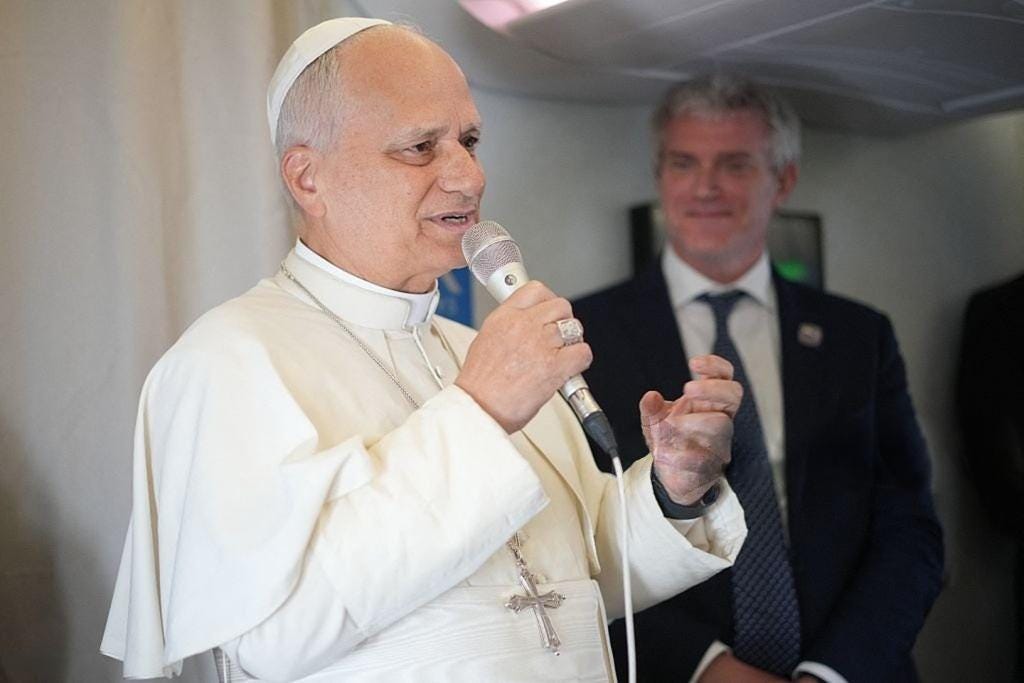
Pope Leo XIV stood in the aisle of his return flight from Malabo to Rome on Wednesday and told reporters what he has been telling the world since the United States and Israel began bombing Iran in June: “As a Church — I repeat — as a pastor, I cannot be in favor of war.”
The line came roughly twenty minutes into a wide-ranging in-flight press conference at the close of his apostolic journey through four African nations — Cameroon, the Democratic Republic of the Congo, Burundi, and Equatorial Guinea — that he described as “a blessing.” Five of the seventy traveling journalists asked questions.
Leo addressed the war in Iran and the diplomatic chaos surrounding it, the global crisis of migration, the death penalty, the Vatican’s relationships with authoritarian regimes, and — for the first time in such pointed terms — the place of sexual ethics in the Church’s broader moral witness.
He moved from issue to issue with the calm of a man who has spent eleven months being pulled in every direction by global pressure and has arrived at the Gospel as his fixed point.
The opening question came from Tg1’s Ignazio Ingrao, who pressed Leo on whether he hopes for regime change in Iran. Leo refused the bait. “The issue is not whether there is regime change or not,” he said. “The issue is how to promote the values we believe in without the death of so many innocent people.”
He kept returning to that frame all flight long. There was no taking gotcha questions about who should rule Tehran or whether NATO should escalate. The argument he was willing to make was the general one — the protection of innocent life — and the conclusions about which leaders have failed it were left to the people listening.
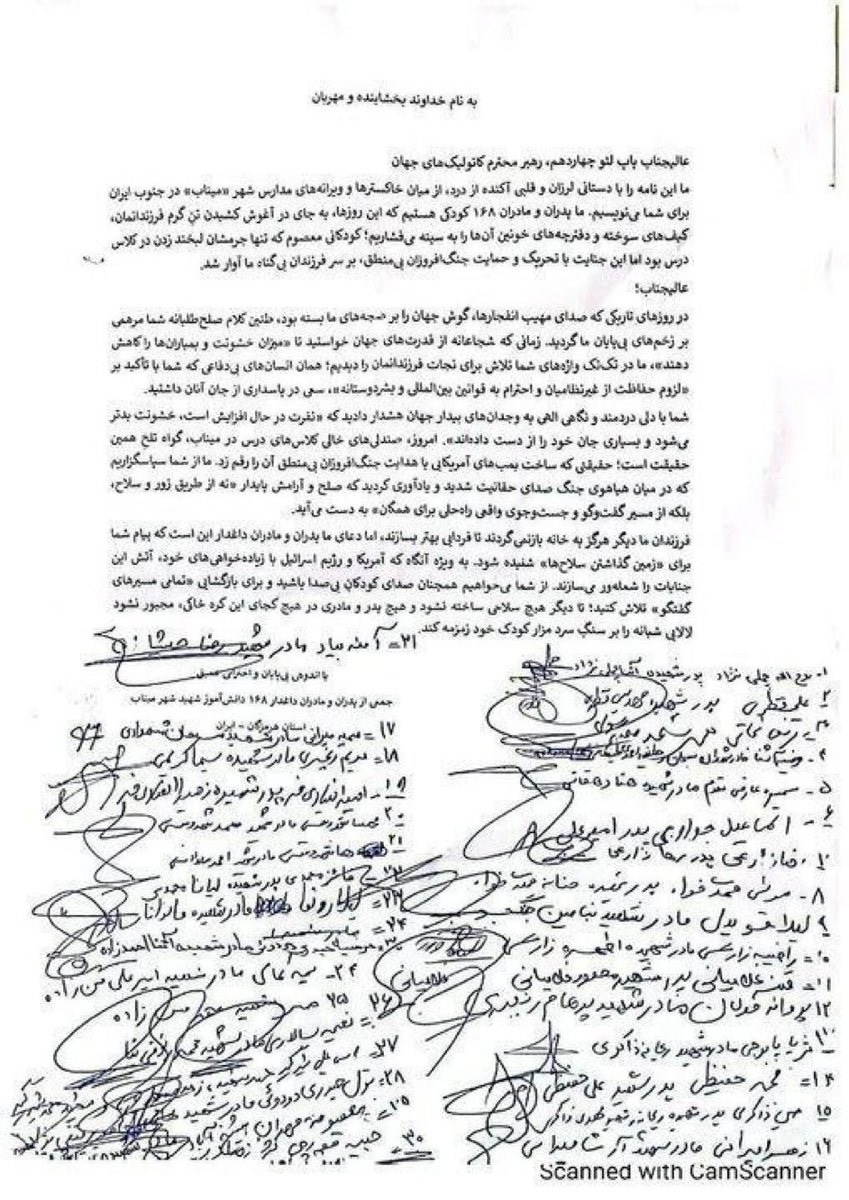
During the flight, he named the dead. The letter we published Sunday from the parents of the Minab schoolchildren killed in the United States bombing of Iran came up by name.
He said he had seen the letter, and it affected him deeply: “I have just seen a letter from families of children who were killed on the first day of the attack. They speak about how they have lost their children, who died in that event.”
He also told reporters of a photograph he carries with him of a young Muslim boy who held up a sign welcoming him to Lebanon last November. He said the boy was killed during the Israel-Lebanon War, although some independent observers have raised questions about the circumstances of his death.
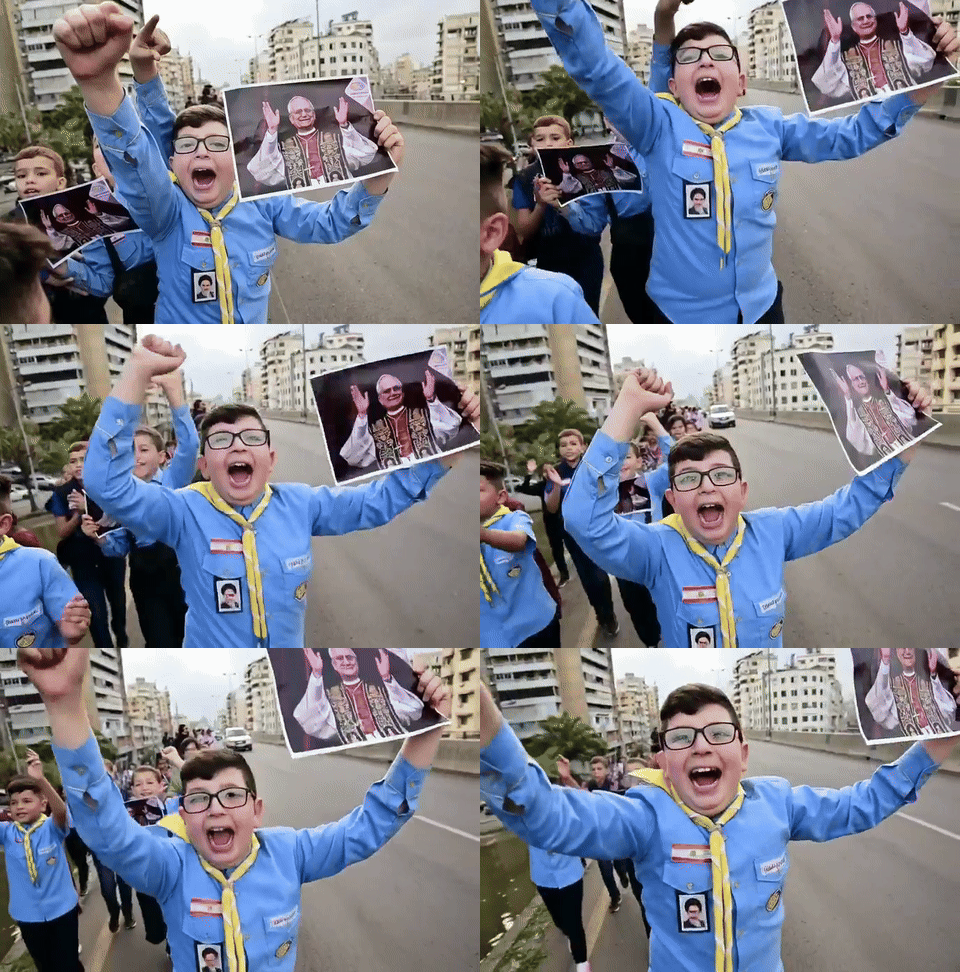
Either way, Leo’s instinct was unmistakable. He keeps the photograph close, and the argument it makes carries on its own.
This is the same pope who two weeks ago called Trump’s threat to destroy the civilization of Iran “unacceptable,” who told American Catholics to call their congressmen, who said the “delusion of omnipotence” governing the world’s nuclear powers must end.
Pressure from Washington has come in many forms since then. He has not stepped back from any of it — not Iran, not Israel, not the larger drumbeat for war.
He told the reporters in the matter-of-fact voice he has used since his first homily as Bishop of Rome that he condemns capital punishment everywhere it is practiced. The executions Iran’s regime carried out this very morning of opposition members fall under that condemnation.
“I condemn all actions that are unjust,” he said. “I condemn the taking of people’s lives. I condemn capital punishment. I believe that human life is to be respected.”
The exchange on migration was where the theology cut deepest. Eva Fernández of Radio Cope asked Leo what message he had for Spanish Catholics divided on the subject. Leo answered her in Spanish, and his answer was a question.
What is the Global North doing to help the Global South, or those countries where young people today cannot find a future and therefore dream of moving north?
He went on. Africa, he said, is too often treated as a place from which to extract minerals for the benefit of richer countries. The richer countries then build walls against the people whose homelands they have hollowed out. Leo acknowledged that states have the right to regulate their borders.
He insisted, in the same breath, that the human being who arrives at the border is a human being, owed the dignity that belongs to every human being. The work of justice, he argued, has to begin upstream — in the wealthy economies that benefit from the underdevelopment they refuse to address.
It is the root-causes argument that Catholic social teaching has made for generations. It is also the argument the Trump administration most wants the Church to abandon.
When Paris Match’s Arthur Herlin asked whether Leo’s presence beside authoritarian heads of state risks lending them moral cover — “pope-washing,” in his phrase — the pope answered in English.
He spoke about the long, patient work of Vatican diplomacy with regimes the Holy See finds repugnant: quiet channels that secure the release of political prisoners, food and medicine that move without press releases, lines of communication kept open so the Gospel can press against the hardest places.
The answer was a defense of presence as moral practice — the conviction that the Church accompanies suffering rather than scolds it from a safe distance.
Then came the question on same-sex blessings. Verena Stefanie Schälter of ARD asked Leo how he intends to preserve unity after Cardinal Reinhardt Marx of Munich gave permission earlier this year for the blessing of same-sex couples in his archdiocese. Leo answered carefully.
The Holy See, he said, still does not agree with the formalized blessings the German bishops authorized; Francis’s 2023 provision in Fiducia Supplicans remains the floor. The disagreement is real, and Leo did not pretend otherwise. But he chose to spend most of his answer on something else.
I think it’s very important to understand that the unity or division of the Church should not revolve around sexual matters. We tend to think that when the Church is talking about morality, that the only issue of morality is sexual. And in reality, I believe there are much greater, more important issues, such as justice, equality, freedom of men and women, freedom of religion, that would all take priority before that particular issue.
He has not put it this plainly before. The thesis has organized his entire pontificate: the Church’s moral imagination has been too long captive to the bedroom and not nearly attentive enough to the battlefield, the border, and the executioner’s chamber.
In his own way, he is picking up the appeal Pope Francis made in his first interview in 2013, where Francis said the Church could not be “obsessed” with abortion, contraception, and gay marriage at the expense of the broader Gospel.
By any honest count, Leo has spoken about war and migration at a ratio of at least a hundred to one against abortion and same-sex marriage. In eleven months as pope, he has yet to publicly mention contraception. I plan to write more about this in the coming days, because it appears to be his settled approach to the most divisive questions in Catholic life.
There is a name for what Leo did on that plane. The American Cardinal Joseph Bernardin called it the seamless garment — a single ethic of life that runs from the womb to the migrant boat to the death row cell to the cluster bomb.
Bernardin’s vision was eclipsed for two generations by an American Church that decided some lives were worth more political energy than others. Leo, a son of that same Church, has spent his pontificate stitching the garment back together.
In his pocket is a photograph of a Lebanese boy. When a Spanish reporter pressed him on migration, he turned the question around — Madrid, Brussels, and Washington had to answer first.
For Leo XIV, the executions Iran’s regime carried out this morning, the airstrikes that orphaned children in southern Lebanon, and the degradations of human dignity unfolding across the globe all belong to the same wound — the wound Bernardin named.
He intends to work to heal the whole of it.
I will have more analysis in the coming days. For now, I’ll leave you with a transcript and video of his own words.
At Letters from Leo, we stand with Pope Leo XIV and the millions of Catholics — and countless others of goodwill — who refuse to accept that the protection of human life is a partisan position.
We stand with the parents of the Minab schoolchildren, with the families in southern Lebanon burying their dead, with the young people of Africa who deserve a future at home, and with everyone who believes that the Gospel still has something to say when the world’s most powerful governments choose violence over justice.
In an age that wants the Church to be quiet about war and loud only about the bedroom, we remain rooted in a faith that refuses to flinch before injustice or bow to the idols of fear and authoritarianism.
This is the fastest-growing Catholic community in the country because people are hungry for something deeper than rage and propaganda. They are looking for courage, for truth, for love made visible in action — and right now, as American power is once again being used to kill children in their classrooms and worshippers in their villages, that hunger has never been more urgent.
If you believe this movement matters — Catholics and people of goodwill standing for human dignity against the politics of war and cruelty — I am asking you to join us this Easter season.
If you’d like to invest in our mission, here are three ways you can help:
Subscribe as a paid member to receive exclusive posts about the life and formation of Pope Leo and help sustain this newsletter.
Donate with a one-time gift to fuel this project’s mission.
Share this post (and Letters from Leo) with a friend who might enjoy it.
Paid subscribers get the deeper work — the biographical series on Pope Leo’s Life & Formation, the ongoing Epstein-Bannon Investigation, our Sunday Scripture Reflection Series, and the archive of the essays that built this community. Your support is what makes all of it possible.
Whether you give $0, 5, $50, $500, or more, your presence here matters — no matter your faith or your politics.
Thank you for reading. I’ll see you on the road.

Make A One-Time Gift to Support My Work
Source: Vatican News. Working English transcription and translation.
Pope Leo XIV: “Good day, everyone. I hope you are well, that you are ready for another journey. With fully recharged batteries already!”
[Pope Leo XIV, in Italian:] When I travel, I speak for myself, but today as Pope, Bishop of Rome, it is above all a pastoral Apostolic Journey to meet, accompany, and get to know the People of God.
Very often the interest expressed is more political: ‘What does the Pope say about this or that issue? Why doesn’t he judge the government in one country or another?’ And there are certainly many things to say. I have spoken about justice, and those issues are there.
But that is not the first word: the journey should be understood above all as an expression of the desire to proclaim the Gospel, to announce the message of Jesus Christ, which is a way of drawing close to the people in their happiness, in the depth of their faith, but also in their suffering.
There, it is clear that very often it is necessary to make comments or to look for ways to encourage people themselves to take responsibility for their lives. It is also important to speak with Heads of State, to encourage a change of mindset or greater openness to thinking about the common good, and to consider issues such as the distribution of a country’s resources. In the talks we had, we did a bit of everything, but above all we saw and met the people with this enthusiasm.
I am very happy with the whole journey, but living, accompanying, and walking with the people of Equatorial Guinea was truly a blessing, with the rain… They were happy with the rain the other day, but above all it was a sign of sharing with the universal Church what we celebrate in our faith.
Ignazio Ingrao (Tg1): Your Holiness, thank you for this journey rich in encounters, stories, and faces. At the peace meeting in Bamenda, Cameroon, you described an upside-down world where a handful of tyrants risk destroying the planet. Peace, you said, must not be invented but welcomed. Negotiations over the Iran conflict are in chaos, with heavy effects on the global economy. Do you hope for regime change in Iran, given that civil society and students also took to the streets in recent months, and there is global concern about the nuclear race? What appeal do you make to the United States, Iran, and Israel to break the deadlock and stop the escalation? And should NATO and Europe be more involved?
[Pope Leo XIV, in Italian:] I would like to begin by saying that we must promote a new attitude and a culture of peace. Very often, when we assess certain situations, the immediate response is that we must go in with violence, with war, with attacks.
What we have seen is that many innocent people have died. I have just seen a letter from families of children who were killed on the first day of the attack. They speak about how they have lost their children, who died in that event. The issue is not whether there is regime change or not; the issue is how to promote the values we believe in without the death of so many innocent people.
The situation in Iran is clearly very complex. Even the negotiations themselves — one day Iran says yes and the United States says no, and vice versa — and we do not know where things are heading. This chaotic, critical situation for the global economy has been created, but there is also an entire population in Iran of innocent people suffering because of this war. So, on regime change, yes or no: it is not even clear what regime currently exists after the first days of attacks by Israel and the United States on Iran.
Rather, I would encourage the continuation of dialogue for peace, that all sides make every effort to promote peace, remove the threat of war, and respect international law. It is very important that innocent people are protected, as has not happened in several places.
I carry with me a photo of a Muslim child who, during the visit to Lebanon, was waiting there with a sign saying “Welcome Pope Leo.” He has been killed in this final phase of the war. There are many human situations, and I think we must be able to think in these terms.
As a Church — I repeat — as a pastor, I cannot be in favor of war. And I would like to encourage everyone to make efforts to seek answers that come from a culture of peace, not hatred and division.
Eva Fernández (Radio Cope): We are leaving a continent where many people desire and dream of traveling to Europe. Your next trip will be to Spain, where the migration issue is very important, especially in the Canary Islands. You know that migration in Spain generates great debate and polarization; even among Catholics there is no clear position. What can we say to Spaniards, and in particular to Catholics, about immigration? And, if you’ll allow me: the next trip will be to Spain, but we know you also wish to travel to Peru, and perhaps to Argentina and Uruguay, and perhaps also to greet Our Lady of Guadalupe?
[Pope Leo XIV, in Spanish:] The issue of migration is very complex and affects many countries, not only Spain, not only Europe, not only the United States; it is a global phenomenon.
So, my answer begins with a question: what is the Global North doing to help the Global South, or those countries where young people today cannot find a future and therefore dream of moving north? Everyone wants to go north, but often the North has no answers on how to offer them opportunities. Many suffer… The issue of human trafficking is also part of migration.
Personally, I believe that a State has the right to regulate its borders. I am not saying that everyone must be allowed to enter without order, sometimes creating in destination countries situations more unjust than those they left behind. But that said, I ask myself: what are we doing in richer countries to change the situation in poorer countries? Why can we not try, both through state aid and through the investments of large wealthy companies and multinationals, to change the situation in countries like those we visited on this visit?
Africa is often seen by many as a place to extract minerals, to take its wealth for the benefit of other countries. Perhaps globally we should work more to promote greater justice, equality, and development in these African countries so that people do not need to emigrate to other countries, including Spain, and so on.
And another point I would like to make is that, in any case, they are human beings, and we must treat human beings humanely, not treat them worse than animals, as often happens. It is a very big challenge: a country can say it cannot receive more than a certain number of people, but when people arrive, they are human beings and deserve the respect that belongs to every human being because of their dignity.
Q: And the next journeys?
I have a strong desire to visit several countries in Latin America. So far, nothing is confirmed; we will wait and see.
Arthur Herlin (Paris Match): Holy Father, thank you very much in the name of all my French colleagues for that amazing trip. It was wonderful. Holy Father, during this trip, you met leaders among the most authoritarian in the world, right? How can you prevent your presence from lending moral authority to these regimes? Isn’t it a kind of let’s say, ‘pope-washing’?
[Pope Leo XIV, in English:] Thank you for the question. Certainly, the presence of a Pope with any Head of State can be interpreted in different ways. It can be interpreted and has been interpreted by some as, “Ah, the Pope or the Church is saying it’s okay that they live like that.” And others may say things differently.
I would go back to something I said in my initial remarks about the importance of understanding the primary purpose of the travel that I do, that the Pope does, to visit the people, and of the great value that the system, that the Holy See continues with, at times, great sacrifice, to maintain diplomatic relations with countries throughout the world. And sometimes we have diplomatic relationships with countries that have authoritarian leaders.
We have the opportunity to speak with them on a diplomatic level, on a formal level. We don’t always make great proclamations — criticizing, judging, or condemning. But there’s an awful lot of work that goes on behind the scenes to promote justice, to promote humanitarian causes, to look for, at times, situations where there may be political prisoners, and finding a way for them to be freed. Situations of hunger, of sickness, etc.
So the Holy See, by maintaining, if you will, a neutrality and looking for ways to continue our positive diplomatic relationship with so many different countries, we’re actually trying to find a way to apply the Gospel to concrete situations so that the lives of people can be improved.
People will interpret the rest of it as they will, but I think it’s important for us to look for the best way that we can to try and help the people of any given country.
Verena Stefanie Schälter (ARD Rundfunk): Holy Father, congratulations on your first papal trip to the Global South. We saw a lot of enthusiasm and even euphoria; I can imagine that was very moving for you as well. I would like to know how you assess the decision of Cardinal Reinhardt Marx, Archbishop of Munich and Freising, that he gave permission to the blessing of same-sex couples in his diocese, and in light of different cultural and theological perspectives, especially in Africa, how do you intend to preserve the unity of the global Church on that particular matter?
[Pope Leo XIV, in English:] First of all, I think it’s very important to understand that the unity or division of the Church should not revolve around sexual matters. We tend to think that when the Church is talking about morality, that the only issue of morality is sexual. And in reality, I believe there are much greater, more important issues, such as justice, equality, freedom of men and women, freedom of religion, that would all take priority before that particular issue. The Holy See has already spoken to the German bishops.
The Holy See has made it clear that we do not agree with the formalized blessing of couples, in this case, homosexual couples, as you asked, or couples in irregular situations, beyond what was specifically, if you will, allowed for by Pope Francis in saying all people receive blessings.
When a priest gives a blessing at the end of Mass, when the Pope gives a blessing at the end of a large celebration like the one we had today, they are blessings for all people. Francis’ well-known expression ‘Tutti, tutti, tutti’ is an expression of the Church’s belief that all are welcome; all are invited; all are invited to follow Jesus, and all are invited to look for conversion in their lives.
To go beyond that today, I think that the topic can cause more disunity than unity, and that we should look for ways to build our unity upon Jesus Christ and what Jesus Christ teaches. So that’s how I would respond to that question.
Anneliese Taggart (Newsmax TV): Holy Father, thank you very much. You have spoken on this trip about how people hunger and thirst for justice. It was just reported this morning that Iran has executed yet another one of the members of the opposition, and this comes as it has been said that the regime has also publicly hanged multiple other people, as well as murdered thousands of its own people. Do you condemn these actions, and do you have any message to the Iranian regime?
[Pope Leo XIV, in English:] I condemn all actions that are unjust. I condemn the taking of people’s lives. I condemn capital punishment. I believe that human life is to be respected and that all people — from conception to natural birth — their lives should be respected and protected.
So when a regime, when a country takes decisions which takes away the lives of other people unjustly, then obviously that is something that should be condemned.