


惯性聚合 高效追踪和阅读你感兴趣的博客、新闻、科技资讯
阅读原文 在惯性聚合中打开

推荐订阅源

WordPress大学
WordPress大学
让小产品的独立变现更简单 - ezindie.com
博客园 - 三生石上(FineUI控件)
雷峰网
雷峰网
爱范儿
爱范儿
P
Proofpoint News Feed
Security Archives - TechRepublic
Latest news
Latest news
The Hacker News
The Hacker News
Cyberwarzone
Cyberwarzone
博客园 - 【当耐特】
Project Zero
Project Zero
小众软件
小众软件
T
Tailwind CSS Blog
量子位
博客园 - 聂微东
I
Intezer
美团技术团队
S
SegmentFault 最新的问题
T
Tor Project blog
Spread Privacy
Spread Privacy
V
Vulnerabilities – Threatpost
Exploit-DB.com RSS Feed
Jina AI
Jina AI
罗磊的独立博客
B
Blog RSS Feed
K
KPMG report finds enterprise disconnect between AI and its ROI | CIO
T
Troy Hunt's Blog
有赞技术团队
有赞技术团队
Google DeepMind News
宝玉的分享
宝玉的分享
C
Cisco Blogs
L
LINUX DO - 热门话题
Last Week in AI
Last Week in AI
cs.AI updates on arXiv.org
AI
AI
钛媒体:引领未来商业与生活新知
钛媒体:引领未来商业与生活新知
Microsoft Azure Blog
L
LINUX DO - 最新话题
Know Your Adversary
Know Your Adversary
GbyAI
GbyAI
Engineering at Meta
Engineering at Meta
freeCodeCamp Programming Tutorials: Python, JavaScript, Git & More
Recent Commits to openclaw:main
L
Lohrmann on Cybersecurity
The Register - Security
L
LangChain Blog
博客园 - 叶小钗
T
Tenable Blog
Cyber Security Advisories - MS-ISAC

Electronic Frontier Foundation

Onward, Friends EFFecting Change: LGBTQ+ Solidarity Against the Tide of Surveillance EFFecting Change Site Banner 6.17.26 Victory! 702 has Expired! Yes to California's Bill to Ban Surveillance Pricing ‘News’ Site Keeps Hallucinating EFF Staffers LGBT Q&A: We’re Back With Season 2! Congress Just Rushed Through a Disastrous Copyright Office Overhaul The 702 Ultimatum: Warrant Requirement or Bust Enshittification Merch That Actually Fights Enshittification 🔊 Mass Surveillance for… Loud Music? | EFFector 38.11 How and Why to Fight Back Against Social Media Bans Tell Congress: Just Say No to NO FAKES VICTORY: Meta Strips Facial Recognition Code From Smart Glasses App After Public Outcry Cheers to the Winners of EFF’s 18th Annual Cyberlaw Trivia Night! EFFecting Change: If You Own It, Why Can't You Fix It? Internet Age-Gates Are a Growing Global Threat LGBT Q&A Season 1 Recap: Staying Safer Online EFF at TechCrunch Disrupt California’s AB 412 Still Demands Developers Do The Impossible Pulte Appointment Underscores Need to Reform Section 702 Spying EFF Testifies to Congress on Protecting Americans’ Rights from Government AI Move Fast, Surveil Things EFF at DEF CON 34 We're Fighting Mass Surveillance Tech—and Winning Welcome New EFF Executive Director Nicole Ozer One Step Forward, Two Steps Back: CA's AB 1856 Exempts Open Source But Expands Age-Gating Barcelona Cybersecurity Congress Age Verification is a Privacy Nightmare More License Plate Reader Mission Creep: School Residency Verification, Background Checks, and Noise Complaints 🔒 A Win for Encrypted Messaging | EFFector 38.10 Microsoft Took a Step Toward Human Rights Accountability. Google and Amazon (and Others) Should Pay Attention! Your Privacy Shouldn't Be A Corporate Decision EFFecting Change: LGBTQ+ Solidarity Against the Tide of Surveillance We Updated Our Privacy Policy. Here's What Changed and Why. EFF at Black Hat USA Help EFF Solve an Issue That's Bigger than Creepy Ads The Science is Not Settled: How Weak Evidence is Fueling a National Push to Ban Social Media for Youth Broken Promises: RIP Instagram’s End-to-End Encrypted DMs Victory! End-to-End Encrypted RCS Comes to Apple and Android Chats EFF Launches New Offline Campaign for Saudi Wikipedian Osama Khalid A Hackers Guide to Circumventing Internet Shutdowns Canada’s Bill C-22 Is a Repackaged Version of Last Year’s Surveillance Nightmare EFF to Fourth Circuit: Electronic Device Searches at the Border Require a Warrant EFFecting Change Site Banner 5.14.26 EFF Stands in Solidarity With RightsCon and the Global Digital Rights Community Congress Narrowed the GUARD Act, But Serious Problems Remain Free Signal Guide Milestone 1.0.0 Release of APK Downloader `apkeep` Powers Research on Android Apps 👎 California's Terrible, No Good, Very Bad Social Media Ban | EFFector 38.9 The SECURE Data Act is Not a Serious Piece of Privacy Legislation Offline: Osama Khalid EFF and 18 Organizations Urge UK Policymakers to Prioritize Addressing the Roots of Online Harm Shut Down Turnkey Totalitarianism EFF Submission to UK Consultation on Digital ID Getting Digital Fairness Right: EFF's Recommendations for the EU's Digital Fairness Act A Bridge to Somewhere: How to Link Your Mastodon, Bluesky, or Other Federated Accounts Utah’s New Law Targeting VPNs Goes Into Effect Next Week Open Records Laws Reveal ALPRs’ Sprawling Surveillance. Now States Want to Block What the Public Sees. Digital Hopes, Real Power: From Connection to Collective Action Aaron v. Bondi EFF Submission to UN Report on the Role of Media in the Context of Israel’s Policies Toward Palestinians Former EFF Activism Director's New Book, Transaction Denied, Explores What Happens When Financial Companies Act like Censors The Open Social Web Needs Section 230 to Survive The GUARD Act Isn’t Targeting Dangerous AI—It’s Blocking Everyday Internet Use Congress Must Reject New Insufficient 702 Reauthorization Bill The Internet Still Works: SmugMug Powers Online Photography Act Now to Stop California’s Paternalistic and Privacy-Destroying Social Media Ban EFF Challenges Secrecy In Eastern District of Texas Patent Case California Coastal Community Must Reject CBP's AI-Powered Surveillance Tower EFF to 9th Circuit (Again): App Stores Shouldn’t Be Liable for Processing Payments for User Content 📁 How ICE Got My Data | EFFector 38.8 EFF Sues DHS and ICE For Records on Subpoenas Seeking to Unmask Online Critics Bay Area Members' Speakeasy with WISP Copyright and DMCA Best Practices for Fediverse Operators Palantir Has a Human Rights Policy. Its ICE Work Tells a Different Story Keep Pushing: We Get 10 More Days to Reform Section 702 EFF at RightsCon Stop New York's Attack on 3D Printing How Push Notifications Can Betray Your Privacy (and What to Do About It) Google Broke Its Promise to Me. Now ICE Has My Data. EFF Calls on Kuwait to Release Journalist Ahmed Shihab-Eldin Digital Hopes, Real Power: The Rise of Network Shutdowns EFF to State AGs: Investigate Google's Broken Promise to Users Targeted by the Government The Dangers of California’s Legislation to Censor 3D Printing The Bay Agenda: Security for Journalists EFF 🤝 HOPE: Join Us This August! Hot Off the Press: EFF's Updated Guide to Tech at the US-Mexico Border War as a Pretext: Gulf States Are Tightening the Screws on Speech—Again Speaking Freely: Dr. Jean Linis-Dinco We Need You: Our Privacy Cannot Afford a Clean Extension of Section 702 Yikes, Encryption’s Y2K Moment is Coming Years Early Comparison Shopping Is Not a (Computer) Crime EFF is Leaving X Banning New Foreign Routers Mistargets Products to Fix Real Problem Another Court Rules Copyright Can’t Stop People From Reading and Speaking the Law 👁 Selling Mass Surveillance | EFFector 38.7 Digital Hopes, Real Power: How the Arab Spring Fueled a Global Surveillance Boom Privacy Index Workshop EU Parliament Blocks Mass-Scanning of Our Chats—What's Next?
We Must Not Normalize Digital Surveillance Abuses. EFF’s New Guide Underlines Concrete Steps to Fight Back.
Veridiana Alimonti · 2026-05-19 · via Electronic Frontier Foundation

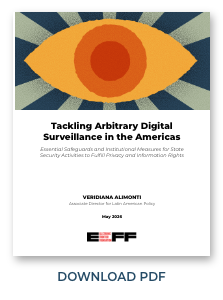
Poor accountability, feeble control mechanisms, and insufficient legal frameworks have led to systematic human rights violations in the Americas, with no consistent remedy or reparation to victims. What's needed is to materialize essential guarantees and measures to combat repeated surveillance abuses in the region. To help build a path for solutions, EFF launches the guide Tackling Arbitrary Digital Surveillance in the Americas, adding to our extensive work leveraging human rights norms to confront state privacy violations.

The document compiles privacy, data protection, and access to information guarantees established within the Inter-American Human Rights System to provide concrete, actionable guidance to governments in the Americas to curb the vicious cycle of state digital surveillance abuses. It outlines the safeguards and institutional measures necessary to protect individuals and details rules, parameters, and standards to overcome current pernicious practices and trends. 

As concerns over national and public security intensify, countries in the region seem to increasingly normalize the pervasiveness of digital surveillance technologies and their arbitrary use by security forces as a distorted form of protection. However, no actual protection can arise from arbitrary surveillance. 

When public security, intelligence, and law enforcement agencies neglect or harm settled rights in the name of national security or public order, they too become a threat. Tolerating rights violations creates the dire situation that the Freedom of Expression Special Rapporteur of the Inter-American Commission on Human Rights thoroughly analyzed in his report about the serious impacts of digital surveillance on freedom of expression in the Americas.

The great majority of states in Latin America have ratified the American Convention on Human Rights. As such, the parameters and rules our new guide describes stem directly from their obligations before international human rights law. State agents and institutions must take the necessary measures to make them a reality.

As EFF’s guide points out, states must implement clear and precise legal frameworks that:

  • define surveillance powers and limitations;
  • ensure all surveillance measures pursue legitimate aims without discriminatory ends;
  • subject interference with privacy to rigorous necessity and proportionality analysis;
  • require prior judicial authorization for digital surveillance measures;
  • maintain detailed records of surveillance operations;
  • establish independent civilian oversight institutions with technical expertise and enforcement powers;
  • guarantee individuals' right to informational self-determination and proper notification; and
  • provide effective remedies and reparation for victims of surveillance abuses.

States must also put in place the institutional processes and structures to give effect to these legal guarantees. As we stress in the document, States that embrace the guide’s recommendations will not only comply with their international obligations, but will also build more resilient, rights-respecting security architectures capable of addressing genuine threats without sacrificing the freedoms they exist to protect. 

Civil society leaders, activists, legal experts, public defenders, oversight institutions, and state officials committed to human rights must gather and ramp up the fight against the normalization of digital surveillance abuses in the Americas. We hope that EFF’s new guide can serve as a crucial tool in strengthening this fight, one that we have joined since our early days.