









 Twenty years ago today, Jeff Barr wrote a blog post that launched the Amazon EC2 Beta. That single post introduced resizable Linux virtual servers in the cloud, billed by the hour, with one instance type (
m1.small) in one Region (US East). It was minimal yet useful, and it changed how the world thinks about computing infrastructure.
In 2021, Jeff covered the fifteen years of EC2 with the backstory and memorable EC2 launches. Over the last five years, AWS has continued to push the boundaries of what cloud computing can deliver, building custom silicon for general-purpose and AI workloads and expanding EC2 into new form factors and deployment models that our customers in 2006 could not have imagined.
The 20 years in brief
In his 15th anniversary post, Jeff chose important milestones of EC2 that established the foundational building blocks that customers still rely on today. Amazon Elastic Block Store (2008) provided persistent block storage. Elastic Load Balancing, Auto Scaling, and Amazon CloudWatch (2009) made applications scalable and highly available. Amazon Virtual Private Cloud (2009) gave customers logically isolated networks. AWS Nitro System (2017) enabled faster innovation and enhanced security. AWS Graviton processors (2018) were designed for cost-sensitive scale-out workloads.
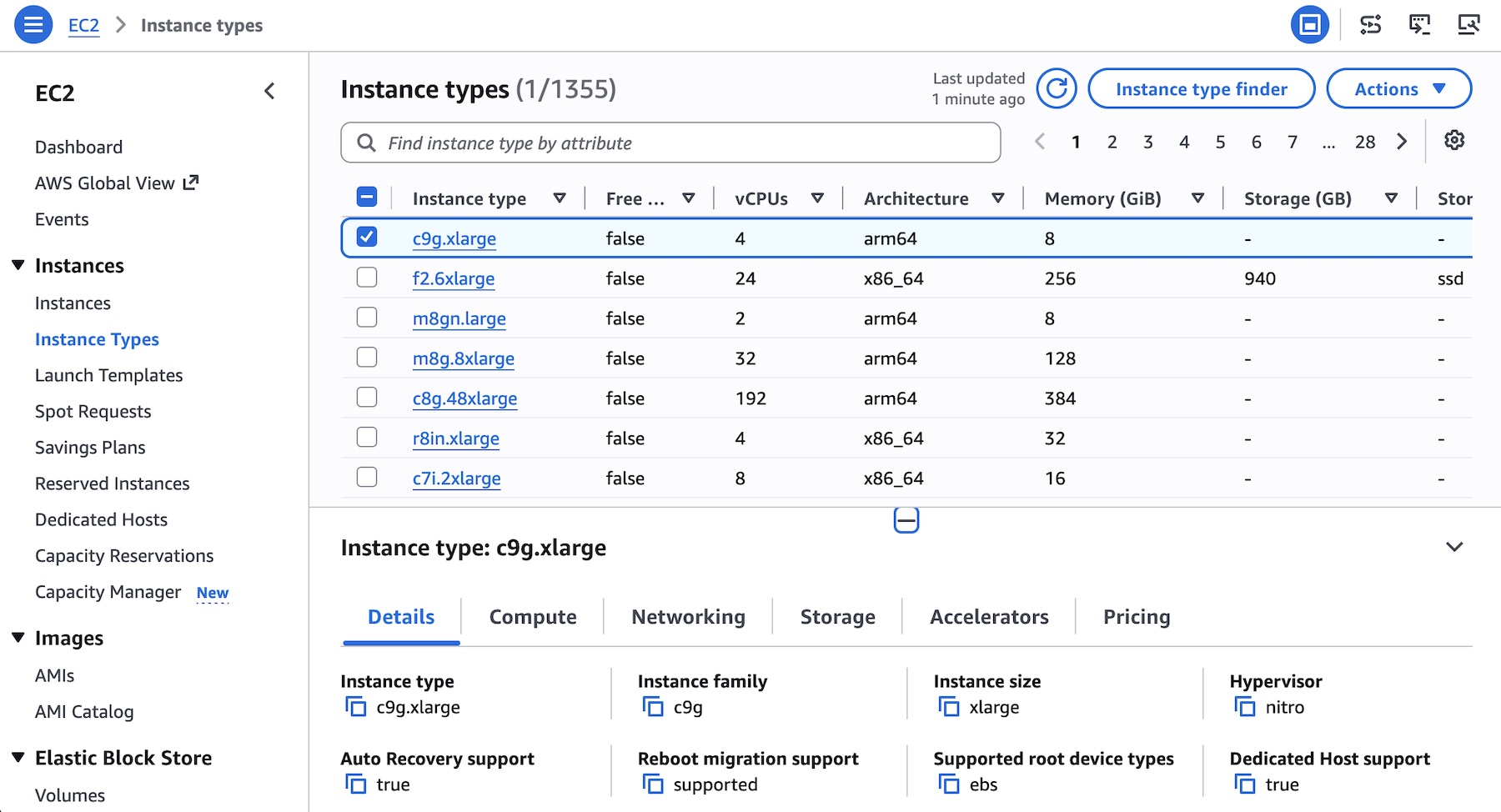
Over 20 years, EC2 grew from one to over 1,200 instance types to meet customer needs across general-purpose, compute-, memory-, and storage-optimized, accelerated computing, and high-performance computing families. These instances expanded from one AWS Region to 39 Regions globally. AWS also extended EC2 beyond the Region boundary with AWS Outposts (2018) running EC2 instances locally, AWS Local Zones (2019) place globally, and AWS Wavelength (2019) inside global 5G telecommunications carrier networks.
While I hate to play favorites, I want to choose some of my favorite EC2 launches of the past five years:
- AWS Inferentia for ML inference at scale (2019): We introduced purpose-built ML inference instances (inf1) with AWS Inferentia chips. Amazon EC2 Inf2 instances became generally available in April 2023 for large-scale generative AI inference workloads. Together with the Inferentia family, AWS Trainium instances now give customers a full stack of AWS-designed silicon optimized for every phase of the AI lifecycle both inference and training.
- EC2 Mac instances (2020): The first Mac instances (mac1) were built on Apple Mac mini with Intel Core i7 (Coffee Lake) on the AWS Nitro System. Mac M1 (mac2) instances launched in July 2022 as the first Arm-based macOS instances on EC2. M2 Pro Mac instances followed in 2023, M4 and M4 Pro Mac instances in 2025, M3 Ultra Mac instances and M4 Max Mac instances in 2026, giving Apple developers a complete range of cloud-based build and test environments for macOS, iOS, iPadOS, tvOS, watchOS, and visionOS apps.
- AWS Trainium for full-stack AI workloads at scale (2021): In November 2021, we previewed Trn1 instances with AWS Trainium accelerators optimized for high-performance deep learning training. In December 2024, Trn2 instances powered by AWS Trainium2 launched, with Trn2 UltraServers linking 64 Trainium2 accelerators via NeuronLink for training trillion-parameter foundation models. At AWS re:Invent 2025, Trn3 UltraServers powered by AWS Trainium3 deliver the best token economics for next-generation agentic, reasoning, and video generation applications. A single Trn3 UltraServer interconnects up to 144 Trainium3 chips to train and serve the largest frontier models. Now, AWS Trainium3 delivers the leading price-performance for high-performance AI training and inference at scale.
- EC2 Capacity Blocks for ML (2023): This new EC2 usage model further democratizes ML democratizes ML by making it easy to access GPU instances to train and deploy ML and generative AI models. You reserve the GPU capacity you need (initially P5 instances) for a future date and only for the duration you require. In November 2024, EC2 Capacity Blocks for ML added supported for provisioning in a matter of minutes and extending up to six months. Now, EC2 Capacity Blocks for ML supports P6-B300, P6-B200, P5e, P5en, P4d, P4de, Trn1, Trn2, and Trn3 instances in addition to P5.
- AWS Graviton5 (2025): Building on eight years of Graviton innovation since 2018, we previewed Graviton5 chips in AWS re:Invent 2025 and launched M9g and M9gd instances powered by Graviton5 and built on the sixth-generation AWS Nitro System. C9g and C9gd followed in June 2026. Now, Graviton5 features 192 cores, a 5x larger cache, and up to 33% lower inter-core latency, making it well suited for the growing demands of agentic AI workloads such as real-time reasoning, code generation, and multi-step task orchestration that require continuous, high-throughput CPU compute at scale.
- AWS Nitro Isolation Engine (2026): Customers wanted to see, not just hear from us, proof of workload isolation in the Nitro Hypervisor. The Nitro Isolation Engine is a purpose-built component inside the Nitro Hypervisor, harnessing formal verification to provide mathematical assurance that customer workloads are isolated from each other and AWS operators, pioneering a new standard for mathematically proven cloud security. This feature is also based on the sixth-generation AWS Nitro System which has continued to evolve since our introduction in 2017.
The foundation underneath it all
Despite two decades of innovation, the fundamental value proposition of Amazon EC2 has not changed. Customers use it to get secure, resizable compute capacity in minutes, pay only for what they consume, and scale on demand without long-term commitments. That same flexibility now extends to AI workloads at a scale no one anticipated in 2006.
EC2 remains the foundational compute layer of AWS. Amazon ECS, Amazon EKS, AWS Lambda, AWS Fargate, AWS Batch, Amazon EMR, Amazon SageMaker AI, and Amazon Bedrock ultimately run on EC2 capacity. Every architectural pattern customers have built over the past twenty years, from simple web servers to trillion-parameter foundation model training clusters, starts with a decision to launch an instance.
We made strong foundational decisions in 2006, and we left room for the service to grow. Twenty years later, that strategy of creating services that are minimal-yet-useful, launching quickly, and iterating rapidly in response to your feedback continues to guide how we build. The next twenty years of cloud computing will demand capabilities we have not yet imagined. Amazon EC2 will continue to be the foundation where your workloads run.
To learn more about Amazon EC2, visit the Amazon EC2 product page or check out what’s new with EC2.
— Channy