



惯性聚合 高效追踪和阅读你感兴趣的博客、新闻、科技资讯
阅读原文 在惯性聚合中打开

推荐订阅源

Help Net Security
Help Net Security
Recorded Future
Recorded Future
爱范儿
爱范儿
美团技术团队
博客园_首页
腾讯CDC
freeCodeCamp Programming Tutorials: Python, JavaScript, Git & More
WordPress大学
WordPress大学
阮一峰的网络日志
阮一峰的网络日志
J
Java Code Geeks
T
Tailwind CSS Blog
雷峰网
雷峰网
V
V2EX
OSCHINA 社区最新新闻
OSCHINA 社区最新新闻
月光博客
月光博客
小众软件
小众软件
博客园 - 三生石上(FineUI控件)
人人都是产品经理
人人都是产品经理
酷 壳 – CoolShell
酷 壳 – CoolShell
L
LangChain Blog
量子位
Stack Overflow Blog
Stack Overflow Blog
Google DeepMind News
博客园 - 司徒正美
V
Visual Studio Blog
罗磊的独立博客
Jina AI
Jina AI
宝玉的分享
宝玉的分享
C
CERT Recently Published Vulnerability Notes
Engineering at Meta
Engineering at Meta
S
SegmentFault 最新的问题
T
Threat Research - Cisco Blogs
F
Fortinet All Blogs
T
Tenable Blog
S
Securelist
D
DataBreaches.Net
P
Proofpoint News Feed
cs.AI updates on arXiv.org
H
Heimdal Security Blog
T
The Exploit Database - CXSecurity.com
S
Schneier on Security
Martin Fowler
Martin Fowler
W
WeLiveSecurity
MyScale Blog
MyScale Blog
The Cloudflare Blog
Security Latest
Security Latest
Hugging Face - Blog
Hugging Face - Blog
Scott Helme
Scott Helme
Threat Intelligence Blog | Flashpoint
Cloudbric
Cloudbric

AWS News Blog

AWS Weekly Roundup: One-click Lambda setup prompt, OpenAI GPT-5.6 models on Bedrock, and more (July 20, 2026) | Amazon Web Services Amazon SQS turns 20: Two decades of reliable messaging at scale | Amazon Web Services AWS Weekly Roundup: AWS Builder Center at 1 year, Network Scanning in Security Hub, Loom for AWS, and more (July 13, 2026) | Amazon Web Services AWS Weekly Roundup: Claude Sonnet 5 on AWS, Amazon WorkSpaces for AI agents, AWS service availability updates, and more (July 6, 2026) | Amazon Web Services Upgrade Amazon EKS clusters with confidence using Kubernetes version rollbacks | Amazon Web Services Accelerate your infrastructure deployments by up to 4x with AWS CloudFormation Express mode | Amazon Web Services Amazon EC2 C9g and C9gd instances powered by AWS Graviton5 processors are now available | Amazon Web Services Automate public TLS certificate issuance with ACME support in AWS Certificate Manager | Amazon Web Services AWS Weekly Roundup, Agentic CX designer for Amazon Connect Customer, EC2 AMI Watermarks, Open Governance for MySQL, and more (June 29, 2026) | Amazon Web Services Run isolated sandboxes with full lifecycle control: AWS Lambda introduces MicroVMs | Amazon Web Services AWS Weekly Roundup: NY Summit recap, Local Zone in Hanoi, Grok 4.3 in Bedrock, price reductions, and more (June 22, 2026) | Amazon Web Services Announcing Amazon EC2 G7 instances accelerated by NVIDIA RTX PRO 4500 Blackwell Server Edition GPUs | Amazon Web Services Amazon ECS introduces new high-resolution metrics for faster service auto scaling | Amazon Web Services Top announcements of the AWS Summit in New York, 2026 | Amazon Web Services Introducing Amazon Bedrock Managed Knowledge Base for faster, more accurate enterprise AI applications | Amazon Web Services Announcing Web Search on Amazon Bedrock AgentCore: Ground your AI agents in current, accurate web knowledge | Amazon Web Services Proactively reduce tech debt autonomously with AWS Transform – continuous modernization (preview) | Amazon Web Services AWS DevOps Agent adds release management capabilities to assess code changes before production (preview) | Amazon Web Services AWS Security Agent adds threat modeling, Kiro power and Claude Code plugin, and more | Amazon Web Services Amazon S3 annotations: attach rich, queryable context directly to your objects | Amazon Web Services AWS WAF adds AI traffic monetization capability to help content owners charge AI bots for content access | Amazon Web Services AWS Weekly Roundup: AWS FinOps Agent in preview, Gemma 4 on Bedrock, Kiro Pro Max, and more (June 15, 2026) | Amazon Web Services Now available: Amazon EC2 M9g and M9gd instances powered by new AWS Graviton5 processors | Amazon Web Services Anthropic Claude Fable 5 on AWS: Mythos-class capabilities with built-in safeguards now available | Amazon Web Services AWS Weekly Roundup: BYOM for Amazon RDS for SQL Server, AWS IoT Device SDK for Swift, and more (June 8, 2026) | Amazon Web Services Try the new console experience in Amazon Bedrock, optimized for Anthropic- and OpenAI-compatible APIs | Amazon Web Services Improve your application resilience with Amazon Cognito multi-Region replication | Amazon Web Services Get started with OpenAI GPT-5.5, GPT-5.4 models, and Codex on Amazon Bedrock | Amazon Web Services AWS Weekly Roundup: Claude Opus 4.8 on AWS, Aurora MySQL with Kiro Powers, and more (June 1, 2026) | Amazon Web Services Introducing the next generation of AWS Resilience Hub for generative AI-based SRE resilience journey | Amazon Web Services Introducing the next generation of Amazon OpenSearch Serverless for building your agentic AI applications | Amazon Web Services Meet Our Newest AWS Heroes – May 2026 | Amazon Web Services AWS Weekly Roundup: AWS Local Zones in Istanbul, open-source ExtendDB, Kiro Web, and more (May 25, 2026) | Amazon Web Services AWS Weekly Roundup: AWS Transform at 1 year, Claude Platform on AWS, EC2 M3 Ultra Mac instances, and more (May 18, 2026) | Amazon Web Services Amazon Bedrock introduces new advanced prompt optimization and migration tool | Amazon Web Services Amazon Redshift introduces AWS Graviton-based RG instances with an integrated data lake query engine | Amazon Web Services AWS Weekly Roundup: Amazon Bedrock AgentCore payments, Agent Toolkit for AWS, and more (May 11, 2026) | Amazon Web Services The AWS MCP Server is now generally available | Amazon Web Services Modernize your workflows: Amazon WorkSpaces now gives AI agents their own desktop (preview) | Amazon Web Services AWS Weekly Roundup: What’s Next with AWS 2026, Amazon Quick, OpenAI partnership, and more (May 4, 2026) | Amazon Web Services Top announcements of the What’s Next with AWS, 2026 | Amazon Web Services AWS Weekly Roundup: Anthropic & Meta partnership, AWS Lambda S3 Files, Amazon Bedrock AgentCore CLI, and more (April 27, 2026) | Amazon Web Services AWS Weekly Roundup: Claude Opus 4.7 in Amazon Bedrock, AWS Interconnect GA, and more (April 20, 2026) | Amazon Web Services Introducing Anthropic’s Claude Opus 4.7 model in Amazon Bedrock | Amazon Web Services AWS Interconnect is now generally available, with a new option to simplify last-mile connectivity | Amazon Web Services AWS Weekly Roundup: Claude Mythos Preview in Amazon Bedrock, AWS Agent Registry, and more (April 13, 2026) | Amazon Web Services Launching S3 Files, making S3 buckets accessible as file systems | Amazon Web Services AWS Weekly Roundup: AWS DevOps Agent & Security Agent GA, Product Lifecycle updates, and more (April 6, 2026) | Amazon Web Services Amazon Bedrock Guardrails supports cross-account safeguards with centralized control and management | Amazon Web Services Announcing the AWS Sustainability console: Programmatic access, configurable CSV reports, and Scope 1–3 reporting in one place | Amazon Web Services AWS Weekly Roundup: AWS AI/ML Scholars program, Agent Plugin for AWS Serverless, and more (March 30, 2026) | Amazon Web Services Customize your AWS Management Console experience with visual settings including account color, region and service visibility | Amazon Web Services Announcing Amazon Aurora PostgreSQL serverless database creation in seconds | Amazon Web Services AWS Weekly Roundup: NVIDIA Nemotron 3 Super on Amazon Bedrock, Nova Forge SDK, Amazon Corretto 26, and more (March 23, 2026) | Amazon Web Services 20 years in the AWS Cloud – how time flies! | Amazon Web Services Our First 2026 AWS Heroes Cohort Is Here! | Amazon Web Services AWS Weekly Roundup: Amazon S3 turns 20, Amazon Route 53 Global Resolver general availability, and more (March 16, 2026) | Amazon Web Services Twenty years of Amazon S3 and building what’s next | Amazon Web Services Introducing account regional namespaces for Amazon S3 general purpose buckets | Amazon Web Services AWS Weekly Roundup: Amazon Connect Health, Bedrock AgentCore Policy, GameDay Europe, and more (March 9, 2026) | Amazon Web Services Introducing OpenClaw on Amazon Lightsail to run your autonomous private AI agents | Amazon Web Services AWS Weekly Roundup: OpenAI partnership, AWS Elemental Inference, Strands Labs, and more (March 2, 2026) | Amazon Web Services AWS Security Hub Extended offers full-stack enterprise security with curated partner solutions | Amazon Web Services
Announcing managed daemon support for Amazon ECS Managed Instances | Amazon Web Services
2026-04-02 · via AWS News Blog

AWS News Blog

Voiced by Polly

Today, we’re announcing managed daemon support for Amazon Elastic Container Service (Amazon ECS) Managed Instances. This new capability extends the managed instances experience we introduced in September 2025, by giving platform engineers independent control over software agents such as monitoring, logging, and tracing tools, without requiring coordination with application development teams, while also improving reliability by ensuring every instance consistently runs required daemons and enabling comprehensive host-level monitoring.

When running containerized workloads at scale, platform engineers manage a wide range of responsibilities, from scaling and patching infrastructure to keeping applications running reliably and maintaining the operational agents that support those applications. Until now, many of these concerns were tightly coupled. Updating a monitoring agent meant coordinating with application teams, modifying task definitions, and redeploying entire applications, a significant operational burden when you’re managing hundreds or thousands of services.

Decoupled lifecycle management for daemons
Amazon ECS now introduces a dedicated managed daemons construct that enables platform teams to centrally manage operational tooling. This separation of concerns allows platform engineers to independently deploy and update monitoring, logging, and tracing agents to infrastructure, while enforcing consistent use of required tools across all instances, without requiring application teams to redeploy their services. Daemons are guaranteed to start before application tasks and drain last, ensuring that logging, tracing, and monitoring are always available when your application needs them.

Platform engineers can deploy managed daemons across multiple capacity providers, or target specific capacity providers, giving them flexibility in how they roll out agents across their infrastructure. Resource management is also centralized, allowing teams to define daemon CPU and memory parameters separately from application configurations with no need to rebuild AMIs or update task definitions, while optimizing resource utilization since each instance runs exactly one daemon copy shared across multiple application tasks.

Let’s try it out
To take ECS Managed Daemons for a spin, I decided to start with the Amazon CloudWatch Agent as my first managed daemon. I had previously set up an Amazon ECS cluster with a Managed Instance capacity provider using the documentation.

From the Amazon Elastic Container Service console, I noticed a new Daemon task definitions option in the navigation pane, where I can define my managed daemons.
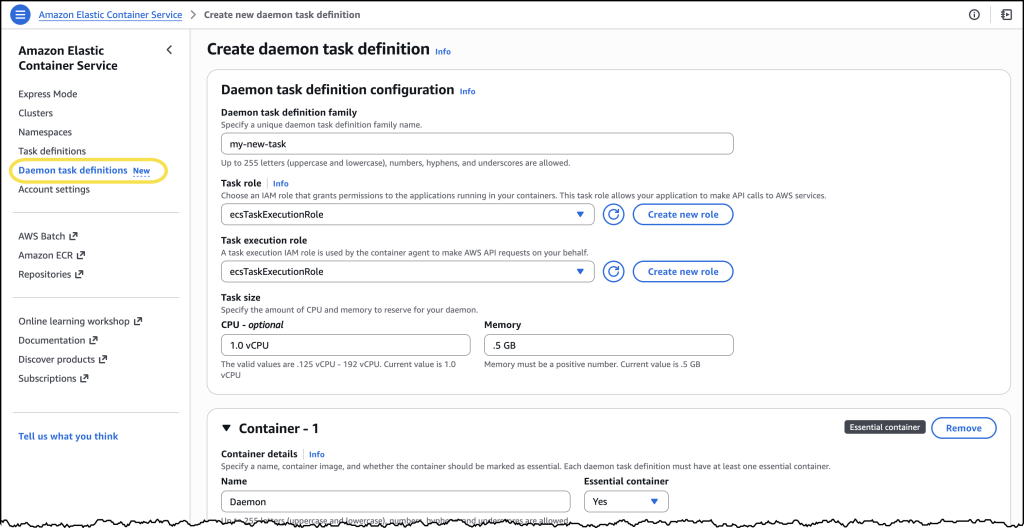
Managed daemons console

I chose Create new daemon task definition to get started. For this example, I configured the CloudWatch Agent with 1 vCPU and 0.5 GB of memory. In the Daemon task definition family field, I entered a name I’d recognize later.

For the Task execution role, I selected ecsTaskExecutionRole from the dropdown. Under the Container section, I gave my container a descriptive name and pasted in the image URI: public.ecr.aws/cloudwatch-agent/cloudwatch-agent:latest along with a few additional details.

After reviewing everything, I chose Create.

Once my daemon task definition was created, I navigated to the Clusters page, selected my previously created cluster and found the new Daemons tab.
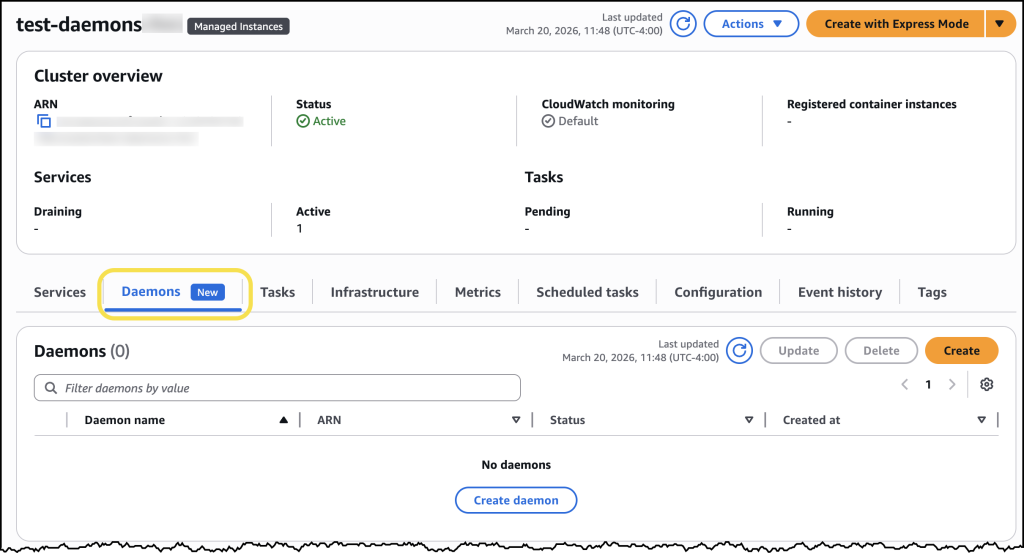
Managed daemons 2

Here I can simply click the Create daemon button and complete the form to configure my daemon.
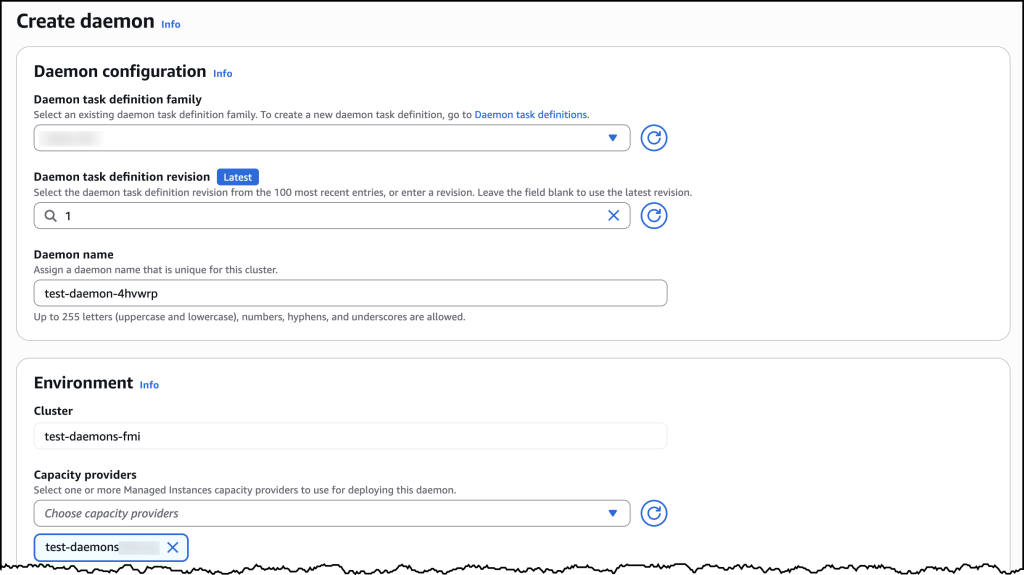
Managed daemons 3

Under Daemon configuration, I selected my newly created daemon task definition family and then assigned my daemon a name. For Environment configuration, I selected the ECS Managed Instances capacity provider I had set up earlier. After confirming my settings, I chose Create.

Now ECS automatically ensures the daemon task launches first on every provisioned ECS managed instance in my selected capacity provider. To see this in action, I deployed a sample nginx web service as a test workload. Once my workload was deployed, I could see in the console that ECS Managed Daemons had automatically deployed the CloudWatch Agent daemon alongside my application, with no manual intervention required.

When I later updated my daemon, ECS handled the rolling deployment automatically by provisioning new instances with the updated daemon, starting the daemon first, then migrating application tasks to the new instances before terminating the old ones. This “start before stop” approach ensures continuous daemon coverage: your logging, monitoring, and tracing agents remain operational throughout the update with no gaps in data collection. The drain percentage I configured controlled the pace of this replacement, giving me complete control over addon updates without any application downtime.

How it works
The managed daemon experience introduces a new daemon task definition that is separate from task definitions, with its own parameters and validation scheme. A new daemon_bridge network mode enables daemons to communicate with application tasks while remaining isolated from application networking configurations.

Managed daemons support advanced host-level access capabilities that are essential for operational tooling. Platform engineers can configure daemon tasks as privileged containers, add additional Linux capabilities, and mount paths from the underlying host filesystem. These capabilities are particularly valuable for monitoring and security agents that require deep visibility into host-level metrics, processes, and system calls.

When a daemon is deployed, ECS launches exactly one daemon process per container instance before placing application tasks. This guarantees that operational tooling is in place before your application starts receiving traffic. ECS also supports rolling deployments with automatic rollbacks, so you can update agents with confidence.

Now available
Managed daemon support for Amazon ECS Managed Instances is available today in all AWS Regions. To get started, visit the Amazon ECS console or review the Amazon ECS documentation. You can also explore the new managed daemons Application Programming Interface (APIs) by visiting this website.

There is no additional cost to use managed daemons. You pay only for the standard compute resources consumed by your daemon tasks.