








Table Of Contents
- Introduction
- The Real Problem With Learning CSS
- BLCU — A Memory Shortcut for CSS Architecture
- PM-BoBaTE — A Better Way to Order CSS Properties
- Before vs After Example
- Why This Matters in Real Teams
- Honest Positioning
- Conclusion
Introduction
CSS isn’t hard because of syntax. CSS becomes hard when projects scale. As frontend engineers, we often find ourselves wrestling with stylesheets that grow into tangled webs, making maintenance a nightmare and collaboration a headache. We've all been there: a simple change in one place unexpectedly breaks something else, or a new team member struggles to understand the seemingly random organization of styles.
The Real Problem With Learning CSS
Learning CSS syntax is relatively straightforward. display: flex; or color: #333; are easy enough to grasp. The real challenge, however, isn't in memorizing properties or values. It lies in establishing organization and consistency across a growing codebase. Without a clear system, stylesheets quickly devolve into a chaotic mess. Components and utilities get mixed, files become inconsistent, and scaling CSS becomes a painful, error-prone process. This lack of clarity impacts not just individual developers but entire teams, slowing down development and increasing technical debt.
This frustration led to the development of two simple, yet powerful, mnemonics designed to bring order to the chaos: BLCU for architectural clarity and PM-BoBaTE for logical property ordering. These aren't just arbitrary acronyms; they are mental models built from real-world development challenges, distilled into easy-to-remember systems.
BLCU — A Memory Shortcut for CSS Architecture
As projects expand, CSS structure often becomes messy. Stylesheets become hard to navigate, components and utilities get haphazardly intertwined, and files lack a consistent pattern. This makes scaling CSS painful and leads to a loss of clarity for development teams. Inspired by scalable CSS architecture principles like SMACSS, BLCU offers a simplified mental model to instantly recall a clean, maintainable CSS structure.
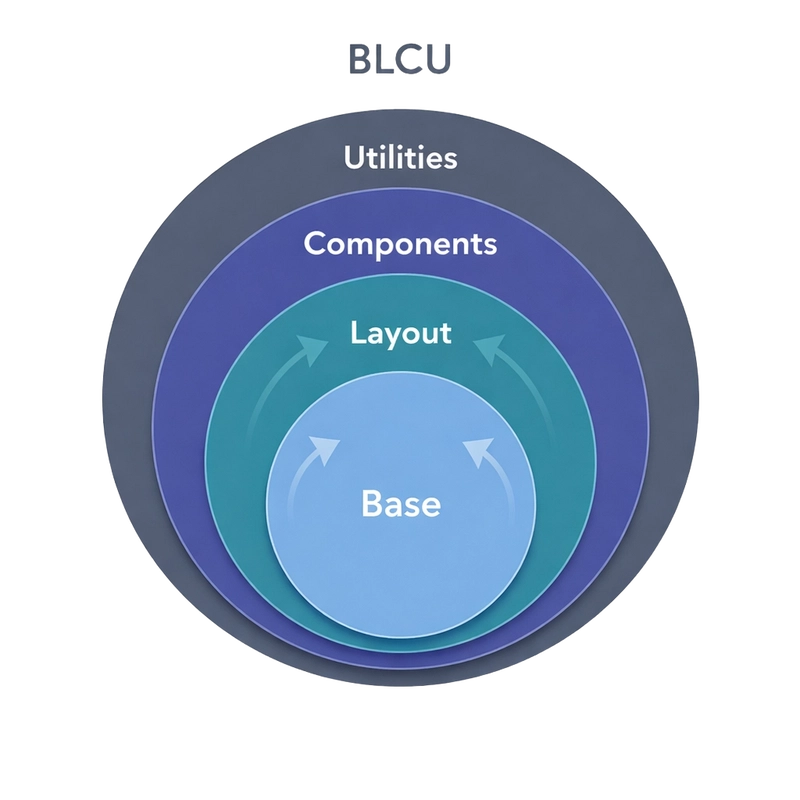
BLCU stands for:
- B = Base: These are the foundational styles that apply globally to raw HTML elements. Think of resets, typography defaults for
body,h1,p, and basic form element styling. These styles provide a consistent starting point across your application. - L = Layout: This layer defines the major structural components of your page, such as headers, footers, sidebars, and grid systems. Layout styles are concerned with the overall arrangement and positioning of elements on the page, often using properties like
display,grid,flex,margin, andpaddingto create distinct regions. - C = Components: This is where the reusable, modular UI elements live. Buttons, cards, navigation items, modals – anything that can be dropped into different parts of your application and maintain its appearance and functionality. Components should be self-contained and highly reusable, with styles scoped to their specific element.
- U = Utilities: These are single-purpose, often immutable classes that do one thing well. Examples include
.text-center,.margin-top-2rem, or.hidden. Utilities are powerful for rapidly applying common styles and overriding component defaults without writing new CSS.
By organizing your CSS into these four distinct layers, you create a clear hierarchy that is easy to navigate, understand, and scale. New developers can quickly grasp where to find or add styles, and consistency is naturally enforced.
PM-BoBaTE — A Better Way to Order CSS Properties
Inside many CSS rules, properties often appear in a chaotic, seemingly random order. This creates unnecessary friction: slower reading, harder debugging, inconsistent team styles, and ultimately, lower maintainability. When you're scanning a CSS block, your eyes shouldn't have to jump around to find related properties. A logical flow makes all the difference.
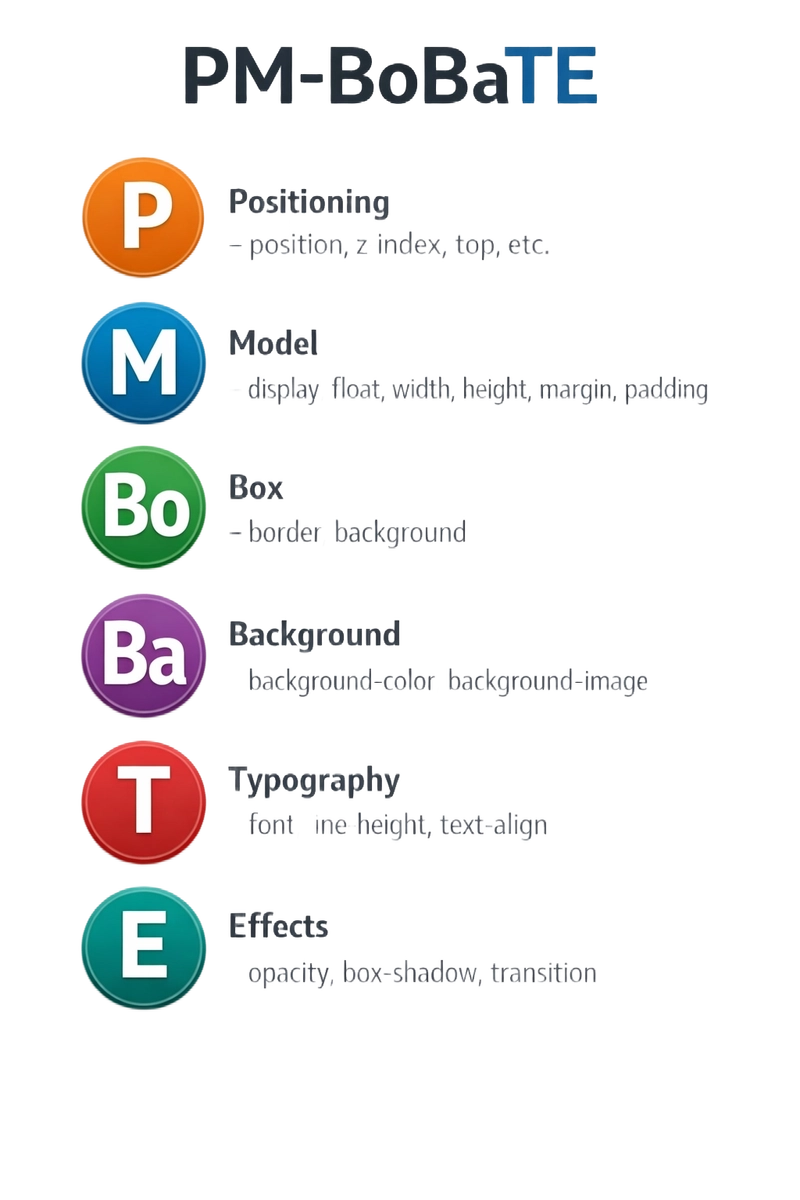
PM-BoBaTE provides a structured, intuitive order for CSS properties, based on how a developer mentally constructs a UI element. It guides you from the element's position in the document flow, through its box model, visual appearance, and finally to its content and interactive effects.
PM-BoBaTE stands for:
P - Positioning (Click to see properties )
position, top, right, bottom, left, z-index, display, float, clear
M - Model / Box Model (Click to see properties)
width, height, max-width, min-width, max-height, min-height, margin, padding, overflow, box-sizing
Bo - Box / Border (Click to see properties)
border, border-width, border-style, border-color, border-radius
Ba - Background (Click to see properties)
background, background-color, background-image, background-position, background-size, background-repeat
T - Typography / Text (Click to see properties)
font-family, font-size, font-weight, line-height, text-align, color, text-decoration, text-transform, letter-spacing, word-spacing, white-space
E - Effects (Click to see properties)
box-shadow, text-shadow, opacity, transform, transition, animation, cursor
Let's look at an example using rem units, as per best practices for scalable typography and spacing:
.card {
  /* P - Positioning */
  position: relative;
  display: flex;

  /* M - Model / Box Model */
  gap: 1rem;
  width: 20rem;
  padding: 1rem;
  margin: 1rem;

  /* Bo - Border */
  border: 0.0625rem solid #ddd;
  border-radius: 0.75rem;

  /* Ba - Background */
  background: #fff;

  /* T - Typography / Text */
  font-size: 1rem;
  line-height: 1.5;
  color: #222;

  /* E - Effects */
  box-shadow: 0 0.625rem 1.25rem rgb(0 0 0 / 10%);
  transition: 0.3s;
}
Notice how the properties are grouped logically, making the .card class much easier to read, understand, and modify. This consistency is invaluable, especially in team environments.
Before vs After Example
Let's take a common scenario: a ProductCard component with chaotic CSS. Imagine a file where font-size is next to margin, and background-color is somewhere in between position and border-radius. It's a mess.
Before (Chaotic CSS):
.product-card {
  margin: 1.5rem;
  background-color: #f9f9f9;
  display: block;
  padding: 1rem;
  border-radius: 0.5rem;
  box-shadow: 0 0.25rem 0.5rem rgba(0, 0, 0, 0.1);
  width: 18rem;
  font-size: 0.9rem;
  color: #333;
  border: 0.0625rem solid #eee;
  position: relative;
  line-height: 1.4;
}
This initial approach is all too common in fast-paced development environments. Without a structured system, properties are added as they come to mind, creating a fragmented and unpredictable structure. For a developer, reading this code feels like scanning a random list; there is no visual hierarchy, making it difficult to quickly identify the box model or positioning at a glance. As the codebase grows, this lack of organization leads to "CSS debt," where making even a small adjustment requires scanning the entire block multiple times to ensure no property was missed.
After (PM-BoBaTE Organized CSS):
.product-card {
  /* P - Positioning */
  position: relative;
  display: block;

  /* M - Model / Box Model */
  width: 18rem;
  margin: 1.5rem;
  padding: 1rem;

  /* Bo - Border */
  border: 0.0625rem solid #eee;
  border-radius: 0.5rem;

  /* Ba - Background */
  background-color: #f9f9f9;

  /* T - Typography / Text */
  font-size: 0.9rem;
  line-height: 1.4;
  color: #333;

  /* E - Effects */
  box-shadow: 0 0.25rem 0.5rem rgba(0, 0, 0, 0.1);
}
By applying the PM-BoBaTE methodology, the same set of properties is transformed into a logical and predictable sequence. The code is now categorized into functional groups—Positioning, Model, Border, Background, Typography, and Effects—each serving a specific role in the element's visual definition. This structured approach creates a "mental map" for the developer; you know exactly where to look for a margin (under Model) or a font size (under Typography). The explicit section comments further reinforce this clarity, turning a simple CSS rule into a self-documenting piece of architecture.
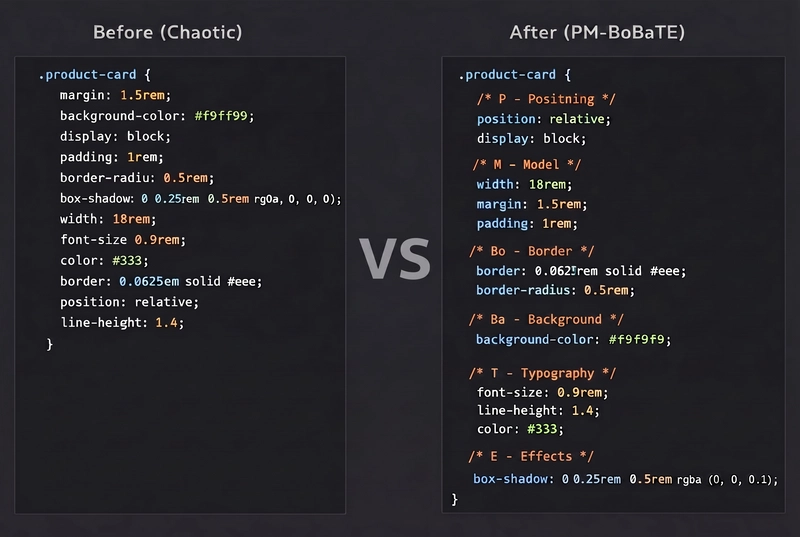
The difference is striking. The PM-BoBaTE organized version is immediately more readable and understandable. Debugging becomes faster, and onboarding new developers to the codebase is significantly smoother.
Why This Matters in Real Teams
These seemingly small organizational improvements have a profound impact on real-world development teams:
- Readability & Maintainability: Cleanly structured and consistently ordered CSS is easier to read and understand, reducing the cognitive load on developers. This directly translates to faster debugging and more efficient maintenance.
- Onboarding: New team members can quickly grasp the CSS architecture and property ordering conventions, accelerating their ramp-up time and productivity.
- Scaling: As projects grow in complexity and team size, BLCU provides a robust framework to prevent CSS from becoming an unmanageable monolith. PM-BoBaTE ensures that even large stylesheets remain coherent.
- Design Systems: Both mnemonics contribute to the success of design systems by promoting consistency and predictability in how styles are written and applied across components.
- Collaboration: When everyone follows the same mental models, code reviews become more focused on functionality and less on stylistic debates, fostering a more collaborative and productive environment.
Honest Positioning
It's important to be clear: BLCU and PM-BoBaTE are not rigid dogma. They are personal frameworks, born out of a desire to solve common CSS frustrations. Think of them as starting points, mental shortcuts that provide a solid foundation. The true power comes not from blindly following them, but from understanding the principles behind them. Use them, adapt them to your team's needs, and improve them. The goal is always better, more maintainable CSS, not strict adherence to an acronym.
Conclusion
CSS doesn't have to be a source of frustration. By leaning on mnemonics like BLCU and PM-BoBaTE, you shift your focus from "where does this property go?" to "what is this component actually doing?" It’s a small mental shift that pays massive dividends in maintainability and team velocity, especially as your codebase scales.
I’d love to hear your thoughts:
- How do you currently organize your CSS? Do you use a specific property order, or do you rely entirely on a linter/formatter?
- Do these mnemonics conflict with or complement your current framework (like Tailwind or CSS Modules)?
- What is the most "chaotic" CSS refactoring job you've ever had to tackle?
Let’s discuss in the comments below!