





The conversation around robotics has changed a lot in the past few years. What used to be mostly about movement and control is now heavily focused on intelligence. Robots are no longer just executing predefined actions — they are expected to perceive, understand, and react in real time.
This shift puts serious pressure on hardware.
The Real Bottleneck in Robotics Today
If you look at modern robotics systems, most of the complexity comes from combining multiple workloads at once:
- motion control
- vision processing
- AI inference
- real-time decision making
Trying to run all of this on a single chip often leads to compromises. Either you sacrifice latency, or you limit the size of AI models you can run.
This is exactly why hybrid architectures are becoming more common.
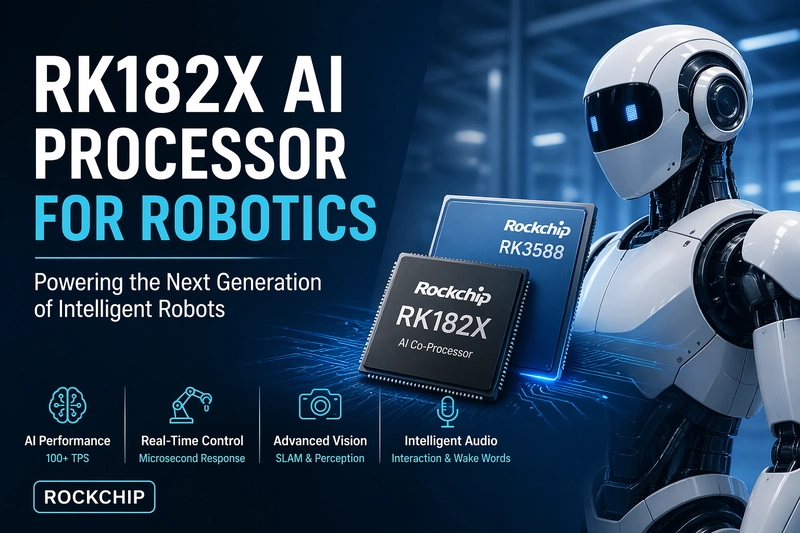
RK3588 + RK182X: Splitting the Workload
A practical approach is to separate responsibilities between chips.
The RK3588 already handles:
- system control
- sensor input
- video pipelines
- general-purpose compute
But when it comes to heavier AI workloads — especially large models — it makes sense to offload them.
That’s where RK182X comes in.
Instead of overloading the main SoC, the AI co-processor handles inference independently. This avoids resource contention and keeps real-time systems stable.
Why This Matters in Real Deployments
This architecture is not just theoretical.
In real robotics systems, timing matters a lot. Even small delays in decision-making can affect navigation, interaction, or safety.
By separating AI inference from control logic:
- latency becomes more predictable
- system stability improves
- scaling AI models becomes easier
This is especially important for applications like:
- humanoid robots
- industrial automation
- autonomous inspection systems
A Broader Industry Trend
This shift toward dedicated AI accelerators is not unique to Rockchip.
According to recent industry analysis by McKinsey & Company, companies are increasingly investing in edge AI infrastructure that enables real-time processing directly on devices, rather than relying on cloud-based systems.
This trend is driven by:
- lower latency requirements
- privacy concerns
- reliability in offline environments
Where RK182X Stands Out
As the industry moves forward, attention is also shifting toward next-generation AI chips. For example, there is already growing discussion around upcoming architectures like RK3688 and what they could bring to edge AI systems. A recent overview of Rockchip’s next-gen RK3688 AI SoC highlights how future designs may push performance even further.
What makes RK182X interesting is how it fits into a complete platform.
It is not just an isolated chip. It is designed to work alongside RK3588 as part of a full robotics stack that includes:
- optimized vision pipelines
- audio interaction systems
- AI model libraries
- ROS2-based frameworks
If you want a deeper technical breakdown of how this platform is structured and what capabilities it includes, this detailed overview of the RK182X AI processor for robotics covers the full stack and real deployment scenarios.
From Demos to Real Products
One of the biggest changes in robotics right now is the transition from prototypes to production systems.
We are seeing:
- robots deployed in factories
- AI-powered logistics systems
- autonomous inspection tools
These are not experiments anymore.
They are real systems running in real environments, which means hardware decisions matter more than ever.
Final Thoughts
The future of robotics is not just about more powerful chips — it is about smarter system design.
Splitting workloads between general-purpose SoCs and dedicated AI processors is one of the most practical ways to scale performance without sacrificing stability.
RK182X is a good example of this approach.
It reflects a broader industry direction:
move intelligence closer to the device, reduce latency, and make systems more reliable in real-world conditions.