惯性聚合 高效追踪和阅读你感兴趣的博客、新闻、科技资讯
阅读原文 在惯性聚合中打开

推荐订阅源

人人都是产品经理
人人都是产品经理
博客园_首页
博客园 - 三生石上(FineUI控件)
V
Visual Studio Blog
Hugging Face - Blog
Hugging Face - Blog
美团技术团队
小众软件
小众软件
T
Tailwind CSS Blog
钛媒体:引领未来商业与生活新知
钛媒体:引领未来商业与生活新知
月光博客
月光博客
有赞技术团队
有赞技术团队
WordPress大学
WordPress大学
博客园 - 【当耐特】
Apple Machine Learning Research
罗磊的独立博客
V
V2EX
酷 壳 – CoolShell
酷 壳 – CoolShell
IT之家
IT之家
量子位
OSCHINA 社区最新新闻
OSCHINA 社区最新新闻
Recent Announcements
M
MIT News - Artificial intelligence
阮一峰的网络日志
阮一峰的网络日志
The GitHub Blog
The GitHub Blog

DEV Community

Authentication Security Deep Dive: From Brute Force to Salted Hashing (With Java Examples) Why AI Systems Don’t Fail — They Drift Spilling beans for how i learn for exam😁"Reinforcement Learning Cheat Sheet" I Replaced Chrome with Safari for AI Browser Automation. Here's What Broke (and What Finally Worked) How Python Borrows Other People's Work The $40 Architecture: Processing 1 Billion API Requests with 99.99% Uptime Vibe Coding: A Workflow Guide (From Zero to SaaS) Most webhook security guides protect the wrong side. The scary part is delivery. Headless CMS for TanStack Start: Build a Blog with Cosmic EU Age Verification App "Hacked in 2 Minutes" — What Actually Happened Comfy Cloud’s delete function does not actually remove files Running AI Models on GPU Cloud Servers: A Beginner Guide Event-driven media intelligence with AWS Step Functions and Bedrock I scored 500 AI prompts across 8 quality dimensions — here's what broke How to Call Google Gemini API from Next.js (Free Tier, No Backend Needed) The Portal Protocol: Reclaiming Human Connection in the Age of AI How to Fix Your Team's Scattered Knowledge Problem With a Self-Hosted Forum Intro to tc Cloud Functors: A Graph-First Mental Model for the Modern Cloud Designing Multi-Tenant Backends With Both Ownership and Team Access I Built a Neumorphic CSS Library with 77+ Components — Here's What I Learned PostgreSQL Performance Optimization: Why Connection Pooling Is Critical at Scale Cómo construí un SaaS multi-rubro para gestionar expensas en Argentina con FastAPI + Vue 3 🚀 I Built an Ethical Hacking Scanner Tool – Open Source Project I Replaced /usage and /context in Claude Code With a Single Statusline A Pythonic Way to Handle Emails (IMAP/SMTP) with Auto-Discovery and AI-Ready Design I Collected 8.9 Million Polymarket Price Points — Here's What I Found About How Markets Really Move EcoTrack AI — Carbon Footprint Tracker & Dashboard Everyone's Using AI. No One Agrees How. 5 self-hosted ebook managers worth trying in 2026 Building Your First AI Agent with LangChain: From Chatbot to Autonomous Assistant
Day 1 — Why 70% of Learners Struggle With DSA (And It's N...
Robin Nayak · 2026-04-27 · via DEV Community
Cover image for Day 1 — Why 70% of Learners Struggle With DSA (And It's Not What You Think)

Robin Nayak

Most articles about struggling with DSA will tell you to practice more, study harder, or find better resources.
That advice misses the actual problem.
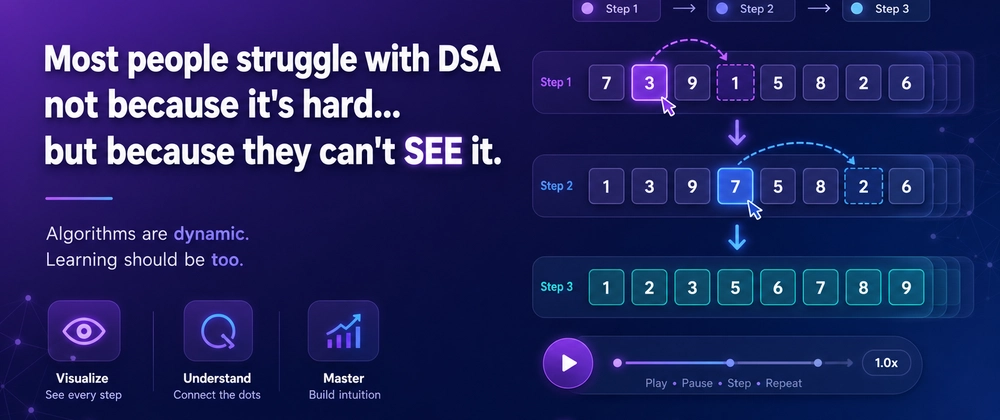
Over 70% of learners report struggling with DSA not because the concepts are too complex — but because they cannot picture how algorithms work internally. It is a representation problem, not an intelligence problem.
The format mismatch

Algorithms are dynamic. They have state that changes at every step. They make decisions based on what happened before. The value of a variable at step 7 depends on what happened at steps 1 through 6.
This is an inherently time-based, visual thing.
And yet the standard format for teaching it is: a block of code, a paragraph of text, a static diagram. None of these can show what is actually happening inside the algorithm as it runs.
What actually helps
The learners who get good at DSA quickly almost always found a way to see it:

Drawing arrays on paper and tracing execution manually
Finding the specific YouTube video where someone animates the algorithm slowly
Working with a tutor who traces execution on a whiteboard in real time

These are workarounds. They work because they provide something the standard format does not: a live, step-by-step view of what the algorithm is doing.

The fix is a format change, not more content
More explanation does not close this gap. More problems do not either — at least not before the mental model is solid.

What closes it is seeing the execution. Watching the array change. Observing which elements move and why. Following the pointer across the structure. Step by step, with full state visible at every move.
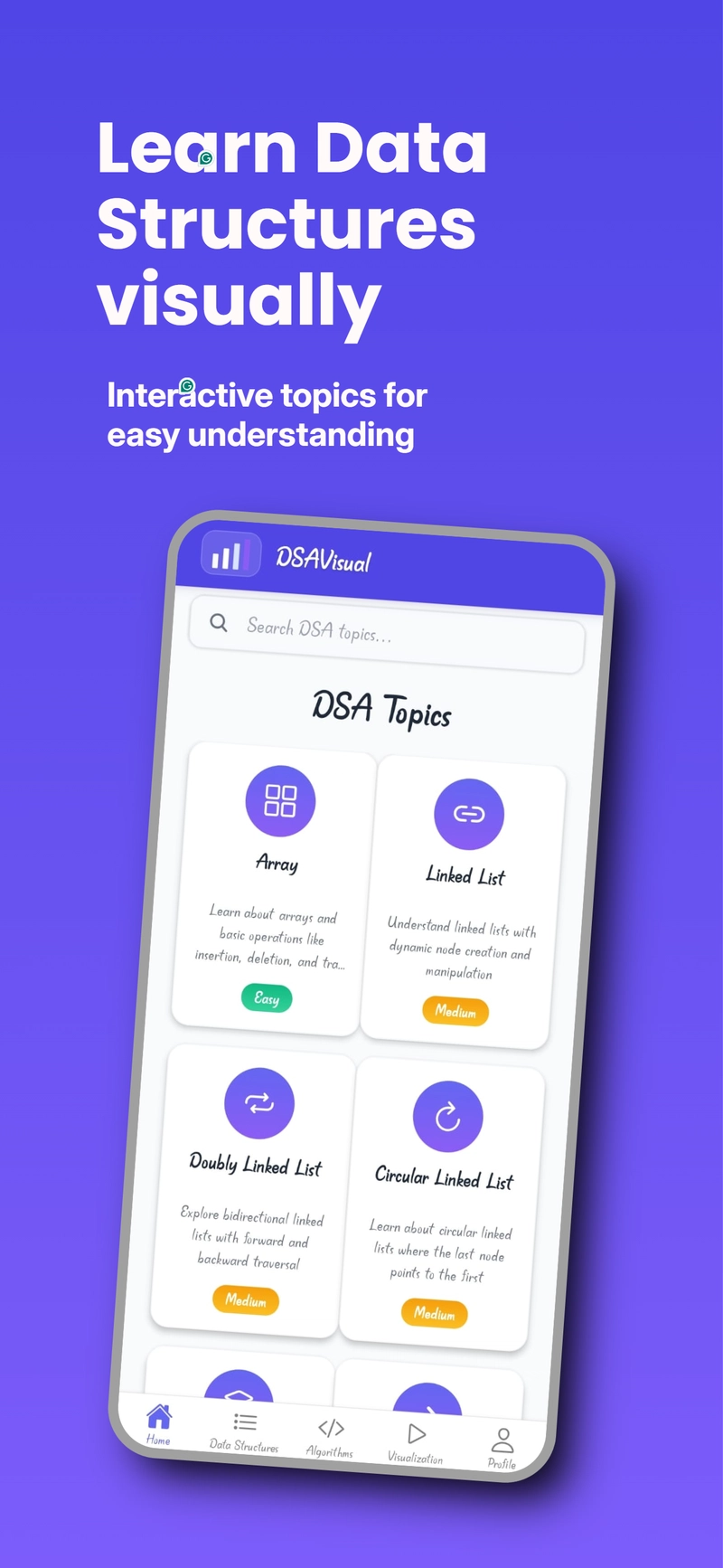
That is what DsaVisual is built to provide — a visual, interactive DSA tutorial platform where every algorithm runs step by step, works offline, and includes a built-in interview checklist.

The representation is the missing piece. Fix the representation, and the understanding follows.
📲 Try DsaVisual on Google Play: [Comming Soon]