







Disclosure: This post includes affiliate links; I may receive compensation if you purchase products or services from the different links provided in this article.
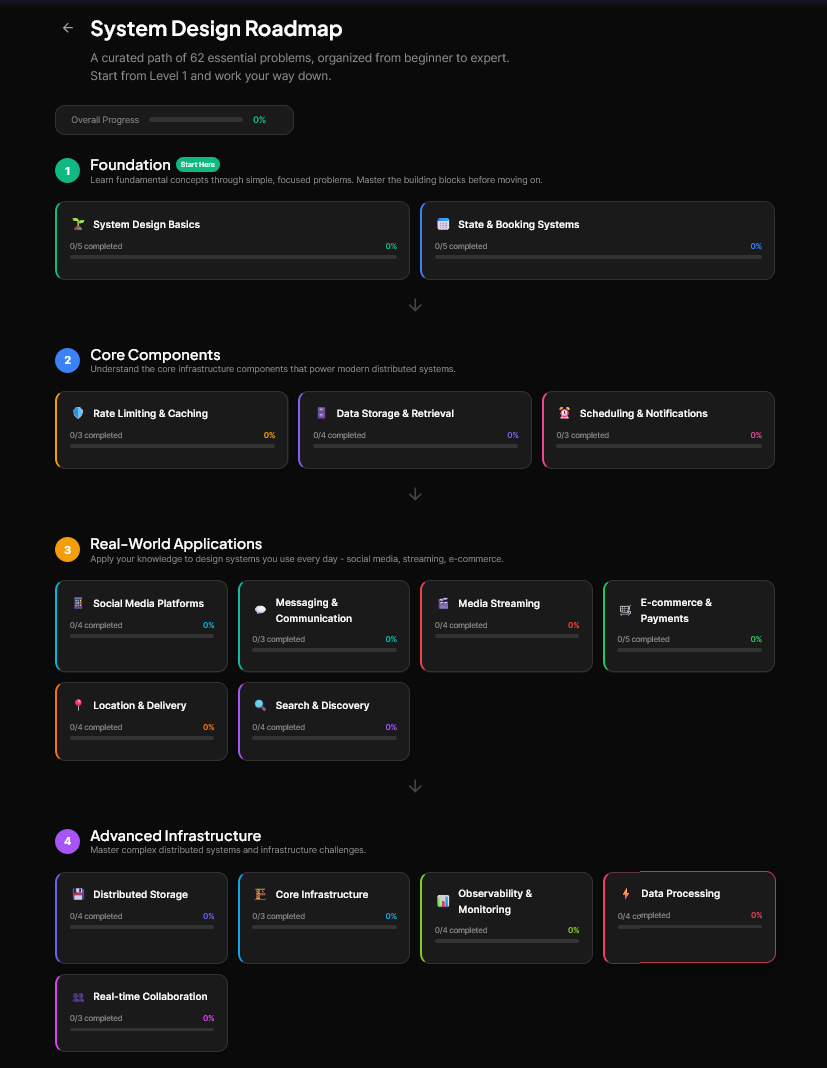
image_credit - codemia.io
Hello friends, if you are preparing for coding interviews but are wondering how to tackle the crucial System design topic and are looking for step-by-step guidance, the right approach, tips, and questions, then you have come to the right place.
In this article, I will share a complete guide to cracking System design interviews.
The Software Engineering job market is on fire! Especially if you have a couple of years of experience under your belt.
And in the world of Software Engineering, *if you are applying for a Senior Engineer / Lead / Architect, or a more senior role, System Design is the most sought-after skill, and hence one of the most important rounds in the whole process.
If you mess this up, nothing else would matter. If you get it right, though, you're looking at a raise of at least tens of thousands of dollars annually.
So how do you ace your system design round? Well, here's what I did while preparing for my interviews with Facebook, Google, and Amazon, and it worked out rather well.
I did end up creating a checklist for myself, which got me through most of my rounds, so if you follow a similar path, you should be able to come up with something that works for you as well.
Before we get into the details, though, what is a system design interview? What do the interviewers really expect from the candidates?

What is expected in System Design interviews?
The first step to prepare for a system design interview is to understand what is expected of you. Once you know that, you can align your preparation strategy to meet those expectations.
So here are the key expectations from you on a System design interview:
- You should be able to design a system that satisfies the requirements given to you and scales well, for example, design Twitter, design a vending machine, or design a trade position aggregator.
- Your design should be pluggable and not restrict the addition of new features.
- You should be able to compare various alternatives and choose the most optimal one. Things like, which database is the most important, or which protocol should you use, or what's the best approach to scale a system, etc.
- You should know the basics that are relevant from a system design standpoint, like:
- Load balancers
- APIs
- Caches
- Databases
- Network Protocols
- Message queues
- CDNs
- High-level details about ML and Big Data
- CAP Theorem
- Monitoring and analytics
These are actually the essential System design topics and concepts every developer should prepare. If you have knowledge about these topics, then you will definitely do well on system design interviews.
By the way, don't get overwhelmed by the number of topics. Most of the good System design courses, like System Design Interview Guide by CodeKarleon Udemy or Grokking the System Design Interview on DesignGurus.io cover all these topics. This course by Design Gurus has helped 60k+ subscribers to crack their system design interview (SDI).
How to prepare for System Design Interviews?
While many things have changed in the last couple of years, the System design interview has also changed with more focus on API, performance, and Microservices.
Anyway, here is a simple four-step process to ace any System Design round, not just this year but also in the coming years.
- Master Essential System Design Concepts like Scalability, Consistency, Caching, Database sharding, and replication, etc.
- Learn from the tech giants by reading their blogs, like Uber and Netflix
- Practice System design questions like designing YouTube, WhatsApp, etc. on sites like Codemia.io, which contains more than 120+ system design problems. It's a Leetcode for system design.
- Practice and Mock Interviews (like tryExponent, Codemia.io, Bugfree.ai or DesignGuru )
1. System Design Concepts
Any system design interview will definitely require you to come up with a basic high-level design for whatever system you are trying to build. Some components will be needed for sure. Make a note of these components.
Here are a few of them:
1. Load Balancer
You cannot have a distributed system without a load balancer to distribute the incoming requests among various nodes. This ensures proper resource utilization and that there is no single point of failure in your system. Here's how Nginx does it.
While learning about Load balancer its also a good idea to learn about API Gateway and carefully understand the difference between load balancer and API Gateway, which is quite important from an interview point of view. This question has already been asked of me a couple of times in interviews.
2. Caching
If you have ever done performance improvement, then you know that the Caching is probably the first thing that comes to mind.
Most systems have some read-heavy interactions, some information that the user will access frequently but not update as much.
It makes sense to cache this information in such a way that it can be easily fetched without the need for a DB lookup.
Think low latency.
Also, based on your use case, you might need to store more frequently accessed information or more recently accessed information. So, read up on various eviction policies like least recently used (LRU).
If you want to learn more, then ByteByteGo System Design course has a lot of information on Caching strategies and how to effectively use caches. You can refer them to learn more.

3. Database
Database is one of the most important skills to have, as most of the real-world applications you will build will have some sort of data store like a relational database or NoSQL.
In fact, there can be no system without some form of data storage. Whether you want to store files, images, product information, financial transactions, or simply dump all the data from various user interactions to run analytics later.
It all needs databases. So read up on it. Find out what matters when you are selecting a database, read about SQL/NoSQL, query patterns, and how CAP theorem might come into play while making tradeoffs.
Sandeep has explained this quite well on his System Design course on Udemy. If you want to learn further, you can refer to that as well.

4. Message queues
Sometimes our system needs to perform some tasks that need to be done but not necessarily immediately, or their outcome does not affect the user's journey.
In such cases, rather than making a service call and waiting for the response, it makes sense to just write the message to the queue so that it can be executed later.
This is also known as asynchronous messaging, which is the backbone for many Microservices.
What if you need to insert information in your database, and bulk insert could be more efficient? It would make sense to just keep track of these inserts in a message queue and perform 1 bulk insert instead of hundreds of 1-to-1 inserts to optimize your resources.
A good knowledge of Messages queues like RabbitMQ, ActiveMQ, and Apache Kafka is essential for any Software Engineer and this is one topic which is covered quite well on Educative.io's Grokking Modern System Design for Software Engineers & Managers course. If you want to learn about not just message queue but other essential System design topics, this is one resource which I personally use.

5. CDN
When your users are distributed geographically, getting your content to them in a reasonable amount of time becomes a real challenge.
CDNs allow us to maintain a copy of our data in various data centers located closer to the users' locations to reduce the latency.
Here is a short video about how Akamai does it.
6. Analytics and Monitoring
This is something that is needed in every system you create. This is a hidden requirement; no one calls it out in the requirement gathering, but every interviewer wants this.
User logs in or logs out? Wish listed an item? Payment failed? It is all the information for us! Anything of importance happens, fire an event, and save it in your messaging queue.
You can perform real-time analytics on data or just dump it in a Hadoop cluster to use later. Similarly, if an API call is regularly failing, or if your servers are about to run out of resources, wouldn't you like to know about it beforehand?
A good knowledge of tools like Grafana, Prometheus can help you with Analytics and monitoring, and also to impress your interviewer during a system design interview.
Alex Xu has also shared a lot of good information on Monitoring on his book and ByteByteGo course. You can refer to them as well.

7. Network Protocols
Based on your requirement, based on the type of content you are sharing, you might need to make a decision on which network protocol to use. Read up on various network protocols like TCP and UDP and when they are relevant, what might be the compromises you might need to make, etc.
The first step is to know about all these concepts. And by knowing concepts, I don't mean just some theoretical knowledge of what these are, but more practical hands-on experience about what should be used when.
You need to know things like:
- Which is the best alternative to choose from, given the use case.
- What are the tradeoffs that you need to consider while making these decisions?
- Best practices for certain use-cases.
To know most of these things, I'll recommend going through this course on System Design by CodeKarle, which covers all of the above with concrete examples from the real world.

2. Learn from the tech giants like Uber and Netflix
This is probably not going to help in the short term. But in the long term, to become an expert in System Design, it's best to look at the Tech blogs of various tech companies and see how they are solving various technical problems.
This would paint a clear picture of the real problems that they face and how innovatively they solve them.
Understanding these things would help you become better at system design and also keep you up to date with the latest innovations in tech.
Some of the best blogs to follow are:
If you don't like reading and prefer watching, then you can also join online courses created by ex-FAANG employees like the Mastering the System Design Interview by Frank Kane, (Ex Amazon Hiring Manager). This is one of the best resources to learn System design for interviews.

3. Solve Frequently asked System Design questions
An obvious way to get started with your interview prep! Knowing the basics is definitely important, but it won't be enough!
The most basic way to get started with your practice is to look at some frequently asked questions and their solutions.
Most system design interviews revolve around some 5--6 commonly asked System design questions and if you know the solutions to those, you are more than likely to clear this interview.
The most common questions are (with solution, click the link to see the solution when you get stuck):
- How to design Twitter?
- How to design a Chat system like WhatsApp or Facebook Messenger
- How to design Ticketmaster?
- How to design an efficient Parking Lot?
- Whatsapp System Design
- Airbnb System Design
- Uber System Design
- Tinyurl System Design
If you need resources to solve these questions, something which not only solves the question but also explains the underlying concepts and approach to solving system design questions, then thishighly-rated course by CodeKarle discusses most of these case studiesand some more problems, which has helped many people crack their interviews for companies like Google, Facebook, Microsoft, Amazon, etc.

4. Practice (Mock Interview)
Practice, practice, practice! Did I say practice? There are a lot of resources out there. I have shared a few that discuss some of the most popular system design problems in detail.
Once you go through a few of them, you will start noticing a pattern and will soon be able to come up with solutions on your own.
You should also get a better understanding of how your systems are designed in your organization. How are the other teams doing things? What factors do they take into consideration?
The next best thing is to practice with a friend. Make sure you also go through a few mock interviewsbefore your actual interview to avoid some common but easily avoidable pitfalls.
Since chances for companies like Google and Meta are hard to come by, you should prepare as best as possible, and Mock interviews are really important for them. They allow you to see your actual preparation level before real interviews.
At the same time, its also important that your mock interview should mimic the real interview and for that I recommend you to join sites like tryExponent, Codemia.io, Bugfree.ai, Designgurus.io or , which allows you to take mock interview with real experts.
Codemia.iois like the Airbnb for mock interviews and career coaching. It connects job seekers with seasoned FAANG interviewers who provide invaluable feedback, getting you ready for real-life interviews.
Many of my friends, readers, and colleagues, along with numerous job seekers, have already reaped the benefits of this platform.
What makes Codemia stand out?
1. Affordability: The average cost per session is significantly lower compared to other platforms.
2. Expert interviewers: Veterans from FAANG and top-tier companies bring years of experience, offering priceless feedback that truly makes a difference.
3. Direct communication: Job seekers can directly message interviewers to address any questions or concerns, such as experience sharing or rescheduling, ensuring better preparation for both parties.
4. All-in-one tools: Meetapro equips you with the essential tools for an effective interview session, including recording options for post-session review.
That's why I highly recommend adding Codemia.ioin your preparation journey for best results. You can learn more about it

Common Mistakes to Avoid on System Design Interviews
There are two important things you can do to become successful in life: do what other successful candidates do and avoid the mistakes of those who failed. Some of the most common mistakes that I have seen people make are:
- Not driving the interview
- Not asking questions
- Not structuring the interview properly
- Running out of time
- Not considering the requirements
- Not exploring all the alternate design options
All these mistakes can be easily avoided by having a few mock interviews with someone who knows System Design well. And time your interviews. The target must be to solve within 40 minutes, including time for some discussion.
Well, that's it, folks. **With this 4-step process, you'll soon be ready to ace any of your system design interviews! Hopefully, this should be a good starting point for you. Happy learning!
For mock interviews, you can also check out Exponent website, which offers 1--1 coaching and classes for in-person learning and also runs a free service called Prampthat offers peer-to-peer interviews for software engineers in data structures and system design.

If you need another option, then DesignGuru also has mock interviews, which cost around $239, and you get a chance to be interviewed by experts and a former Facebook Engineer and founder of DesignGuru.io
Best System Design Interview Resources
If you need more resources like books and online courses to prepare for the System Design Interview, here are my recommendations:
- CodeKarle's System Design Interview Course on Udemy
- Grokking the System Design Interview on DesignGurus.io
- Mastering the System Design Interview by Frank Kane
- Codemia.io for Practicing System Design Problems
- Software Design and Architecture Specialization [Coursera]
- System Design Interview course and Mock Interview by Exponent
- System Design Interview Course on ByteByteGo by Alex Wu
- Web Application & Software Architecture 101 [Educative.io]
- Pragmatic System Design [Udemy Course]
- Grokking Modern System Design for Software Engineers & Managers
Thanks for reading this article so far. If you like this System design interview roadmap, questions, tips, and resources, then please share it with your friends and colleagues who are preparing for tech interviews.
If you have any questions or feedback, please drop a note.