
惯性聚合 高效追踪和阅读你感兴趣的博客、新闻、科技资讯
阅读原文 在惯性聚合中打开

推荐订阅源

酷 壳 – CoolShell
酷 壳 – CoolShell
H
Hacker News: Front Page
P
Palo Alto Networks Blog
T
ThreatConnect
Apple Machine Learning Research
博客园_首页
T
True Tiger Recordings
P
Privacy & Cybersecurity Law Blog
B
Blog
IT之家
IT之家
Last Week in AI
Last Week in AI
F
Full Disclosure
Hacker News: Ask HN
Hacker News: Ask HN
C
Comments on: Blog
Microsoft Azure Blog
C
Cybersecurity and Infrastructure Security Agency CISA
Microsoft Security Blog
博客园 - 【当耐特】
N
News and Events Feed by Topic
NISL@THU
NISL@THU
腾讯CDC
雷峰网
雷峰网
Security Latest
Security Latest
李成银的技术随笔
M
Microsoft Research Blog - Microsoft Research
L
LangChain Blog
L
Lohrmann on Cybersecurity
cs.CL updates on arXiv.org
C
Check Point Blog
Y
Y Combinator Blog
Recent Announcements
博客园 - Franky
N
News | PayPal Newsroom
V
V2EX
A
About on SuperTechFans
The Register - Security
月光博客
月光博客
奇客Solidot–传递最新科技情报
奇客Solidot–传递最新科技情报
Google Online Security Blog
MyScale Blog
MyScale Blog
Cisco Talos Blog
Cisco Talos Blog
Vercel News
Vercel News
WordPress大学
WordPress大学
C
Cyber Attacks, Cyber Crime and Cyber Security
The Hacker News
The Hacker News
IntelliJ IDEA : IntelliJ IDEA – the Leading IDE for Professional Development in Java and Kotlin | The JetBrains Blog
爱范儿
爱范儿
A
Arctic Wolf
L
LINUX DO - 最新话题
freeCodeCamp Programming Tutorials: Python, JavaScript, Git & More

DEV Community

The Context Tax: Why Every Cursor Session Costs You 15 Minutes Prompt Physics: Building a Cognitive Steering Layer for Gemma 4 Pain Points Will Always Outlive Platforms 92. BERT: The Model That Reads in Both Directions QAOA vs. 75,000 Nodes: Building a Hybrid Architecture to Solve NP-Hard Problems When Quantum Simulators Hit a Wall E2B? E4B? 26B A4B? The Gemma 4 Model Names Finally Explained One Tool That Cuts Token Costs 40-80% for Claude Code, Codex, opencode, and openclaw Building a 32-URL economy microsite on top of a 754,000-row SQLite dataset Coordinating 100+ AI Agents in the Field: Practical Patterns for Robotic Swarms Static site search for Astro in 2026: why I picked Pagefind over Algolia and Lunr How I built pairwise AI model compare pages with Claude Haiku and a budget cap Three post-deploy checks I run after every Cloudflare Pages build Why I'm betting on AI-curated directories when Google AI Overviews answer the same queries When boto3 doesn't have it (yet), you write it: a realtime speech-to-speech story in Python Zero-Trust RAG: Defeating the Shared Private Link Deadlock in Azure Terraform You Can't Co-Design What You Don't Operate Counting tokens is dumb. So we built a free metric for AI proficiency. Choosing the Right RAG Strategy A Complete Decision Guide to Chunking, Agentic RAG, and GraphRAG The Egregious Cost of Compliance: One Platform's Overly Broad Restrictions GitHub Breach via VSCode Extension, ZTE Router CVE-2026-34472, & Public Repo Secrets Leaks Applied AI: From Agent Orchestration to Workflow Automation & Code Generation SQLite Journaling on SMB, TypeGraph for SQL Graphs, Cross-Engine Migrations Steps to Deploying a Virtual Machine in Linux Stop Putting dd() Everywhere Debug the Database From the Source Instead Africa's Digital Ecosystem is Not Dead Digital Payments in Africa: A System Designer's Lament # How to Validate UK VAT Numbers, NINO, Company Numbers and UTR in Any Language (2026) Chat with your database in plain English — locally, for free The simplest self-hosted RAG you'll ever set up (Apache 2.0, 20K stars) Building Production RAG Pipelines: Practical Lessons Benchmarking AWS Nova on Log Data: How It Compares to ChatGPT-3.5 Tracking Real-Time Solana Liquidity Pools Using PHP and Webhooks Strands Agents + AgentCore Runtime - a perfect match Data Ingestion: RSS Feeds, Knowledge Base, S3 Vectors, and Metadata Filtering Building a Full-Stack AI Agent on Amazon Bedrock AgentCore Tencent just released a RAG framework and nobody's talking about it Why hypergraphz beats every other Python hypergraph library Gary Winston Won: How “Antitrust” Predicted the Fate of Developers 5 Chinese AI tools with 100K+ stars that the West is ignoring I built a multi-agent AI workflow with Claude Code + Java/Spring Boot (real-world experiment) Understanding Solana: From Account Model to Token Creation Hello DEV! I'm a DevOps Engineer who built a 15-microservice Ecommerce Platform 🚀 Are you really doing CI/CD? The security problem nobody is talking about: MCP servers Transparency correlates with security maturity: what the TRACS study found about EDR vendors Why I built a baby tracker after a week of trying every other one Turn Any API Into a SQL Database Preventing double-bookings with PostgreSQL exclusion constraints Gemma 4 wrote three summaries in one response. The middle one was a self-disclaimer. Trunk-Based Development with Release Streams: A Real-World Case Study Hardware End-of-Support-Life (EOSL) — The EOL Risk Nobody Tracks The Complete EOL Calendar for 2026 — Every Major Software End-of-Life Date Your EOL Dependencies Are a Compliance Problem — Not Just Tech Debt Hidden Compliance Risks from Unsupported Software — What Auditors Find First React End-of-Life Dates — What's Actually Supported in 2026 AI Cost Attribution Evidence Anchors in 2026: How to Close Tenant Chargeback Disputes Without Re-running Allocation Self-evolving retrieval lifts benchmark scores 25% Building a Self-Healing Kill Switch for AI Infrastructure AI/ML Research Digest — May 16, 2026 My Experiment with Global Access: A Cautionary Tale of Unchained Commerce Shipping Your Machine: Building a Container in 60 Lines of Code (Part 1) How I Built a Sub-10ms Car Database API for 86,835 Vehicles Using FastAPI and Supabase AVL Trees Explained: How Rotations Keep BST Operations O(log n) Go Gotchas That Cost Me Hours (Learn From My Pain) Python Day 2: Conditions, Loops & Functions — The Engine Behind Every AI App Access Denied: What Every AWS Beginner Gets Wrong About IAM Stop Running LLM Workloads on Vanilla Kubernetes Google I/O 2026: From Consumer to Builder OpenGuard AI How to Validate Spanish NIF, NIE, CIF and IBAN in Any Programming Language (2026) What I Learned Building a 402-Powered API for Agent Workflows Faking a Payment Gateway in a Country Stripe Does Not Support AWS vs DigitalOcean for SaaS: Why We Chose DigitalOcean for a Production Rails App Running an Online Store Without a Credit Card Processing Account is a Myth Handling Non-Stationary Time Series: Building a Probabilistic Engine with XGBoost & Python AI-Written Code Is Only Better When a Skilled Programmer Is Holding the Wheel What I learned scraping 141 crypto cardholder agreements Google I/O Review (1/5) — Gemini 3.5 'Flash' Costs 15x More Than Flash 2.0. It's Pro in Disguise Inspector.dev (Neuron), Laravel AI SDK, and Prism PHP: A Practical Comparison for Laravel Developers Beyond CRUD: Building a GitHub Activity Tracker to Level Up Backend Engineering Building a native terminal for AI coding agents in Rust + GPUI Bypassing Bandwidth Limitations for Global E-commerce Platforms Without the Traditional Cost Burden The Dark Side of Standardized E-commerce Solutions for Global Creators Saved by chance The git commands I actually run every day Google I/O Review (4/5) — Google Quietly Killed Gemini CLI Rate Limiting Strategies in Go: Token Bucket, Leaky Bucket, and Sliding Window Understanding Reinforcement Learning with Human Feedback Part 3: Collecting Human Preferences Building Software for Undocumented Citizens: Why PayPal, Stripe, and Gumroad Don't Cut It Outside the US Which LLM is the best stock picker? I built a benchmark to find out. Google I/O Just Made MCP Inevitable kovax-react 0.7: Next.js App Router, kovax-react/server, and jest-axe in every test Spec Anchor Development: The Methodology That Replaced Our AI Chaos The Art Of Keeping Business Logic Honest Legal Buddy 🚀 — AI-Powered Legal Chat, Document Review & Drafting with Gemma 4 I replaced nginx with a reverse proxy I wrote in Go How to Stop Leaking AWS Keys to GitHub (And What to Do When You Already Did) JavaScript Number Tricks Every Developer Should Know (2026) Talki vs Intercom: An Honest Comparison for B2B Startups in 2026 Idea: **Shazam for Movies** Upload a screenshot, short clip, or Reel/Shorts link from social media and instantly find the movie or TV show using AI. Thinking of building this with **Next.js + FastAPI + OpenCLIP + Whisper**. Thoughts?
The hidden engine behind the AI Revolution: The Transformer
Raghavendra · 2026-04-26 · via DEV Community

Artificial Intelligence didn’t suddenly emerge in 2022. It has been evolving for decades, progressing from rule-based systems to machine learning, and then to deep learning.

But here’s the key insight: ChatGPT is not the origin of this revolution—it’s the result of it. The real breakthrough happened years earlier, with the introduction of a new model architecture that fundamentally changed how machines understand language. That architecture is the Transformer, and at the heart of that shift is a landmark research paper from Google titled Attention Is All You Need.

The Breakthrough: Parallel Thinking
The landmark paper “Attention Is All You Need” introduced a radical idea: What if we stopped reading sequentially and looked at the entire sequence at once? Transformers replaced the "straw" with a "panoramic lens." Because they process all tokens in a sequence simultaneously, they unlocked two things that changed the world:

  1. Massive Parallelization: We could finally utilize the full power of GPUs to train on trillions of tokens.
  2. Global Context: The model could understand how the first word of a book relates to the last, instantly.

For years, powerful AI models existed behind APIs, research papers, and specialized tools. ChatGPT changed that by turning advanced AI into something anyone could use instantly—no setup, no training, no barrier to entry. It didn’t just showcase what AI can do. It demonstrated how AI should be delivered, experienced, and adopted at scale. When ChatGPT launched in late 2022, it wasn’t just another AI release—it marked a breakthrough in productization.

Why It Went Mainstream

  1. Natural, Conversational Interface
    No commands. No syntax. No learning curve. Users could simply type what they wanted—in plain English—and get meaningful responses. This removed the traditional friction between humans and machines, making AI feel intuitive for both technical and non-technical audiences.

  2. Immediate, Tangible Value
    From the very first interaction, the value was obvious: Writing emails and content, generating and explaining code, summarizing complex information, and Brainstorming ideas. There was no need for onboarding or training—the usefulness was instant and visible.

  3. Low Friction, High Accessibility
    All it took was opening a browser and starting a chat. No infrastructure setup. No integrations. No specialized tools. This simplicity enabled rapid adoption across individuals, teams, and enterprises.

The Key Shift

AI moved from:

              “Specialized tools for experts”
                          to
              “General-purpose assistants for everyone”

Enter fullscreen mode Exit fullscreen mode

Transformer Architecture: The Core Innovation

The true engine behind ChatGPT is not the interface—it’s the Transformer model. Before Transformers, interacting with computers meant one thing: learning their language. Whether it was C, C++, Java, etc., or low-level instructions, humans had to think like machines—structured, precise, and rigid.
Then everything changed. With the introduction of the Transformer architecture, the direction flipped. For the first time, machines began to understand our language.

No syntax. No compilers. No rigid commands. Just intent, context, and conversation.

This wasn’t just a technical upgrade—it was a fundamental shift in computing:

From humans adapting to machines → to machines adapting to humans

And that shift is the real reason AI exploded after 2022.
ChatGPT didn’t just make AI better.It made AI accessible.

For the first time, humans no longer needed to “think like a computer”—instead, computers began to understand human language directly.

What is a Transformer?

A Transformer is a deep learning architecture designed to process entire sequences of data at once, rather than step-by-step. Instead of reading a sentence like a human reading word by word, it analyzes the entire context simultaneously.
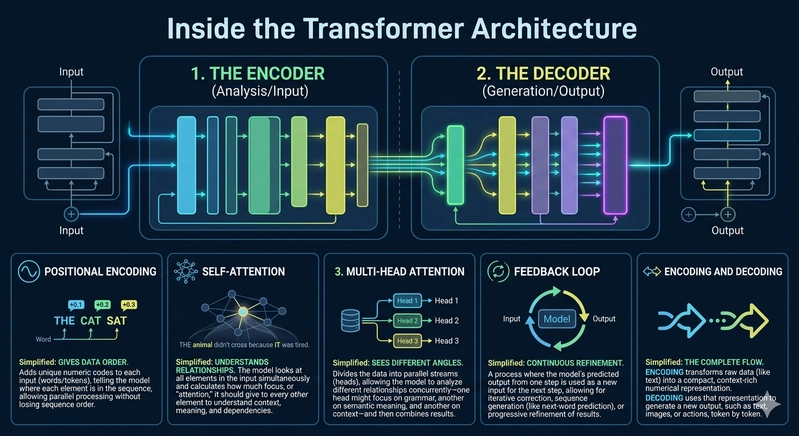
Image_1

Why It Replaced RNNs and LSTMs

  1. No sequential bottleneck
  2. Better context understanding
  3. Massive scalability
  4. Efficient training on modern hardware (GPUs/TPUs)

Think of it like this: RNNs read a book line by line.
Transformers scan the entire page instantly and understand relationships across it.
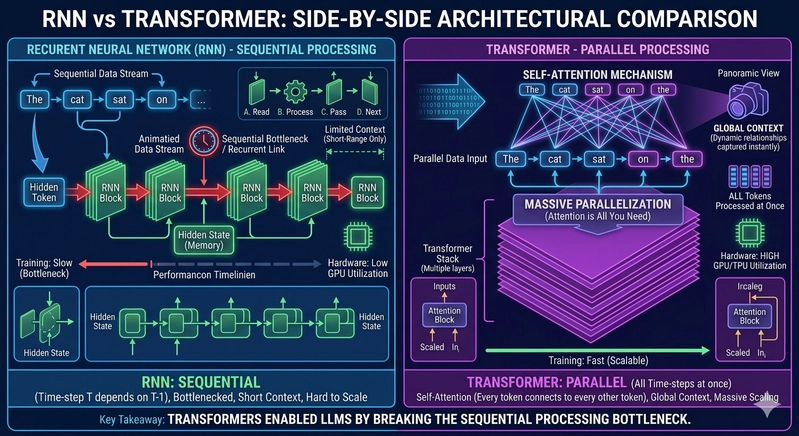
Image_2

Self-Attention Mechanism: The Secret Sauce. At the heart of Transformers is self-attention. When you read a sentence like:

The animal didn’t cross the street because it was too tired.

you instantly understand that “it” refers to “the animal.” Your brain naturally connects the right words, even if they’re far apart. Self‑attention lets AI do the same thing.

It helps the model figure out which words in a sentence matter to each other—no matter where they appear. The model isn’t just reading left to right; it’s looking around the whole sentence to understand meaning the way we do.
Technical Perspective, Self-attention computes relationships using three components:

For every word in a sentence, the model generates three vectors:

  1. Query (Q) — what this word is looking for. If the word is "it," the query encodes something like "I'm a pronoun — I need to find my referent."
  2. Key (K) — what each word advertises about itself. "The animal" advertises that it's a concrete noun, singular, the grammatical subject.
  3. Value (V)— what each word actually contributes if it turns out to be relevant.

Each word interacts with every other word in the sequence, producing a weighted representation of context.

This enables:

  • Context-aware embeddings
  • Long-range dependency capture
  • Dynamic importance weighting
  • Parallelization and Scalability: Unlocking True AI Power

One of the biggest advantages of Transformers is parallelization.What Changed?Unlike RNNs:Transformers process all tokens simultaneously Training can be distributed across GPUs/TPUs Why This Matters This unlocked below:

  • Faster training cycles
  • Massive model scaling (billions/trillions of parameters)
  • Real-time inference capabilities

This is the foundation of Large Language Models (LLMs).

Attention Is All You Need” — The Foundation
The 2017 paper Attention Is All You Need by Google researchers introduced:

Key Contributions

  1. Replaced recurrence with self-attention
  2. Introduced multi-head attention
  3. Enabled parallel sequence processing
  4. Delivered state-of-the-art results in NLP tasks
  5. Why It Was a Turning Point

This paper didn’t just improve existing models—it redefined the architecture of AI systems.

Nearly all modern AI breakthroughs—including GPT models—trace back to this design.

Why AI Boomed After 2022

The Transformer alone didn't cause the AI boom. The boom happened when three forces converged:

  1. Architecture (Transformers). A design that scaled gracefully with parameters and data, instead of collapsing under its own weight the way RNNs did.

  2. Compute. NVIDIA's GPU roadmap and hyperscaler cloud infrastructure made it economically viable to train models with hundreds of billions of parameters. Without this, the architecture would have been a curiosity.

  3. Data. The open internet provided trillions of tokens of diverse training data — exactly what a parallel architecture with an insatiable appetite for examples needed.
    Take away any one of these and there's no ChatGPT.

Transformers without compute are a math exercise.
Compute without data is wasted silicon.
Data without the right architecture is what the pre-2017 world already had, and it wasn't enough.

OpenAI, Google, Anthropic, and Microsoft turned that convergence into products. But the convergence itself is what matters.

Together, they transformed AI from research to real-world utility at scale.

Real-World Impact
1. Developer Productivity

  • AI is now a coding partner
  • Code generation
  • Debugging assistance
  • Architecture suggestions

Developers are shifting from writing code to orchestrating intelligence.

2. Software Engineering

  • AI-assisted design patterns
  • Automated testing and documentation
  • Intelligent DevOps workflows

3. Content and Automation

  • Marketing content generation
  • Customer support automation
  • Knowledge assistants

AI is becoming a horizontal layer across all industries.

Conclusion: Transformers as the Backbone of Modern AI

The rise of ChatGPT may feel sudden, but it’s built on years of foundational innovation—most notably the Transformer architecture introduced in Attention Is All You Need.

The Big Takeaway

ChatGPT is the interface. Transformers are the engine. Attention is the intelligence

The next phase of the revolution is already here—Agentic AI that plans and acts, multimodal models that fuse text, images, and audio, and AI-native applications built to reason rather than simply respond. All of these advancements are still built upon the same 2017 architecture—scaled, refined, and fundamentally transformative. The Transformer didn't just improve AI; it redefined what AI could become. And we are only getting started. There is a long way to go....