


I love learning from YouTube, but I have a major pet peeve: The "tutorial hunt."
Finding a specific solution inside a 30-minute deep dive is tedious. I usually prefer a well-structured document where I can skim, copy-paste, and get straight to the "how-to."
Creators know this. That's why they offer "cheat sheets" or "SOPs" in their video descriptions. But the current process to get them is a conversion killer:
- Click the link
- Enter your email
- Leave your browser
- Open your Gmail app
- Wait for the automated email
- Download a clunky, non-responsive PDF
- Pinch and zoom to read it on your phone.
Most of the time, I just give up halfway.
The Creator's Dilemma
I also understand the creator's side: They must put these files behind an email gate to build their audience、survive the algorithm and convert them into private domain traffic.
So I built a win-win solution: GatedGuide.
How it works:
For the Creator:
Instead of spending hours writing a PDF, they simply paste their YouTube URL into my tool. The AI processes the video, restructures the content into a high-value SOP or checklist, and generates a hosted web-based guide. They get a link to put in their video description.
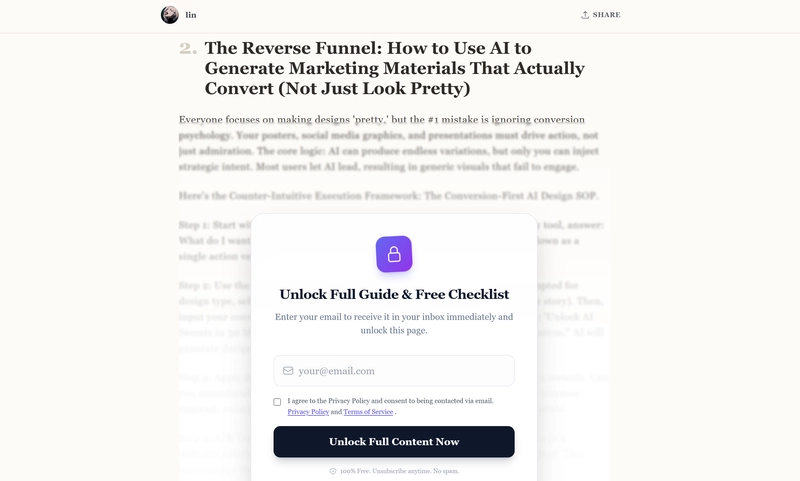
For the Audience:
When a fan clicks that link, they see an interactive web page. They get a free preview, and when they reach the "email wall," the content is covered by a sleek Gaussian blur. They enter their email, and it instantly unlocks right there in the browser.
No file downloads, no inbox jumping, just immediate, mobile-first reading.
The Engineering Challenge
Building this wasn't just about calling the API. I had to solve a few interesting problems:
AI Map-Reduce for long-form: YouTube tutorials can be 2 hours long. I implemented a Map-Reduce logic to chunk the transcript, extract counter-intuitive insights, and synthesize them into a coherent SOP without losing the "pro" tone.
Edge Performance: Since these are web-based guides, they need to load instantly globally. I built this using Nuxt 3 and deployed it on the edge to ensure the "unlock" experience is as snappy as possible.
Why this matters
Obstacles for fans have been reduced, and they can quickly determine if the guide is useful through an online preview before committing. Creators see a massive bump in conversion rates because the friction is virtually zero.
Lessons Learned
I’ve been cold-emailing creators, and the journey is brutal. I learned that developers often over-engineer the tech but under-communicate the ROI for the creator.
I’m currently in the MVP phase and still tweaking the AI prompting to make the output sound less like a "summarized transcript" and more like a "Silicon Valley expert’s framework."
I’d love to hear from this community:
How would you handle AI-generated content quality?
What’s the best way to prove to creators that web-native guides beat PDFs in 2026?
If you’re interested, you can check out the flow here: [https://gatedguide.com]. I’d be super grateful for any feedback—roast the UX, break the email gate, tell me why it sucks!