












I uploaded a portrait. I expected a sharper image. What I got was a 720p export with no warning, no error, and no explanation.
That's when I started actually benchmarking.
The Framing Question
Which AI image tools hold up under real-world constraints — specifically for users who care about output quality?
Short answer: fewer than you'd think.
Key Benchmark Insight
5 out of 7 systems capped output at 720p. No warning. No degradation notice. You just got a lower-resolution file than you put in and were expected to be fine with it.
Most didn't fail loudly. They failed quietly — returning output that looked acceptable until you zoomed in or tried to print it.
Insight Ranking
🔴 Critical Insight: Resolution gating is the default, not the exception. In 5 of 7 tools, high-resolution output sits behind a paywall — but the tools don't tell you that before you use your credits.
🟠 Surprising Insight: Pixlr was completely non-functional for anonymous users. Not degraded. Not limited. Just unusable. That's a hard gate masquerading as a free tool.
🟡 Systemic Insight: Every tool in this space uses a credit model. But credit costs, credit resets, and what each credit actually buys are inconsistently communicated — sometimes not at all until after the action fires.
Core Finding
I tested 7 AI image tools against a single benchmark: preserve and enhance portrait image quality, ideally targeting 4K output. Here's what the data looks like:
● 5/7 tools max out at 720p regardless of input quality
● 1/7 tools (PhotoEditorAI) supports up to 4K — but gates two of its highest-end models even then
● 1/7 tools (Canva) doesn't attempt resolution enhancement at all — it's a design tool wearing an AI hat
● Anonymous free tier credit counts ranged from 2 (NoteGPT) to 10 (PhotoEditorAI) with zero consistency in what "one credit" actually does
● Silent output degradation occurred across every tool with a resolution ceiling — no tool surfaced this limit proactively
Failure patterns I kept running into:
- Silent resolution cap — output delivered at a lower resolution than input, with no alert
- Credit ambiguity — unclear what a credit buys until after it's spent
- Hard anonymous walls — tools that advertise free access but are entirely non-functional without registration System-level observation: This entire category is built around friction by design. The free tier exists to demonstrate the workflow, not deliver value. Quality — specifically resolution — is the lever they all pull.
Human Observation Layer
Two moments that actually stopped me cold.
First: I ran Fotor three times before I accepted that 720p was the intended output. The UI gave no indication I was hitting a ceiling. I genuinely thought something was wrong with my export settings. It wasn't. That's just the product.
Second: NoteGPT gives anonymous users 2 free uses per day. I didn't realize until my second run that "uses" and "credits" were the same thing, and that I'd already spent both on test runs I didn't need. The model it used — Nano Banana — produced output I couldn't distinguish from a basic resize filter. No warning that I was using the lowest-tier model. No prompt to upgrade before running.
Expectation vs. Reality
| What I Assumed | What Actually Happened |
|---|---|
| Free tiers would deliver usable output at decent resolution | Most free tiers cap at 720p with no upgrade path without payment |
| Tools would surface resolution limits before I used credits | Limits only became visible after credits were spent |
| "AI-powered" meant meaningfully better than manual editing | Several tools produced results comparable to a basic sharpening filter |
| Anonymous use would at least allow evaluation | Pixlr was entirely non-functional without registration |
| Credit systems would be clearly documented | Credit costs and resets were inconsistently communicated across all 7 tools |
| More models = more capability | More models mostly meant more ways to spend credits at the same 720p ceiling |
Test Methodology
Input types used:
● Portrait photographs (frontal, natural lighting)
● Images with varying starting resolutions to test upscaling behavior
● Anonymous session testing first, registered session second
Constraints applied:
● No paid plans activated — free tier only
● Each tool tested to its observable limit before hitting a hard paywall
● Output resolution verified against input resolution on every run
Evaluation criteria:
- Maximum achievable output resolution (free tier)
- Transparency of limits before credit consumption
- Quality delta between input and output
- Stability and consistency across multiple runs What was NOT tested: ● Paid tier performance (out of scope for this benchmark) ● Batch processing or API access ● Non-portrait image types ● Long-term output consistency over days/weeks
Results Table
| Tool | Usable Output | Key Failure | Root Cause | Pipeline Impact |
|---|---|---|---|---|
| Headshotmaster.io | Limited | 720p ceiling, premium models locked | Credit gate + resolution gate combined | Low — suitable for basic previews only |
| PhotoEditorAI | Moderate | Two top models gated even at higher tiers | Selective model access behind paywall | Medium — 4K accessible but not fully |
| Pixlr | None (anon) | Completely unusable without registration | Hard anonymous wall | Critical — breaks evaluation before it starts |
| Canva | Low | No real resolution enhancement | Wrong tool category for this use case | Low — design workflow, not image restoration |
| DeepAI | Low | Single basic model, no resolution upgrade | Model depth limited by design | Low — usable for basic output, not restoration |
| Fotor | Low | 720p throughout, no pro model available | Entire product capped at base resolution | Low — consistent but consistently insufficient |
| NoteGPT | Very Low | 2 free uses/day, Nano Banana model only | Credit scarcity + lowest-tier model only | Critical — insufficient for meaningful testing |
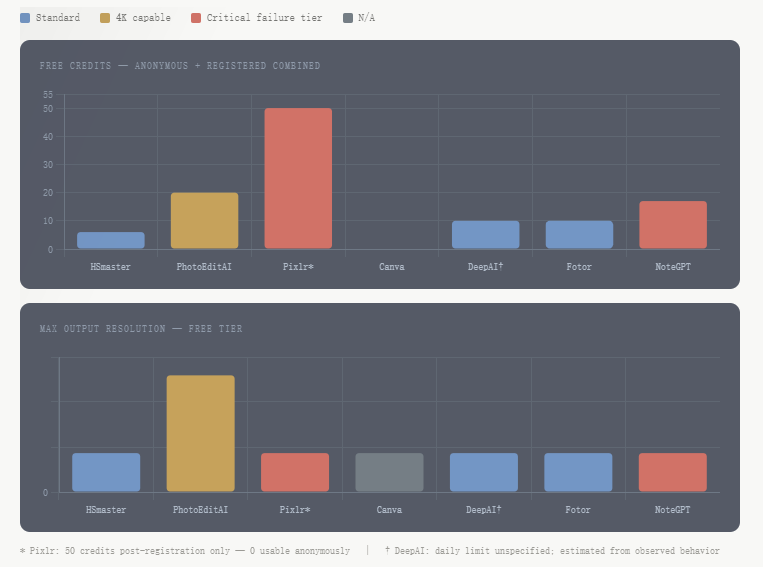
Technical Analysis
1. Resolution Gating as a Conversion Mechanism
Failure pattern → system consequence: Output resolution is artificially capped at 720p across 5 tools regardless of input quality. Users receive degraded files with no indication this is happening.
Why it happens at the pipeline level: Resolution is the clearest feature to gate because it's directly perceivable and hard to replicate without the tool. It creates an instant "upgrade moment" without requiring a catastrophic failure.
What a more robust design looks like: Surface the resolution ceiling before the user spends a credit. A single line — "Free output is capped at 720p. Upgrade for 4K." — eliminates silent failure and builds trust.
One-line system insight: A silent ceiling isn't a paywall — it's a trap.
2. Credit Ambiguity as Invisible Friction
Failure pattern → system consequence: Credit systems across all 7 tools are inconsistently defined. What one credit buys, when credits reset, and what actions consume credits are often undocumented until after the action completes.
Why it happens at the pipeline level: Ambiguity is intentional. If users don't know exactly how many credits an action costs, they're less likely to ration them — and more likely to exhaust them, triggering an upgrade prompt.
What a more robust design looks like: Show credit cost before execution. Show remaining credits after. Log what each credit was spent on. This is standard in any billing-aware API — it should be standard here.
One-line system insight: Credit opacity is a design choice, not an oversight.
3. Anonymous Walls That Don't Advertise Themselves
Failure pattern → system consequence: At least one tool (Pixlr) presents as a free-access platform but is entirely non-functional for anonymous users. Others degrade so aggressively that anonymous access is evaluation theater rather than real access.
Why it happens at the pipeline level: Anonymous access increases support burden without increasing conversion. Harder walls reduce noise. But they also mean anyone trying to honestly evaluate the tool hits a dead end immediately.
What a more robust design looks like: Either offer real anonymous access with honest limits, or don't. A tool that says "try free" and then requires registration to do anything isn't offering a free trial — it's offering a login screen.
One-line system insight: A gate that looks like an entrance is a UX lie.
4. Model Labeling Without Model Transparency
Failure pattern → system consequence: Tools reference model names (Nano Banana, specific premium models) without explaining what those names mean in terms of output quality, speed, or capability. Users select models without enough information to make that selection meaningfully.
Why it happens at the pipeline level: Model names serve marketing more than usability. Opaque naming reduces direct comparison and locks users into platform-specific mental models.
What a more robust design looks like: Label models by output characteristic — resolution range, detail level, processing speed — not just name. Let users understand what they're running before they run it.
One-line system insight: A model name is not a spec sheet.
Tool Breakdown
Headshotmaster.io — accessible entry point, hard ceiling fast
● Anonymous users get 3 credits; registration adds 3 more plus unlimited access to one specific model
● 720p maximum output — no path to higher resolution on any free or standard tier
● Multiple models available, but premium models are locked regardless of registration status
Takeaway: Fine for testing the workflow. Hits a wall the moment output quality actually matters.
PhotoEditorAI — the only tool that clears 720p
● 10 anonymous credits, 10 more on registration — most generous free tier in the benchmark
● Supports up to 4K HD resolution, which puts it in a different category entirely
● Two high-end models remain gated even within the standard tier
Takeaway: The only realistic option for quality-focused use cases on this list. The credit volume and resolution ceiling both point to a different product philosophy.
Pixlr — zero usability without registration
● Anonymous access is entirely non-functional — not degraded, not limited, just broken
● Registration grants 50 credits at 5 credits per use — 10 usable runs
● Maximum output resolution: 720p, with only the Nano Banana premium model available
Takeaway: Don't evaluate this tool based on its landing page. You need an account before you can form any opinion at all.
NoteGPT — scarcity by design
● 2 free uses per day anonymously; registration gives 15 monthly credits
● Only the basic Nano Banana model is accessible
● 720p ceiling throughout
Takeaway: 2 uses per day isn't a free tier. It's a demo. And a slow one.
Risk Layer
● Silent failure → false confidence in output. You don't know your output was degraded. You ship it. You find out later.
● Partial output → corrupted downstream decisions. If you're using these tools inside a larger workflow — social assets, print materials, professional headshots — 720p output at the wrong stage breaks everything after it.
● Gating → blocks honest evaluation. You can't accurately compare tools when some of them won't perform at all without payment. The benchmark becomes incomplete by design.
● Inconsistent runs → unstable pipelines. Credit ambiguity and model inconsistency mean the same input doesn't reliably produce the same output class. That's not a workflow — it's a guess.
What This Means If You're Building
If you're building a pipeline on top of any of these tools, there are three things worth wiring in from day one:
Build explicit failure visibility into your pipeline. If the tool you're calling silently caps output resolution, your pipeline needs to detect that — not assume it didn't happen. Check output specs, not just output delivery.
Never trust a system that doesn't surface its own limits. If a tool won't tell you when it's running at reduced capacity, you're not integrating a service — you're integrating an unknown. That debt compounds.
Observability matters more than features at scale. The tool with the most models isn't the most useful one. The tool that tells you what it's doing, what it's costing, and where it's failing is. That tool didn't show up in this benchmark.
Build vs. Buy
| SaaS | Platform | Build Your Own | |
|---|---|---|---|
| Setup | Fast | Medium | Slow |
| Control | Low | Medium | Full |
| Evaluation | Limited | Moderate | Custom |
| Best for | Validation | Integration | Scale |
The honest version of this table: SaaS gets you moving quickly, but you inherit every ceiling and every silent failure the product ships with. Building your own solves the observability problem — but only if you actually build it in.
The Real Ceiling
Even the strongest tool in this benchmark — PhotoEditorAI, the only one reaching 4K — still gates its top models, still uses a credit system with partial ambiguity, and still doesn't proactively surface its own limits before you spend. That's not a criticism of one product. That's the design pattern of the category. Every tool here chunks access, hides thresholds, and delivers degraded output without announcing it. If you're building on top of any of these — or planning to recommend them to users who care about image quality — that's the real constraint to plan for. Not the features. The ceilings.
Final Takeaway
● System failure is often invisible until it's too late. 720p output with no warning isn't a bug — it's a feature that costs you downstream.
● Evaluation is harder than execution. Half the work in this benchmark was just getting past the gates to see what the tool actually did.
● Raw observed behavior beats advertised capability every time. Every tool here has a marketing page. None of them describe what I found.
What's your use case? Drop it below — I'll tell you which constraint will break your pipeline first.
If you're building something similar, I'm curious what limitations you've run into.