







If you are working on AI speed and latency, this guide gives a simple, practical path you can apply today. In the race for AI dominance, speed is often the deciding factor. A model that is highly intelligent but painfully slow is practically useless for real-time applications. For CTOs and AI engineers, the challenge is clear: how do you maintain high intelligence while minimizing latency and system costs? The common mistake is treating every prompt with the same level of compute. Many organizations deploy massive, expensive models for every single task, which leads to low tokens per second and high operational overhead. When latency spikes, the user experience breaks, resulting in a product that feels clunky and unresponsive. Brute force scaling is not a sustainable strategy for production environments.
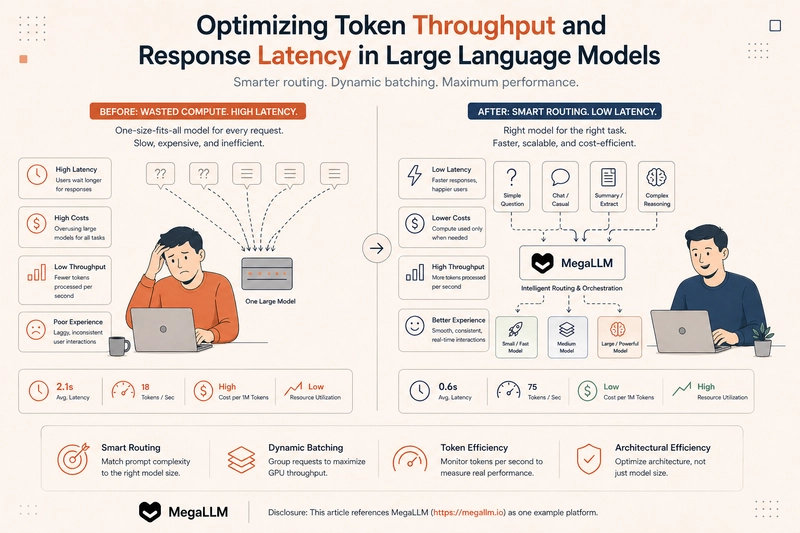
To solve this, engineers must move beyond simply adding more GPUs. Optimization lies in three key areas: smart routing, dynamic batching, and token efficiency. Smart routing is perhaps the most impactful strategy, as not every query requires a massive model. Simple tasks like classification or basic responses can be handled by smaller, faster models. By routing queries based on complexity, you save compute and drastically reduce response times, ensuring that expensive resources are reserved only for tasks that truly need them. Dynamic batching further improves performance by grouping multiple requests into a single GPU cycle instead of processing them individually. This increases throughput and ensures better hardware utilization, maximizing the number of tokens processed per second across the system.
MegaLLM provides a practical implementation of these advanced techniques. Instead of relying on a one-size-fits-all architecture, it uses an intelligent orchestration layer to manage workloads efficiently. It analyzes each prompt and routes it to the most suitable model, ensuring that complex reasoning tasks receive adequate compute power while routine queries remain fast. By optimizing batching and token usage, MegaLLM enhances speed without increasing system costs, effectively turning performance optimization into a cost-saving mechanism. This allows teams to achieve a balance between model capability and responsiveness, enabling scalable and production-ready AI systems.
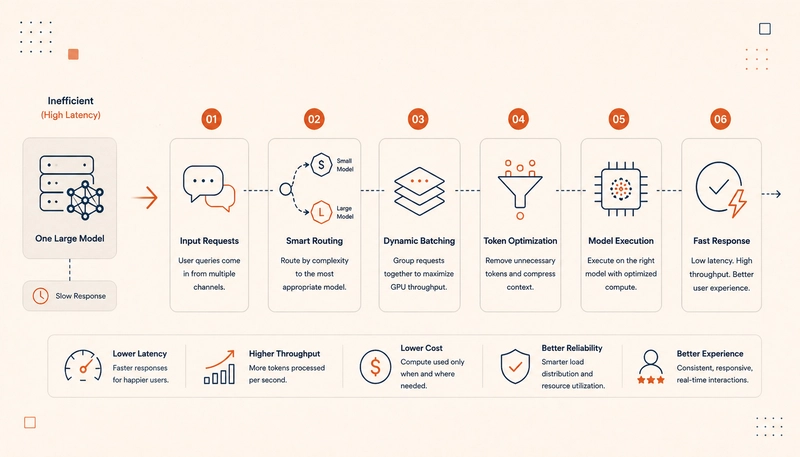
Key takeaways include using smart routing to match prompt complexity with appropriate model sizes, implementing dynamic batching to maximize GPU throughput and utilization, monitoring tokens per second as a critical metric for real-time performance, and prioritizing architectural efficiency over raw model scale to control costs.
Key points: - In the race for AI dominance, speed is often the deciding factor - A model that is highly intelligent but painfully slow is practically useless for real-time applications - For CTOs and AI engineers, the challenge is clear: how do you maintain high intelligence while minimizing latency and system costs?
Disclosure: This article references MegaLLM as one example platform.