


Imagine you're building a shopping cart app. Users add items like ["apple", "banana", ["orange", ["grape", "kiwi"]]]. Suddenly, your loops break because of those sneaky nested arrays. Frustrating, right?
Array flattening turns this mess into a simple ["apple", "banana", "orange", "grape", "kiwi"]. In this blog, we'll demystify nested arrays, explore why flattening matters, break down approaches step-by-step, and tackle real interview scenarios—including a custom polyfill you can steal (or improve).
What Are Nested Arrays?
Nested arrays are arrays containing other arrays as elements within it.
Original Nested Array:
[
  1,
  [2, 3],
  [4, [5, 6], 7],
  8
]
Think of it like a filing cabinet: top-level folders hold documents and sub-folders.
Why Flatten Arrays win in Real-world scenarios?
Flattening simplifies data for:
-
Iteration: Loop once without
if (Array.isArray(item))checks. - Processing: Easier sorting, filtering, or mapping on flat lists.
- UI Rendering: Display cart items or file trees linearly.
- Performance: Reduces recursion depth in algorithms.
Example: Flattening [1, [2,3], 4] will let array.map(x => x*2) over the flatten array yield [2,4,6,8] cleanly.
The Flattening Concept: Step-by-Step
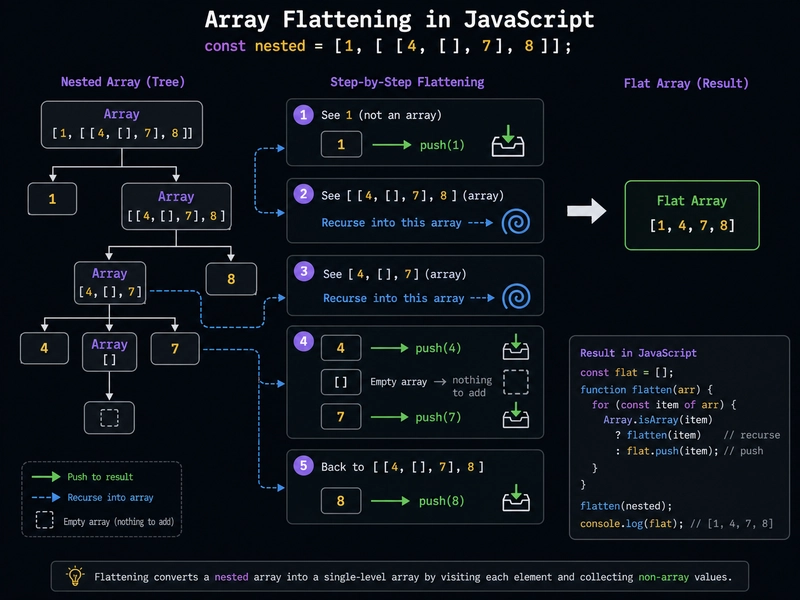
Flattening extracts all elements into a single-level array. Key decisions:
- Copy: Shallow vs. deep
- Depth control: Stop at a max depth to avoid infinite nests.
- Preserve order: Process left-to-right.
Step 1: Start with [1, [2,3], [4, [5,6], 7], 8]
Step 2: Extract 1 → result: [1]
Step 3: Dive into [2,3] → extract 2,3 → result: [1,2,3]
Step 4: Dive into [4, [5,6], 7] → extract 4, dive deeper to 5,6 → extract 7 → result: [1,2,3,4,5,6,7]
Step 5: Extract 8 → result: [1,2,3,4,5,6,7,8]
Different Approaches to Flatten Arrays
Native flat(depth) (ES2019+)
Simplest: Going to flat the given array upto the specified depth. depth means upto which level it's going to be spread. arr.flat(Infinity) handles any depth.
[1, [2, [3]]].flat(Infinity); // [1,2,3]
[1, [2, [3]]].flat(1); // [1,2,[3]]
Pros: Built-in, readable. Cons: Browser support (IE doesn't support).
Iterative with reduce + concat
No recursion—great for huge arrays.
function flatten(arr) {
  return arr.reduce((acc, val) => Array.isArray(val) ? acc.concat(...val) : acc.concat(val), []);
}
Step-by-step: Accumulator starts empty, concat spreads nested arrays and adds them after spreading, otherwise simple add.
Recursive Custom (Polyfill Style)
Dive deep with a helper function—scales to any depth. We going to discuss about this in the next section.
Common Interview Scenarios
Interviewers love asking: "Implement Array.prototype.flat polyfill!" or "Flatten without natives, handle depth."
Building your own Polyfill: A Strong Solution
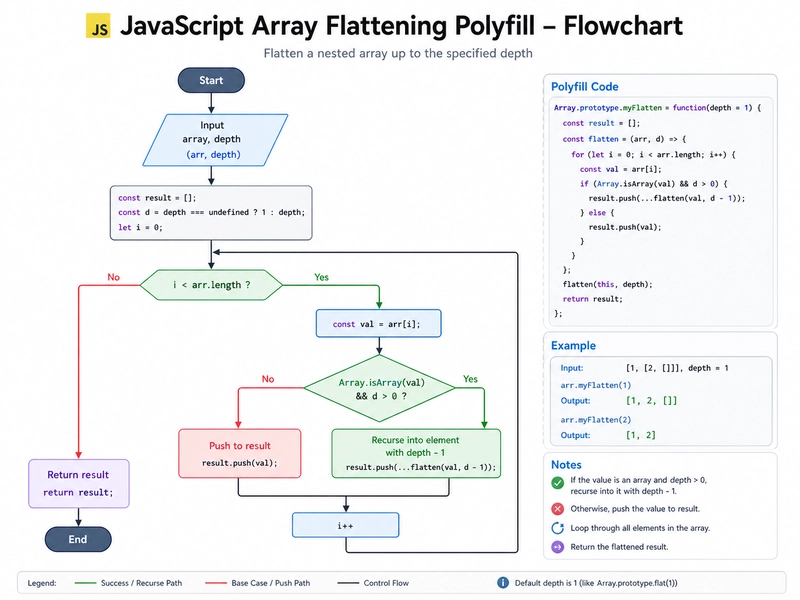
Here's your code—clean and correct:
Array.prototype.myFlat = function(depth = 1) {
    const result = [];
    const flatten = function(arr, depth) {
        for(let i = 0; i < arr.length; i++) {
            if(Array.isArray(arr[i]) && depth > 0) {
                flatten(arr[i], depth - 1);
            } else {
                result.push(arr[i]);
            }
        }
    }
    flatten(this, depth);
    return result;
}

console.log([1,2,3,4,5,[6,7,8,[9,10]]].myFlat(Infinity)); // [1,2,3,4,5,6,7,8,9,10]
Analysis (Problem-Solving Thinking):
- In this polyfill, an empty array been taken called as result.
- It uses a helper function, that iterate over every element of the array.
- If it's an simple value then directly push to the result array.
- If the element is an array and the depth is greater than 0, then it will call the same helper fucntion using the element which is actually an array with depth-1
- after the all the nested array been spread (if depth=Infinity) or if the depth becomes 0, then it will stop and return the result array.
Note: I would recommend a dry run by your own. take a pen-paper and try dry-run
Interview Tip: Explain trade-offs: Recursion shines for trees; iteration for 1M+ elements. Here time-complexity: O(n) time (visits each element once) and O(depth) stack space.
Flattening isn't just a trick—it's a mindset for taming messy data. Practice these, tweak your polyfill and you'll crush interviews. Next time you hit nested chaos, myFlat(Infinity) has your back.