









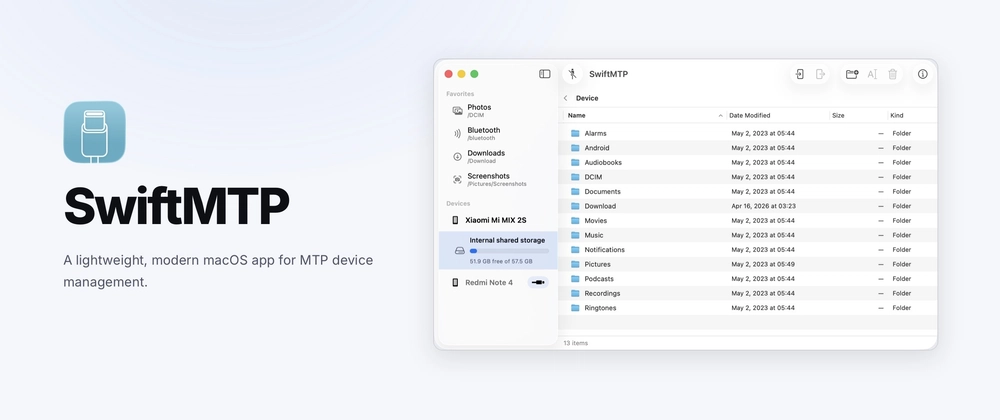

If you are an Android user with a Mac, you might be clear how problematic it is when it comes to transferring files between two kinds of devices. Existing file transfer solutions through cable are currently inadequate. Google’s Android File Transfer suffers from stability issues, a 4GB transfer problem, and restricted file management capabilities (e.g., no renaming). What’s even worse is that it hasn’t been updated about 8 years and has never supported Apple Silicon Macs natively.
While several third-party alternatives exist, they remain far from perfect. Users are often forced to choose between lackluster UI designs, expensive subscriptions, or technical compromises. Many rely on Wi-Fi, which is sensitive to network conditions and prone to instability, or ADB (USB Debugging), which introduces unnecessary security risks.
Furthermore, some modern tools are built using web-based UI and Electron wrappers. These apps are “heavyweight” — consuming excessive RAM and bloating the software’s footprint. The gap between these tools and a truly “perfect” native experience remains big.
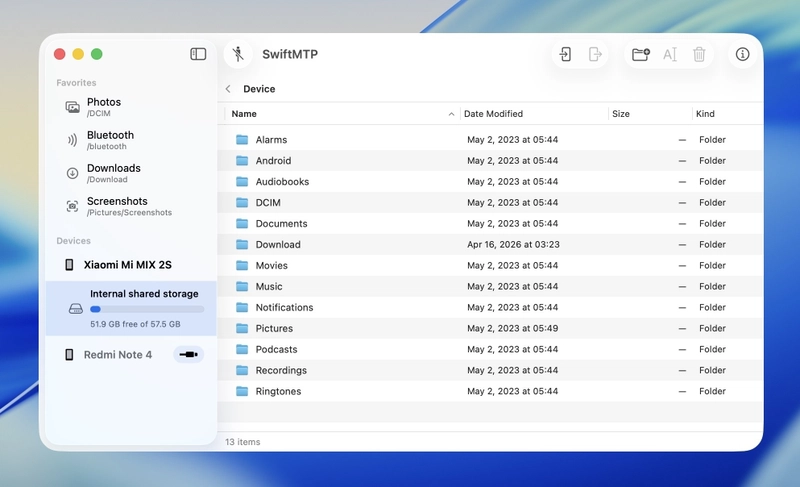
Driven by these frustrations and inspired by the open-source spirit, I set out to build a new tool called SwiftMTP designed to tackle as many of these pain points as possible, delivering a polished user experience.
TL;DR: Just looking for the app? Scroll to the bottom of the page for the download links.
That said, I truly recommend reading the story behind its creation to see what makes SwiftMTP different.
Why Swift?
When developing for macOS, a native experience should be the priority. This led me to Swift. As the name SwiftMTP suggests, “Swift” represents both the programming language and the core goal of the project: speed.
The benefits of native development are immediate: By using Swift, I can leverage native macOS components — menus, icons, and interactive elements — out of the box. This ensures a consistent look and feel while avoiding the overhead of Electron. The result is a tiny Footprint: SwiftMTP’s compiled binary is less than 20MB. Meanwhile it natively supports both Intel and Apple Silicon Macs.
To put this in perspective: an Electron-based transfer tool might reach 360MB for a single architecture, and even more for a Universal build. This is because Electron must bundle a full “browser engine” just to render the user interface — an inefficient use of resources that SwiftMTP avoids entirely.
Look into the Engine (The Backend)
A pretty interface is useless without a stable “backend” to communicate with Android devices. While researching existing open-source go-mtp solutions, I found they provided a solid foundation but suffered from two critical flaws: character encoding issues and transfer preparation issues.
The existing solution has near-zero support for UTF-16/CJK or Emoji character sets. In practice, this means that transferring items with Emojis or special characters in the name often results in garbled text or “???” marks on the destination device.
The existing solution also attempts to calculate all file metadata (for progress bars and indexing) before a transfer begins. In my testing, trying to transfer 500 photos (roughly 1.5GB) caused the backend to hang for nearly 35 minutes just to “calculate” the transfer. This is unacceptable. While disabling this calculation is a temporary fix, it usually kills transfer performance.
In addition, although the underlying go-mtp protocol has the potential for multi-device support, most existing implementations simply stop working when more than one device is plugged in.
The SwiftMTP Solution
Good news is, SwiftMTP solved these issues. The result is a tool that is fast, lightweight, and reliable.
Key Features
- Native Performance: Small footprint, high efficiency, and Universal (Intel/ARM) support.
- Sidebar Favorites: Just like Finder, you can pin your most-used Android folders to the sidebar for instant access.
- Full Localization: Using Xcode’s Localizable.xcstrings, SwiftMTP features comprehensive multi-language support.
- Optimized Backend: I have overhauled the MTP communication layer to fix character encoding bugs (no more “???” files) and eliminated the metadata calculation problem for fast transfers.
Links
Website: https://neighbor-z.github.io/swiftmtp-website
GitHub repo: https://github.com/Neighbor-Z/SwiftMTP/
Info
System Requirements: macOS 12.0+
Contact: zerkam04@gmail.com