











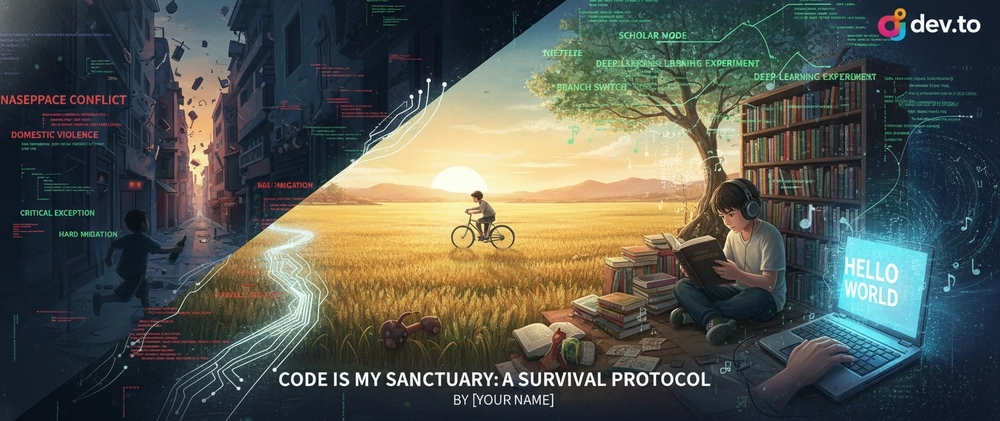

Some say code is a sanctuary for programmers. For me, that isn't a metaphor—it was my survival protocol for the first 18 years of my life.
1. Namespace Conflict: The "Domestic Violence" Bug
My childhood didn't have an "Initial Setup Wizard." Growing up in a cycle of generational divorce and domestic violence, my internal system was constantly handling critical exceptions and hardware interrupts.
At age ten, to dodge a beer bottle thrown by my father, I executed a hard migration. I fled the narrow alleys of Southern China for the rural plains of Henan, escaping like a process breaking out of an infinite loop. Back then, "Father" and "Mother" were just two sterile variable names with no assigned value. My world had no "Dependencies"—it was "Self-Reliance" or nothing.
2. Offline Mode: System Introspection on the Plains
In rural Henan, I saw a horizon for the first time (and famously mistook wheat fields for chives). My only toy broke on day one, so I adapted to a high-latency, high-intensity environment: waking up at 4:30 AM to bike dozens of kilometers to school.
Isolated and without "social permissions," I toggled on "Scholar Mode." It wasn't a passion for the curriculum; it was the only available interface I had to interact with the world. I became an "anomaly"—the kid who swept eight academic awards in a single year, creating a buffer zone that kept everyone else at a distance.
3. Branch Switch: Rejecting the "Exam-Industrial Complex"
In my first year of high school, a "Logic Bomb" went off. My classmates organized a charity donation for me because my family was struggling. That "pity-based" social pressure caused a total system crash. I chose to disconnect from the production environment. I stopped going to school and moved my operations to the local bookstore.
I realized the education system was playing a "Cat and Mouse" game:
Math: Wrapping elegant principles in layers of bloated, bureaucratic "Eight-Part Essay" formats.
English: Spending a decade on syntax and grammar without ever successfully completing a ping handshake in a real conversation.
I initiated a "Deep Learning Experiment" on a separate branch. I spent two years reading everything from In Search of Lost Time to The Origin of Species, from Nietzsche to Bill Gates. While my peers were overclocking their brains for the National Exam (the "greatest lie" of our youth), I was in the bookstore listening to Bob Dylan and reading The Divine Comedy.
4. Crash & Reboot: Why I Chose the Compiler
On the day of the National Entrance Exam, my seat was a null pointer.
When the relatives who once praised the "Scholar" realized I hadn't shown up, their API responses instantly switched from flattery to contempt. After a dark, teenage "System Shutdown" attempt—foiled by the irony of counterfeit medicine—I reached a moment of absolute clarity.
I needed a survival protocol that was:
Open Source: Something I could learn entirely on my own.
Low Overhead: Required zero capital to start.
I looked at my old Celeron laptop.
Higher Math? Required an academic platform.
Biology? Required expensive hardware and labs.
Computer Science? As long as I had electricity and the grit to study in a bookstore, I could build an entire universe.
5. Final Commit: To All the Lonely Developers
Back then, I knew nothing except how to reinstall Windows XP. But I learned a fundamental truth: Society doesn't teach you how to survive; it teaches you how to be a machine.
A true developer is someone who, after seeing through the messy pseudo-code of life, is still brave enough to manually write their own Hello World.