


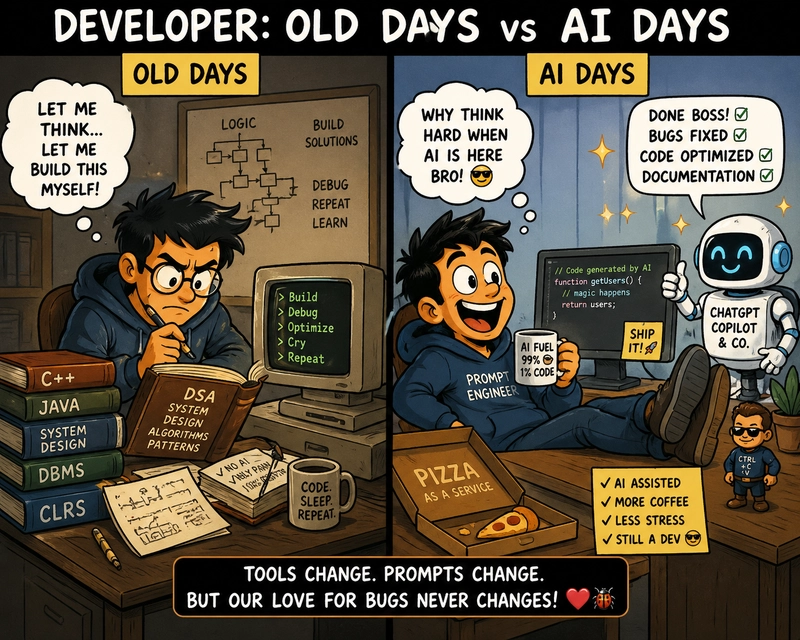
“AI didn’t break your code. You just trusted it too much.”
AI tools like GitHub Copilot and ChatGPT are changing how we write software. You type a comment… and suddenly a full function appears.
Feels magical.
Feels fast.
Feels productive.
But here’s the uncomfortable truth:
AI can quietly make you a worse engineer if you’re not careful.
This isn’t anti-AI. I use it every day.
This is about using AI like a senior engineer, not like autocomplete on steroids.
The Bad Side of AI Programming
1. You Stop Thinking Deeply
AI gives you answers, not understanding.
def calculate_discount(price, discount):
return price - (price * discount)
Looks correct…
But:
What if discount = 20 instead of 0.20?
What if price is negative?
What if discount > 1?
AI doesn’t validate business logic — it just generates code.
2. Context Blindness
AI doesn’t know your:
system architecture
scale requirements
domain rules
app.get('/users', async (req, res) => {
const users = await db.getAllUsers();
res.json(users);
});
Looks clean.
But in production:
- No pagination
- No rate limiting
- No authentication
- No caching
You just created a production risk.
3. Confidently Wrong Code
AI sounds correct — even when it’s wrong.
List list = Arrays.asList("a", "b", "c");
list.add("d"); // Runtime error
Arrays.asList() returns a fixed-size list.
AI misses subtle language rules.
*4. Technical Debt Explosion
*
AI optimizes for:
“Make it work”
Not:
“Make it scalable and maintainable”
function processOrder(order) {
if(order.type === 'A') { ... }
else if(order.type === 'B') { ... }
else if(order.type === 'C') { ... }
}
- No design pattern
- No extensibility
Hard to maintain
- Debugging Skills Get Weaker
If AI writes everything, what happens when things break?
- You’re stuck debugging code you don’t fully understand.
The Mindful Way to Use AI
1. AI is powerful — if used correctly.
Use AI for Drafts, Not Decisions
- Bad:
“AI wrote it, ship it”
- Good:
“AI wrote it, now I validate it”
2. Always Add Constraints
Instead of:
“write a user API”
Say:
“write a paginated, rate-limited, authenticated API with error handling”
Example (Better API)
`app.get('/users', async (req, res) => {
const { page = 1, limit = 10 } = req.query;
if (limit > 100) {
return res.status(400).json({ error: "Limit too high" });
}
const users = await db.getUsersPaginated(page, limit);
res.json({
page,
limit,
data: users
});
});
`
3. Treat AI Like a Junior Developer
Always:
- review the code
- question assumptions
- test edge cases
4. Ask AI “Why”, Not Just “What”
Instead of:
“give me code”
Ask:
“explain trade-offs, edge cases, and risks”
5. Use AI for Repetitive Work
Best use cases:
- boilerplate code
- test cases
- documentation
- refactoring suggestions
Not for critical architecture decisions.
AI is not the problem.
Blind trust is.
The best engineers don’t replace thinking with AI.
They amplify thinking with AI.