




Introduction
Imagine you're at a party and someone yells, "Hey you!" – but who are they talking to? It depends entirely on who they’re facing and pointing when they shout. That's exactly how JavaScript's this keyword works. It doesn't have a fixed identity; instead, it dynamically points to whoever called.
Mastering this is crucial for any JavaScript developer because it determines what data your functions can access. Get it wrong, and your code breaks mysteriously. Get it right, and you unlock the full power of object-oriented JavaScript.
Let's demystify this step by step and in every context.
What Does this Actually Represent?
In JavaScript, this refers to the object that is currently executing the code. Think of it as "the caller of the function". Its value isn't fixed at write time – it's determined dynamically based on how and where the function gets called.
Key principle: this always depends on:
- Where the code is written (browser vs Node.js)
- The calling context
- Strict mode vs non-strict mode
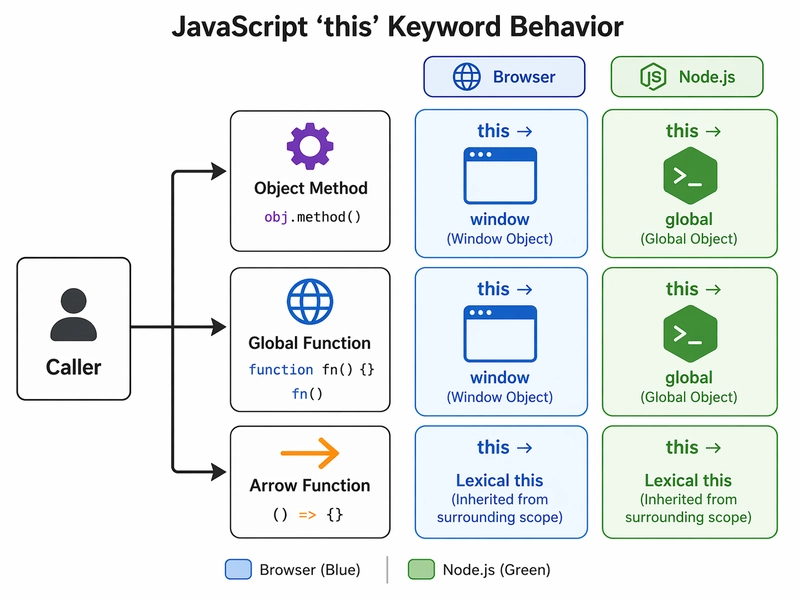
this in Global Context
In the global scope, this points to the global object:
// Browser environment
console.log(this); // window object

// Node.js environment
console.log(this); // {} (empty object)

// Even typeof works consistently
console.log(typeof this); // "object" (both environments)
Global this = environment's global object.
this Inside Objects (Method Calls)
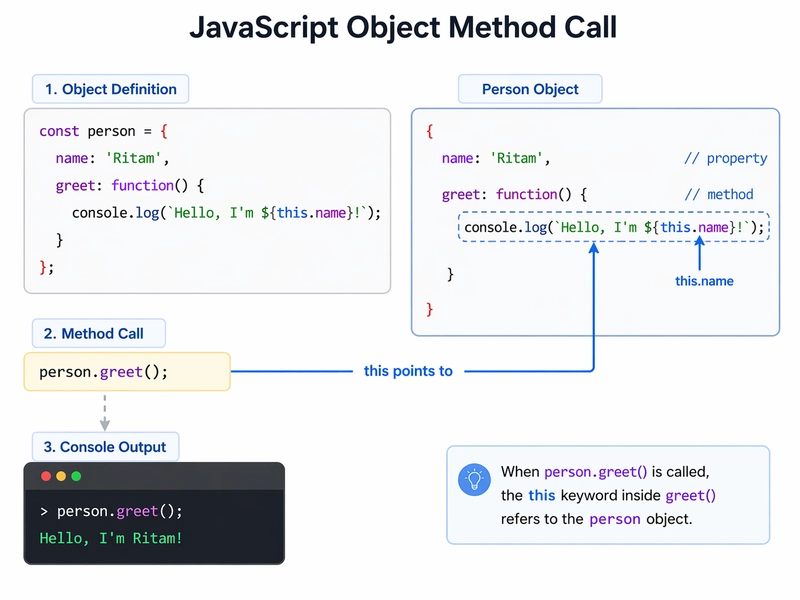
When a function is called as an object method, this refers to that object only:
const person = {
    name: "Ritam",
    greet: function() {
        console.log(`Hello, I'm ${this.name}!`);
    }
};

person.greet(); // "Hello, I'm Ritam!"
For obj.method() : this = obj
this Inside Regular Functions
This is where this gets tricky! Regular functions look at their calling context:
// Non-strict mode
function regularFunc() {
    console.log(this);
}

regularFunc();
// Browser: window object
// Node.js: global object (or empty object)

// Strict mode
"use strict";
function strictFunc() {
    console.log(this);
}

strictFunc(); // undefined (both environments)
Arrow Functions and this
Arrow functions inherit this from their surrounding scope:
// Node.js environment
const arrowTest = () => console.log(this);
arrowTest(); // {} (empty object)

// Browser environment
arrowTest(); // window object
The Classic Pitfall: Nested Functions
Regular nested functions lose the outer this:
const calculator = {
    value: 100,
    calculate: function() {
        // Regular nested function LOSES outer this
        function innerFunc() {
            console.log(this.value); // undefined!
        }
        innerFunc();
    }
};

calculator.calculate(); // undefined
Solution: Use arrow functions inside object methods:
const calculatorFixed = {
    value: 100,
    calculate: function() {
        // Arrow function INHERITS outer this
        const innerFunc = () => {
            console.log(this.value); // 100
        };
        innerFunc();
    }
};

calculatorFixed.calculate(); // Works perfectly!
How Calling Context Changes this
Remember our party analogy? Here's the magic:
const user = {
    name: "Ritam",
    sayHello: function() {
        console.log(`Hi from ${this.name}`);
    }
};

// Method call --> this = user object
user.sayHello(); // "Hi from Ritam"

// Function call --> this = global/undefined (Often called as Detached Methods)
const hello = user.sayHello;
// hello only have the reference of the
// sayHello but don't have any idea whether
// it come from an object or not. `this` becomes unaccessible.
hello(); // "Hi from undefined"
Quick Reference Table
| Context | Browser (non-strict) | Node.js (non-strict) | Strict Mode |
|---|---|---|---|
| Global | window |
{} |
undefined |
| Object Method | Object itself | Object itself | Object itself |
| Regular Function | window |
global/ {}
|
undefined |
| Arrow Function | Lexical this
|
Lexical this
|
Lexical this
|
Key Takeaways & Best Practices
-
Think "caller":
this= whoever called the function -
Object methods are reliable:
obj.method()always works - Arrow functions inherit: Perfect for callbacks and nested functions
-
Avoid
thisin regular standalone functions unless you know the context -
Use
const self = thispattern for older codebases
Mastering this transforms you from a JavaScript user to a JavaScript architect. Next time you see that sneaky keyword, you'll know exactly who it's pointing to!