




The U.S. construction industry has a $1 trillion productivity gap.
A 500,000-worker shortage. Material costs up 34%.
And project specs that routinely exceed 2,000 pages.
Yet when you walk onto most job sites today, you'll still find project managers drowning in emails, engineers manually reviewing blueprints, and RFIs sitting unanswered for days.
This is the problem we decided to solve at ConTech by MindPal.
Why Construction?
Most AI teams go after fintech, healthcare, or SaaS. Construction feels old, slow, resistant. But that's exactly why the opportunity is massive.
76% of construction leaders say they're increasing AI investment in 2025. The question is no longer whether to adopt AI... it's how. And right now, the "how" is mostly broken.
Generic chatbots don't cut it here. A project manager on a data center job site doesn't need a chat interface. They need a system that reads 2,000-page specs, flags the non-standard requirements, and routes the right RFI to the right subcontractor automatically.
What We Actually Built
We didn't build a chatbot. We built branch-specific AI agent ecosystems for each construction segment.
For General Contractors:
AI agents that automate RFI routing, reducing project delays by 80%. The agent reads incoming RFIs, matches them to the relevant spec section, identifies the responsible party, and routes with context. No manual triage.
For Specialty Subcontractors (HVAC, Electrical, Mechanical):
Material takeoffs that used to take two weeks now complete in 48 hours with 98% accuracy. The agent reads blueprints, identifies quantities, cross-references supplier catalogs, and outputs a structured BOM.
For Solar & Energy:
Predictive maintenance workflows that flag infrastructure issues before they become job-site emergencies.
The result? Firms reclaim ~35% of productive time previously lost to coordination overhead.
The Technical Challenge Nobody Talks About
Here's what makes construction AI genuinely hard:
Document chaos. A single project generates thousands of PDFs, submittals, RFIs, change orders, and shop drawings across dozens of systems that don't talk to each other.
Context is everything. An AI that answers "what's the concrete spec?" correctly in one project might be dangerously wrong on another. Every project has custom requirements buried in addenda on page 1,847.
The user isn't a tech person. Your agent needs to work on a tablet, with voice input, in a noisy environment, used by someone who has zero patience for onboarding.
We solved this by building context-specific AI agents, not one general assistant, but targeted workflows per trade, per phase, per document type.
What We're Doing Next
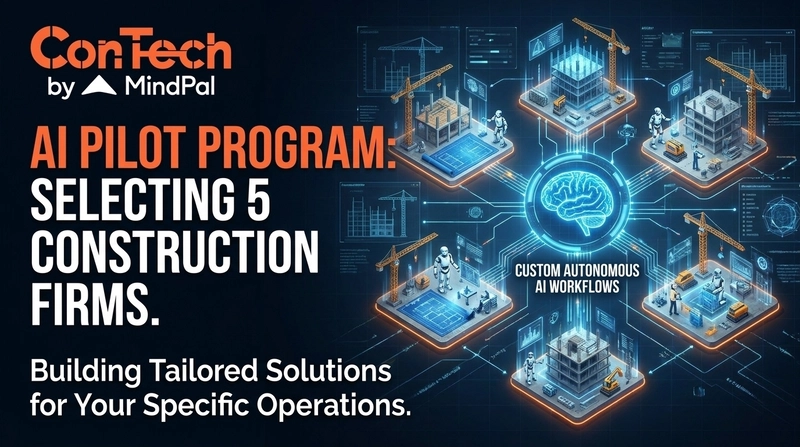
We're currently selecting 5 construction firms for a pilot program where we build custom autonomous AI workflows tailored to their specific operations.
If you're building in the ConTech space — or just curious how we architected the agent workflows — I'd love to exchange notes.
What's your take — is construction the most underrated AI opportunity right now, or are we crazy?
I wrote this because most AI content ignores industries where the real complexity lives. Construction is messy, high-stakes, and full of people who've been burned by overpromised software before. Building for that context taught us more about practical AI deployment than any greenfield project.
Drop your questions in the comments — happy to go deep on any of it:
- How we handle document context across projects
- The agent architecture behind the takeoff automation
- Why we built voice input as a first-class feature
- What "98% accuracy" actually means in practice
Follow us for more ConTech builds:
LinkedIn · YouTube · Instagram