





If you’ve ever tried to track competitor prices or product changes, you’ve probably realized something:
It’s not the idea that’s hard — it’s everything around it.
On paper, the problem sounds simple: "Know when a competitor changes price, stock, or product details."
In reality, most solutions fall into two categories, and both have trade-offs.
- Scraping-based approaches
Tools like scraping platforms (e.g. Apify) are often the first place people go.
They’re powerful and flexible. You can extract almost anything from a page and build your own pipelines.
But in practice, this usually means:
- running scheduled jobs
- storing raw data
- comparing results manually or in code
- handling noise and inconsistencies
You don’t actually get "price changes" — you get snapshots of data.
Everything else is up to you.
- Generic website monitoring tools
Another common approach is using page monitoring tools (e.g. Visualping).
These are much easier to set up:
- paste a URL
- get notified when something changes
But they tend to detect everything:
- layout updates
- content tweaks
- minor changes that don’t matter
Which leads to a different problem:
Too many alerts, not enough signal.
And most outputs are designed for humans (screenshots, diffs), not systems.
The real problem?
Both approaches miss something important:
You don’t actually care that a page changed.
You care that something meaningful changed.
For example:
- a price dropped
- a product went out of stock
- a new product appeared
That’s the difference between data and signal.
What actually works better?
Instead of scraping everything detecting every change, it would be more useful to focus on meaningful events only, return structured data and trigger actions automatically
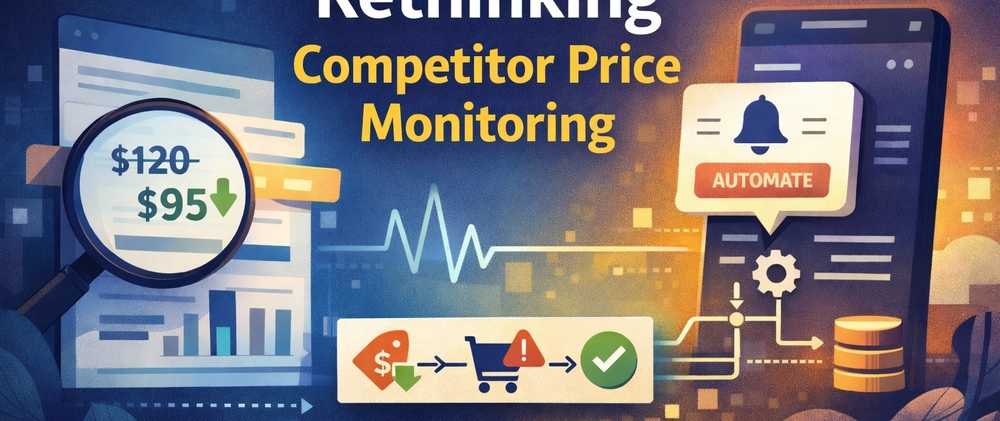
In other words, going from "Something changed on the page" to "Competitor price dropped from £120 → £95"
Why does this matter?
Because once you have clean, structured change events, everything becomes easier:
- you can automate pricing decisions
- trigger alerts only when relevant
- feed data into internal tools or AI systems
And most importantly, you remove the need to build and maintain complex scraping pipelines.
A simpler model
A more practical workflow looks like this:
- Add a competitor product URL
- Monitor it continuously
- Receive structured events when something meaningful changes
For example:
- price_drop
- price_increase
- stock_change
Delivered via API or webhook.
Where this is going
As more systems become automated, the need shifts from:
"collect as much data as possible" to "get the right signal at the right time"
That’s the difference between monitoring and decision-ready data
Final thought
Competitor monitoring isn’t a data problem anymore.
It’s a signal problem.
And the tools that win will be the ones that:
- reduce noise
- deliver structured insights
- and integrate directly into workflows
If you're working on pricing, ecommerce, or automation systems, this shift is worth paying attention to.
You can see an example of this approach here:
https://webintel.io