


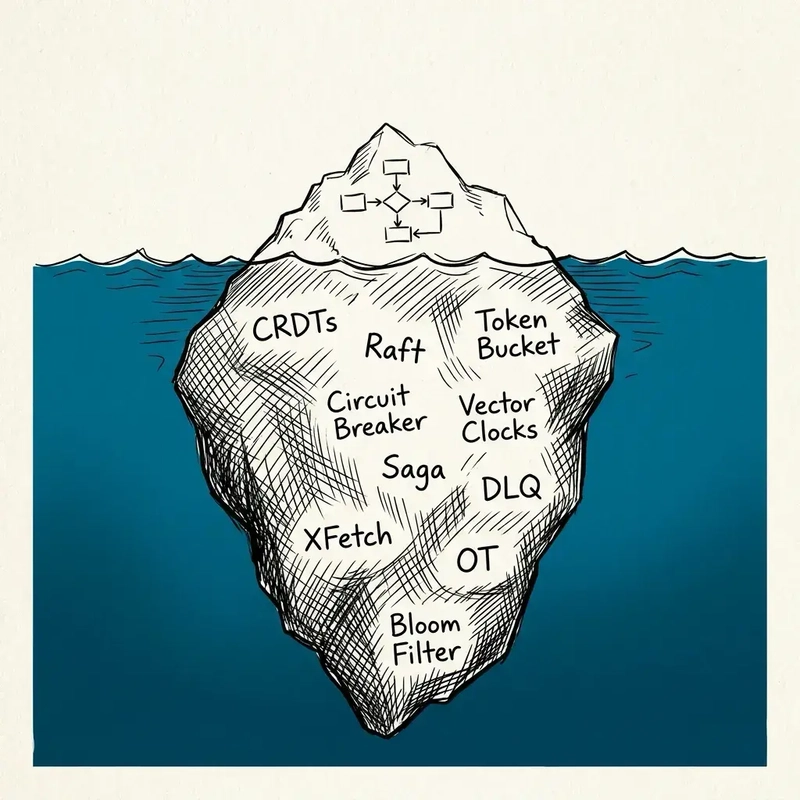
The System Design Interview: A Map to Winning It
You have 45 minutes. The problem is something you've never built. The interviewer expects a production-grade answer. Welcome to the modern System Design interview.
Let me be direct: the System Design interview is not a test of whether you can design a system. Nobody designs anything production-worthy in 45 minutes. It is, fundamentally, an erudition and experience test — a structured conversation where you demonstrate breadth of knowledge, depth in key areas, and the kind of instincts you only develop by actually shipping distributed systems.
The problem you're given — collaborative editor, distributed index, drone delivery — is a canvas. What the interviewer is actually evaluating is whether you paint on it with the vocabulary, patterns, and intuition of someone who has been in the trenches.
This article is a map of what that conversation should cover, and how to win it.
The 45-Minute Reality
The interviewer hands you a problem. The surface topic almost doesn't matter. What they're watching for:
- Do you know the vocabulary of distributed systems?
- Do you recognize the canonical problems and name them before they do?
- Do you have real-world intuition — war stories, legacy awareness, production instincts?
- Do you make precise tool selections — and explain why?
- Do you have domain depth — the named algorithms, the math, the edge cases?
If you're hitting all five, you're passing. Let's go through each.
1. Speak the Language
An interviewer can tell within the first three minutes whether you've lived in distributed systems or studied them last week. You don't need to recite definitions — you need to reach for the right term at the right moment and use it naturally.
When discussing a social feed, you say "eventual consistency is fine here." When the interviewer asks about a banking ledger, you say "strong consistency — we can't show a stale balance at withdrawal time." When someone mentions collaborative editing, you say "causal consistency" — not just "we need to keep things in order."
The same applies to infrastructure vocabulary: consistent hashing (and why it minimizes data movement), leader-follower vs. leaderless replication (and when convergence conflicts become your problem), range partitioning vs. hash partitioning (and which one you can actually do a range scan on).
The move: name the model, name the trade-off, name the business consequence. Every time.
CAP is the classic example. Don't just say "CAP theorem." Say: "In the presence of a partition, I'm choosing availability here — a post missing from a social feed for 200ms is invisible to users. But for the payment service, I'd pick consistency — a stale balance means real money lost." That's the level of fluency they're testing.
2. Name the Problem Before the Interviewer Does
Every distributed system hits the same walls. Naming the wall — unprompted, at the right moment — is one of the strongest signals of real experience.
Here's what I mean by unexpected:
Thundering Herd
Not just about caches. Yes, the classic scenario is a hot cache key expiring and thousands of requests stampeding the database. But the same pattern shows up when you restart a fleet of microservices simultaneously — they all try to establish database connections, fetch configs, and warm up at the same moment. Or after a brief DNS outage, when every client retries at the same instant.
The solution vocabulary is the same — jitter, request coalescing, probabilistic early expiration (XFetch) — but recognizing the pattern in non-obvious contexts is what makes you stand out.
Circuit Breaker
The answer to "what if your dependency is slow, not down?" Most candidates think about failure as binary. It's not. A dependency returning responses in 30 seconds instead of 30 milliseconds is worse than one that's completely down — because your threads pile up waiting, your connection pool fills, and you become the outage. Name the three states (closed, open, half-open), mention the half-open probe, and you've signaled that you've been paged at 3 AM for a cascading failure.
DLQ Depth as an SLO Signal
When discussing any event-driven architecture, mention that Dead Letter Queue depth is one of the first alerts you'd set up. If the DLQ is growing, something systematic is broken. This is a production instinct — not something you'd get from a textbook.
The list goes on — backpressure, idempotency, saga pattern (choreography vs. orchestration) — but the point isn't to enumerate them all. The point is: drop these names naturally, at the moment in your design where the problem actually appears. That's the difference between a candidate who's read a list and one who's fought these fires.
3. Show Real-World Intuition
This is where you separate from candidates who learned system design from YouTube. The marker isn't knowing what to build — it's knowing how systems are actually built, with all the messy reality of existing infrastructure, legacy services, and organizational constraints.
The Legacy System Reality
Almost every design problem in a real company comes with a footnote: "We already have X."
Example: The interviewer asks you to design a web crawler. At some point, you need to discuss seed data.
- Textbook answer: "We start with a curated list of popular domains."
- Experience answer: "In most companies, this isn't a cold start problem. We likely already have crawl data from an existing system — maybe a legacy crawler, maybe a sitemap index from a partner integration. I'd bootstrap the seed queue from the last crawl's output. For new domains, I'd build a nomination pipeline — partners submit URLs through an API, and they go through a freshness scoring model before entering the queue. The key insight is that seed quality matters more than seed quantity — garbage in means wasted crawl budget."
That answer tells the interviewer: you've worked in a real system where nothing starts from scratch. You think about migration paths, not greenfield fantasies.
This pattern applies everywhere: designing a search index? The ranking signals probably already exist in a legacy analytics pipeline. Building a recommendation engine? There's almost certainly a collaborative filtering service already running somewhere — even if it's a cron job generating a CSV file.
4. Precise Tool Selection
This is not about memorizing a table of databases. It's about showing the interviewer that you observe the data before reaching for a tool — and that your observations lead to non-obvious, precise choices.
The Observation That Changes Everything
Example: The interviewer asks you to design a URL shortening service. You're discussing the redirect lookup — given a short code, find the original URL.
Most candidates immediately jump to database sharding: "We'll shard by short code hash across N Postgres instances."
But stop. Think about the data. How many unique domains exist on the internet? Roughly 350 million registered domains. That's a lot — but it's bounded. And for your short URL service, the number of target domains your users actually link to is much smaller — probably in the tens of thousands, following a power-law distribution.
That observation changes everything. A bounded, high-frequency access pattern with a power-law distribution is a caching problem, not a sharding problem. You can fit the top 10,000 domains (which cover 95%+ of redirects) in a Redis instance with trivial memory. The long tail hits the database, but that's a tiny fraction of traffic.
The move: not "I'll add Redis in front of the database" (everyone says that), but "The cardinality of target domains is bounded and follows a power law, so the cache hit ratio will be extremely high — I'd solve this with caching before I'd even consider sharding."
Cache Patterns — Know When, Not Just What
There are four cache patterns: cache-aside, read-through, write-through, and write-behind. You should know them — but more importantly, you should reach for the right one at the right moment.
Write-behind is the interesting one for interviews. It's risky — you can lose data if the cache node dies before flushing to the database. But for a metrics ingestion pipeline where you're aggregating counters, that trade-off is acceptable: lose a few seconds of counter increments vs. hammering the database with per-request writes.
"I'd use write-behind here because losing a few seconds of counter data on a cache node crash is acceptable, but saturating the database with per-event writes is not."
That's a precise, defensible decision.
5. Domain Depth — The Real Differentiator
This is where the interview is won or lost. This is where you demonstrate that you're not just an infrastructure generalist — you have the nerdy, specific algorithmic knowledge that comes from real curiosity and deep work.
The key move: name the algorithms. Don't say "I'd add rate limiting." Say which rate limiting algorithm and why.
Rate Limiting — Yes, You Need to Know All Five
| Algorithm | Behavior | Best For |
|---|---|---|
| Fixed Window Counter | Simple, boundary bursts | Internal admin APIs |
| Sliding Window Log | Precise, memory-heavy | Audit-sensitive systems |
| Sliding Window Counter | Approximate, memory-efficient | General APIs |
| Token Bucket | Bursty-friendly | User-facing APIs |
| Leaky Bucket | Smooth egress | Downstream integrations |
Interview-winning moment: "I'd use a token bucket here because this is a user-facing API where occasional bursts are acceptable — a user opening a dashboard triggers 20 API calls simultaneously, and I don't want to reject those. But for the downstream payment processor, I'd use a leaky bucket to guarantee a smooth egress rate, even if it means buffering."
That single sentence shows you know the difference, know when it matters, and have opinions.
Conflict Resolution — Name the Algorithm, Know Its Constraints
When the problem involves collaborative editing, multi-leader replication, or offline-first sync:
- LWW (Last Write Wins): simple, lossy, fine for user preferences, never for document editing.
- Vector Clocks: causality detection, conflict surfacing. DynamoDB uses this — Amazon's shopping cart deliberately preserves concurrent additions (better to show extra items than lose one).
- OT (Operational Transformation): the algorithm behind Google Docs. Requires a central server to serialize transforms — decentralized OT is notoriously hard (Jupiter protocol, 1995).
- CRDTs (Conflict-free Replicated Data Types): the modern answer for decentralized/P2P systems. Mathematically guaranteed convergence. Know the types: G-Counter, PN-Counter, LWW-Register, RGA for text sequences. Figma uses CRDTs. Apple Notes sync uses CRDTs.
The move in a collaborative editor interview: mention OT, acknowledge the centralization constraint, pivot to CRDTs for offline-first scenarios. Name specific CRDT types. The interviewer will know you've gone beyond the surface.
The Unexpected Domains
The deepest impression comes from domain-specific knowledge the interviewer wasn't expecting.
Food delivery by drone? Most candidates talk about GPS and routing APIs. You talk about battery health modeling — effective range is a function of capacity × efficiency(wind, payload, temperature), and capacity degrades with cycle count. You mention drone migration — what happens when battery drops to 20% mid-route? Dynamic rerouting to the nearest charging station, similar to EV range-anxiety routing. You mention geofencing — FAA LAANC authorization, temporary flight restrictions, R-tree spatial indexes for polygon containment queries. You mention fleet rebalancing — the same optimization problem as scooter/bike-share.
Designing a stock exchange? Talk about order matching engines, LMAX Disruptor pattern for single-threaded mechanical sympathy, the difference between price-time priority and pro-rata matching.
Designing a code deployment pipeline? Talk about blue-green vs. canary vs. feature flags, progressive rollout percentages, automated rollback on error budget violations.
Name the specifics. Even if the interviewer has never built a drone system, they recognize engineering depth when they see it.
Putting It Together: The 45-Minute Framework
[0–5 min]   Clarify requirements
            Ask about scale, consistency needs, read/write ratio, SLA.
            Don't design before you understand the problem.

[5–10 min]  High-level design
            Components, data flow, APIs. Whiteboard the happy path.

[10–25 min] Deep dive
            Pick 2–3 critical components and go deep.
            This is where you demonstrate the above.

[25–35 min] Scaling and failure modes
            "What happens at 10x load?"
            "What's the single point of failure?"

[35–45 min] Trade-offs and evolution
            "If I had more time, I'd..."
            "The decision I'm least confident about is X because..."
The last 10 minutes signal maturity. An engineer who says "I'd revisit the database choice as we get real load data — I might have over-indexed on write throughput at the expense of query flexibility" is an engineer who has shipped real systems and learned from them.
Final Thought
The best system design interviews share one trait: they think out loud about trade-offs, not solutions. The solution is almost always "it depends." The trade-off is where the experience lives.
When you say "I'd use a leaky bucket here instead of a token bucket because this service feeds into a payment processor — I'd rather smooth the egress rate than allow any bursting, even if it means slightly higher latency for legitimate requests" — that sentence is the interview. Not the diagram.
Know the names. Know the algorithms. Have the war stories. And think out loud about the trade-offs.
That's the game.