



Most AI products are still framed around capability.
Can the model answer?
Can it summarize?
Can it classify?
Can it call tools?
Can it automate the task?
But as AI enters real operational workflows, I think the harder question is no longer:
Can the AI do this?
The harder question is:
Who decided where the work should go, how far it could be delegated, what had to be blocked, where a human had to step in, and what receipt remained afterward?
That is the part that still feels underbuilt.
A chatbot can answer.
A workflow tool can move steps around.
A SOAR tool can automate response.
A governance dashboard can observe policy.
But none of those, by themselves, fully answer the delegation question:
- Where should the work go?
- How far can it proceed?
- What actions are allowed?
- What actions are blocked?
- When does a human checkpoint become mandatory?
- What can be replayed later?
That is what I’m testing with NoeX.
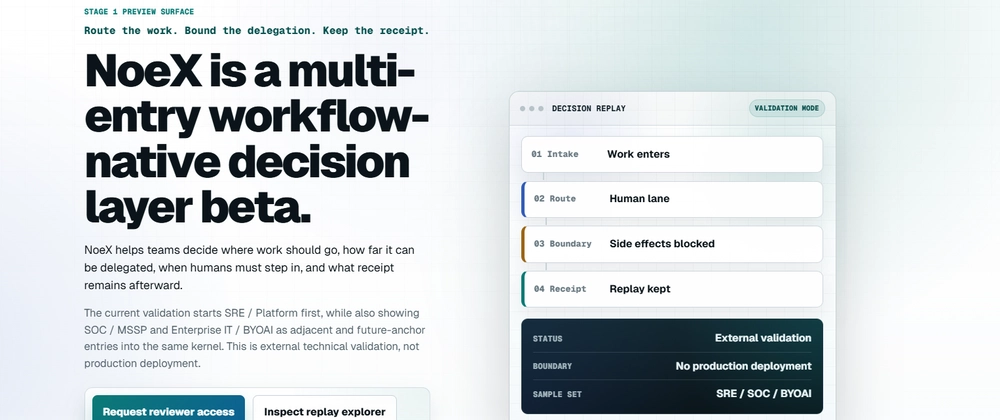
NoeX is currently a public technical validation front door for a workflow-native decision layer beta.
The core loop is simple:
route decision → delegation boundary → human checkpoint → receipt / replay
The point is not to make AI more autonomous by default.
The point is to make delegation explicit before AI-assisted work moves forward.
A concrete example: incident investigation
Imagine an SRE / Platform incident investigation.
An incident comes in.
Before any AI/tool-assisted work proceeds, a team may need to know:
- which lane the work should go to
- what candidate lanes were considered
- why one lane was chosen
- what actions are allowed
- what actions are blocked
- whether human approval is required
- what escalation path exists
- what receipt remains afterward
That receipt should not be just a generic audit log.
It should explain the decision trail:
- Why this route?
- Why this boundary?
- Why this checkpoint?
- What was allowed?
- What was blocked?
- What context should carry forward?
The risk is not only “the model was wrong”
AI delegation creates a new kind of operational risk.
Not only:
The model made a bad answer.
But also:
- the work was routed to the wrong lane
- autonomy went too far
- approval happened too late
- blocked actions were unclear
- nobody can replay why the decision happened
- future workflows learn nothing from the outcome
If AI-assisted workflows keep scaling, teams may need a layer that is neither chatbot nor automation engine.
A layer between work intake, tools, humans, and AI capabilities.
A decision layer.
What NoeX is testing
The first validation entry for NoeX is:
SRE / Platform incident investigation routing
SOC guarded delegation and Enterprise IT / BYOAI conditional admission are included as adjacent validation entries.
But they are not production runtimes.
That distinction matters.
NoeX is not a production launch.
It is not a SOAR replacement.
It is not a governance dashboard.
It is not an AI marketplace.
It is not a chatbot.
It is not claiming live SOC or BYOAI runtime.
The current public site is only a validation front door.
The part to inspect is the replay / receipt explorer.
What I want to learn
I’m looking for technical feedback on one question:
Would route → boundary → checkpoint → receipt be useful in real operational workflows where AI, tools, automation, and humans interact?
If the answer is no, I want to know why.
If the answer is yes, the next question is where this decision layer should live first:
- SRE?
- SOC?
- Enterprise IT?
- AI platform teams?
- Somewhere else?
Public validation page:
https://noex-public-validation.pages.dev/
The useful part to inspect is the replay / receipt explorer.